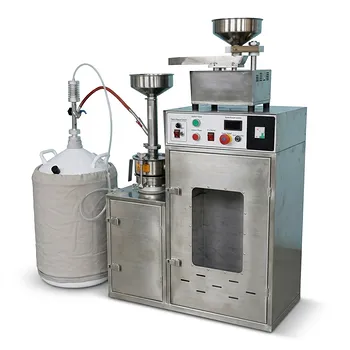
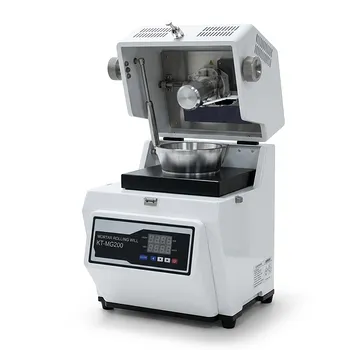
A grain mill is utilized to pulverize dried biomass into a fine powder prior to thermochemical conversion. This mechanical process drastically increases the surface area-to-volume ratio of the material, creating the optimal physical conditions for efficient thermal treatment.
While the mill is a mechanical tool, its primary purpose is chemical efficiency. By reducing biomass to a specific size (often below 3mm), it ensures that heat transfer is uniform and reaction rates are maximized during processes like torrefaction and gasification.
The Physics of Pretreatment
Increasing Specific Surface Area
The primary goal of the grain mill is to reduce particle size, often to below 3mm.
This reduction creates a massive increase in the specific surface area available for reaction.
The Importance of "Fine Powder"
Large biomass chunks naturally resist thermal penetration.
Pulverizing the material into a fine powder removes physical barriers, exposing the internal structure of the biomass to the reactor environment.
Impact on Thermochemical Efficiency
Facilitating Uniform Heat Transfer
Thermodynamic efficiency relies on heat reaching the center of a particle quickly.
Fine powder allows for uniform heating, eliminating temperature gradients where the outside of a particle might be charred while the core remains under-reacted.
Enhancing Reaction Rates
Chemical reactions occur at the interface between the biomass and the heat source.
A higher surface area leads to faster, more thorough chemical reactions, which is critical for the success of processes like torrefaction, pyrolysis, and gasification.
Understanding the Operational Requirements
The Moisture Prerequisite
It is critical to note that the process relies on the pulverization of dried biomass.
Attempting to mill biomass with high moisture content generally leads to inefficient particle reduction and potential equipment issues; the material must be dry to shatter into powder effectively.
Energy Input vs. System Efficiency
While the milling process itself requires energy input, it lowers the overall energy consumption of the entire system.
By investing energy upfront to grind the material, you significantly reduce the energy and time required to achieve conversion in the reactor.
Making the Right Choice for Your Goal
To ensure your biomass conversion process is effective, consider how particle size impacts your specific objectives:
- If your primary focus is process speed: Prioritize fine grinding to maximize reaction rates and reduce the necessary residence time in the reactor.
- If your primary focus is product quality: Ensure particle size is strictly uniform to guarantee consistent heat transfer and a homogeneous final product.
By mechanically unlocking the surface area of the biomass, the grain mill transforms raw material into a feedstock ready for efficient chemical conversion.
Summary Table:
| Factor | Impact of Milling (Fine Powder) | Benefit to Thermochemical Conversion |
|---|---|---|
| Surface Area | Drastically increased ratio | Faster, more thorough chemical reaction rates |
| Heat Transfer | Uniform penetration to core | Eliminates temperature gradients and under-reacted cores |
| Particle Size | Typically reduced to < 3mm | Enhances process speed and residence time efficiency |
| Material State | Must be dried biomass | Prevents equipment clogs and ensures effective shattering |
| Energy Balance | High upfront mechanical input | Lowers total system energy by optimizing reactor phase |
Elevate Your Biomass Research with KINTEK Precision
Achieving consistent thermochemical results starts with perfect sample preparation. KINTEK specializes in high-performance laboratory equipment, providing the advanced crushing and milling systems and sieving equipment necessary to produce the uniform fine powders required for efficient pyrolysis and gasification.
Our comprehensive range also includes high-temperature furnaces (muffle, tube, rotary, vacuum) and high-pressure reactors to take your processed biomass to the next stage of conversion. Whether you are refining torrefaction protocols or developing new biofuels, KINTEK offers the tools and consumables—from crucibles to PELLET presses—to ensure your lab achieves peak thermodynamic efficiency.
Ready to optimize your feedstock preparation? Contact KINTEK today to find the perfect milling solution for your biomass applications!
References
- Mohamed Khairy, Ahmed Elwardany. The influence of torrefaction on the biochar characteristics produced from sesame stalks and bean husk. DOI: 10.1007/s13399-023-03822-9
This article is also based on technical information from Kintek Solution Knowledge Base .
Related Products
- Liquid Nitrogen Cryogenic Grinder Mill Cryomill with Screw Feeder
- Vibrating Disc Mill Small Laboratory Grinding Machine
- Laboratory Grinding Mill Mortar Grinder for Sample Preparation
- Laboratory Single Horizontal Jar Mill
People Also Ask
- What is cryogenic grinding of crumb rubber? Achieve Fine, High-Quality Rubber Powder
- What are the advantages of using a cryogenic grinder? Achieve Nanoscale Precision for All-Solid-State Battery Cathodes
- Why is a cryogenic grinder required for cured alkyd resin HRMAS NMR? Ensure Structural Integrity & Sample Precision
- What is the role of a cryogenic grinder in PET recycling? Transform Waste into High-Reactive Micron Powders
- What are cryogenic ground spices? Unlock Maximum Flavor with Advanced Grinding Technology