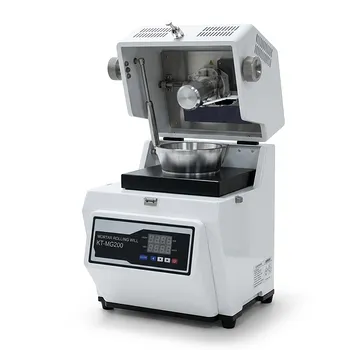
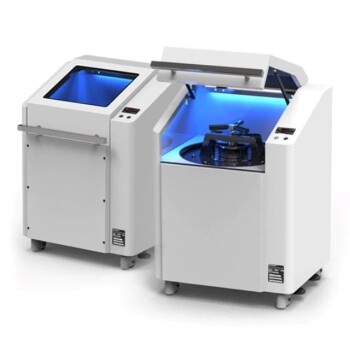
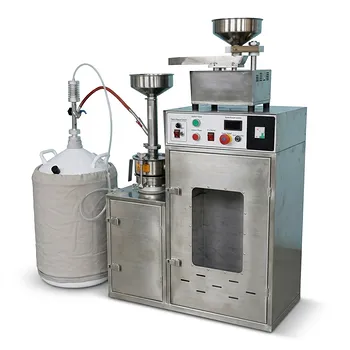
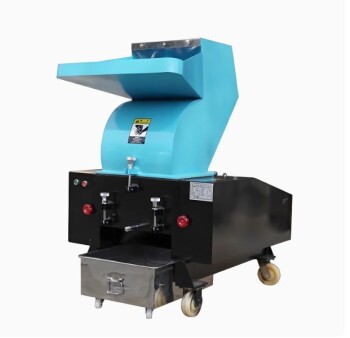
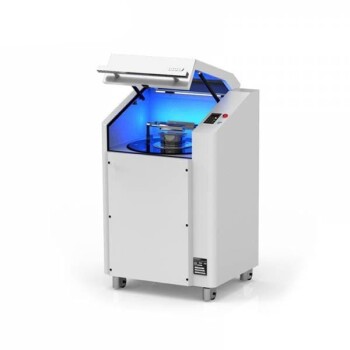
The grinding mill acts as the essential activation step in cement production, transforming inert clinker into reactive cement. It uses mechanical force to crush hard clinker particles into an extremely fine powder, ensuring the material achieves the high specific surface area required for a complete chemical reaction with water. Simultaneously, it blends additives like gypsum to strictly regulate the final product's setting time.
Core Insight Raw cement clinker cannot chemically react effectively in its coarse state. The grinding mill is necessary to exponentially increase the material's specific surface area for hydration and to ensure the uniform integration of additives that control how the concrete hardens.
Unlocking Chemical Potential
The primary function of the grinding mill is to alter the physical state of the clinker to enable chemical performance.
Increasing Specific Surface Area
In its raw form, clinker consists of hard, coarse particles. The grinding mill applies intense mechanical force to pulverize these solids.
This process reduces the particle size significantly, which drastically increases the specific surface area of the powder.
Ensuring Complete Hydration
Surface area is directly linked to reactivity. By creating an extremely fine powder, the mill exposes more of the material to moisture.
This exposure allows the cement to undergo a complete hydration reaction when mixed with water, which is the mechanism that gives concrete its strength.
Controlling Material Behavior
Beyond reducing particle size, the grinding mill serves a critical role in homogenizing the final product to ensure consistent performance.
Uniform Mixing of Additives
The grinding process is also a mixing process. It facilitates the uniform distribution of essential additives, most notably gypsum, throughout the clinker powder.
Regulating Setting Time
Without this uniformity, the cement's behavior would be unpredictable. The precise blending of gypsum allows manufacturers to strictly control the setting time of the cement.
This ensures the material remains workable for the required duration before hardening.
The Risks of Inadequate Grinding
While the goal is fine powder, understanding the consequences of process failure highlights the mill's importance.
Risk of Incomplete Reaction
If the mill fails to grind the clinker finely enough, the specific surface area will remain too low.
This results in a "lazy" material that cannot undergo a full hydration reaction, leading to structurally weak concrete.
Risk of Unpredictable Setting
If the mill does not achieve a uniform mix, the gypsum will not be evenly distributed.
This can cause distinct batches—or even pockets within the same batch—to flash-set instantly or take far too long to harden, making the product unusable for construction.
Ensuring Product Quality
Reliable cement production hinges on the efficiency and precision of the pulverization stage.
- If your primary focus is structural integrity: Ensure the grinding process maximizes specific surface area to guarantee a complete and robust hydration reaction.
- If your primary focus is usability and application: Verify that the mill achieves a perfectly uniform blend of additives to maintain precise control over setting times.
The grinding mill is not merely a crushing tool; it is the instrument that calibrates the chemical reactivity and handling properties of the final cement product.
Summary Table:
| Factor | Role of the Grinding Mill | Impact on Final Product |
|---|---|---|
| Particle Size | Reduces coarse clinker to fine powder | Increases specific surface area for faster hydration |
| Chemical Reactivity | Activates inert particles through mechanical force | Ensures complete chemical reaction with water |
| Additive Integration | Uniformly blends gypsum with clinker | Regulates setting time and prevents flash-setting |
| Consistency | Homogenizes material distribution | Guarantees predictable strength and workability |
Elevate Your Material Processing with KINTEK Precision
Maximize the efficiency of your cement production and laboratory research with KINTEK’s advanced crushing and milling systems. Whether you are pulverizing hard clinker or developing new material formulations, our high-performance equipment ensures the precise particle size distribution and uniformity required for superior chemical reactivity.
From industrial-grade crushing and milling to a comprehensive range of laboratory essentials—including high-temperature furnaces, hydraulic presses, and specialized ceramics—KINTEK provides the tools needed to guarantee structural integrity and product quality.
Ready to optimize your grinding process? Contact our experts today to find the perfect solution for your lab or production facility!
References
- Noorullah Zahid, Fada Mohammad Mohammadi. Effect of nano-materials on mechanical properties of cement and concrete. DOI: 10.33545/27068919.2022.v4.i1c.706
This article is also based on technical information from Kintek Solution Knowledge Base .
Related Products
- Laboratory Grinding Mill Mortar Grinder for Sample Preparation
- Laboratory Disc Cup Vibratory Mill for Sample Grinding
- Vibrating Disc Mill Small Laboratory Grinding Machine
- Laboratory Jar Mill with Agate Grinding Jar and Balls
- Laboratory Ball Mill Jar Mill with Metal Alloy Grinding Jar and Balls
People Also Ask
- What laboratory apparatus is used for grinding? Match the Right Mill to Your Sample Material
- What is the function of a laboratory grinding mill? Achieve Precise Sample Preparation for Accurate Results
- What is the purpose of using a laboratory grinder and standard sieves? Unlock Precise Rice Husk Pretreatment
- What is the role of laboratory-grade grinders and sieves in sample prep? Ensure High-Precision Corrosion Analysis
- What is the purpose of using a laboratory grinder with specific mesh sieves for oat straw? Optimize Pellet Quality