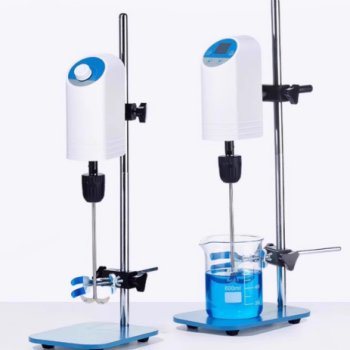
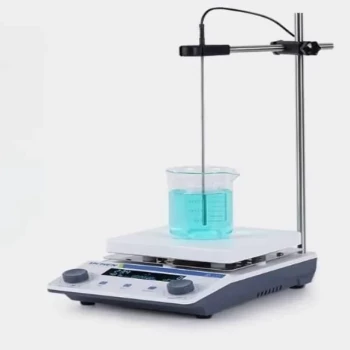
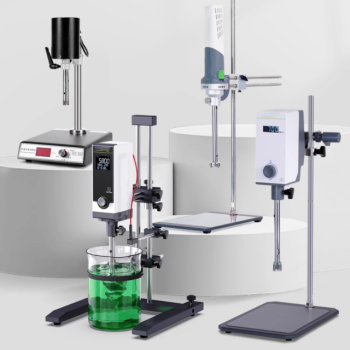
Precision stirring is the primary mechanism for controlling particle distribution. In the synthesis of silver-silica colloids, a high-precision magnetic stirrer acts as the regulating force during the dropwise addition of sodium hydroxide and silver nitrate. By applying continuous and uniform shear forces, it ensures reactants are rapidly dispersed throughout the microwave-treated silica suspension, preventing the high local concentrations that lead to unwanted particle defects.
The core function of the stirrer is to eliminate chemical "hotspots." By maintaining a uniform environment, it ensures silver nanoparticles are reduced and deposited evenly across the silica carrier's surface and pores, rather than clumping into ineffective agglomerates.
Managing the Reaction Environment
The Danger of Local Concentration
When you add reactants like silver nitrate to a suspension, they create immediate, localized spikes in concentration at the point of entry.
Without intervention, these "hotspots" trigger rapid, uncontrolled particle growth.
High-precision stirring neutralizes this threat by instantly distributing the fresh reactants into the bulk volume.
Controlling In-Situ Reduction
The synthesis relies on the in-situ reduction of silver.
For this process to yield a consistent product, the chemical reduction must happen at the same rate throughout the entire vessel.
Uniform stirring guarantees that the reducing agents meet the silver precursors under identical conditions everywhere in the reactor.
Ensuring Rapid Dispersion
The silica suspension, often microwave-treated, serves as the host for the silver particles.
The stirrer ensures that the introduced reactants penetrate this suspension immediately.
This rapid dispersion is the only way to achieve a homogeneous mixture before the reaction kinetics take over.
Achieving Structural Integrity
Optimizing Pore Distribution
The goal of this synthesis is not just to coat the outside of the silica, but to utilize its internal structure.
A uniform stirring environment facilitates the transport of reactants deep into the pores of the silica carrier.
This ensures that silver nanoparticles are distributed internally as well as externally, maximizing the functional surface area.
Preventing Agglomeration
Particle agglomeration is the enemy of colloidal stability.
When particles clump together, they lose their specific surface area and effectiveness.
The continuous shear force provided by the stirrer physically prevents particles from settling or bonding with one another during the critical formation phase.
Understanding the Trade-offs
The Necessity of "Precision"
Not all stirrers are equal; a standard stirrer with fluctuating speed can introduce variability.
If the shear force drops, local agglomeration can occur instantly; if it spikes, it may disrupt the suspension stability.
The "high-precision" aspect is vital to maintain a constant kinetic energy input throughout the dropwise addition.
Mechanical Limits
While stirring solves mixing issues, it cannot correct chemical imbalances.
Even perfect stirring cannot compensate for incorrect stoichiometry or poor temperature regulation.
It must be viewed as a tool for physical homogenization, operating in concert with precise chemical measurements.
Making the Right Choice for Your Goal
To ensure your silver-silica colloid synthesis is successful, align your stirring strategy with your specific objectives:
- If your primary focus is preventing clumping: Prioritize consistent, high-speed shear forces to eliminate local concentration gradients immediately upon reactant addition.
- If your primary focus is maximizing active surface area: Ensure the stirring is vigorous enough to force reactants into the silica pores, ensuring internal distribution of the silver nanoparticles.
Precision stirring transforms a chaotic chemical precipitation into a controlled, reproducible engineering process.
Summary Table:
| Feature | Impact on Silver-Silica Synthesis | Benefit |
|---|---|---|
| Uniform Shear Force | Eliminates chemical "hotspots" and local concentration | Prevents unwanted particle defects |
| Rapid Dispersion | Distributes reactants instantly into silica suspension | Ensures consistent in-situ reduction |
| Pore Penetration | Facilitates reactant transport into internal structures | Maximizes functional surface area |
| Constant Speed | Maintains stable kinetic energy during addition | Guarantees process reproducibility |
| Anti-Agglomeration | Physically prevents particle bonding and settling | Enhances colloidal stability |
Elevate Your Nanomaterial Synthesis with KINTEK Precision
Achieving the perfect silver-silica colloid requires more than just chemistry; it requires the physical precision of high-performance laboratory equipment. KINTEK specializes in providing researchers and industrial professionals with the high-precision stirring solutions, high-temperature furnaces, and crushing systems necessary for advanced material engineering.
Whether you are managing delicate in-situ reductions or require robust high-temperature high-pressure reactors and autoclaves, our comprehensive portfolio—including ceramic crucibles, PTFE consumables, and advanced cooling solutions—is designed to ensure your results are reproducible and your yields are maximized.
Ready to eliminate chemical hotspots and optimize your particle distribution? Contact KINTEK today to discover how our expert-grade tools can transform your laboratory efficiency.
References
- Aleksandra Strach, Sylwia Golba. Microwave Irradiation vs. Structural, Physicochemical, and Biological Features of Porous Environmentally Active Silver–Silica Nanocomposites. DOI: 10.3390/ijms24076632
This article is also based on technical information from Kintek Solution Knowledge Base .
Related Products
- High Performance Laboratory Stirrers for Diverse Applications
- Laboratory Small Constant Temperature Heated Magnetic Stirrer Heater and Stirrer
- Custom PTFE Teflon Parts Manufacturer for Magnetic Stirring Bar
- Custom PTFE Teflon Parts Manufacturer for PTFE Stirring Bar Recovery Rod
- High Shear Homogenizer for Pharmaceutical and Cosmetic Applications
People Also Ask
- How does a laboratory stirrer influence MOF product quality? Master Precision in Non-Solvothermal Synthesis
- What critical role does a Laboratory Stirrer play during leaching? Enhance Titanium-Magnesium Waste Recovery
- What is the primary function of laboratory stirring equipment in the preparation of compost leachate? Optimize Extraction
- What is a laboratory mixer? A Guide to Achieving Perfect Sample Homogeneity
- What is a laboratory mixer used for? Choose the Right Tool for Liquids or Solids