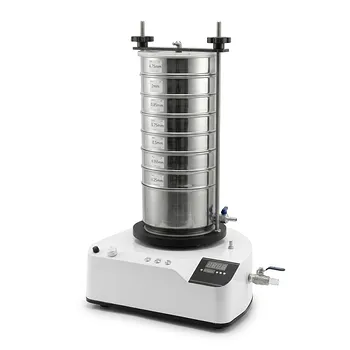
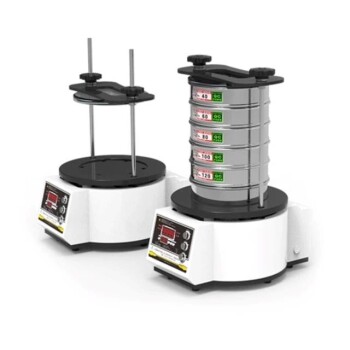
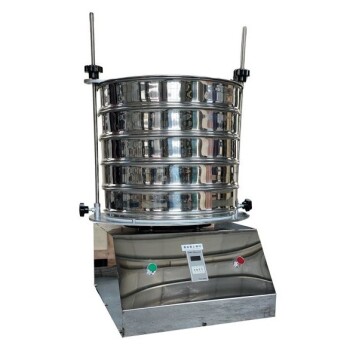
Precision particle size control is the foundational requirement for accurate combustion modeling. A high-precision vibratory sieve shaker is necessary to isolate specific particle size ranges—typically between 100 and 200 micrometers—to ensure that experimental heat and mass transfer rates mirror those found in industrial-scale boilers. Without this precision, the resulting data on ignition temperatures and combustion kinetics would be too inconsistent to apply to real-world power plant operations.
A high-precision vibratory sieve shaker transforms raw fuel into a standardized experimental variable. By ensuring a uniform particle size distribution, researchers can eliminate physical inconsistencies and produce repeatable, high-fidelity data essential for industrial kinetic modeling.
The Impact on Thermal Physics and Kinetics
Controlling Specific Surface Area
Particle size directly dictates the specific surface area available for chemical reactions. In a combustion environment, the surface area determines how quickly oxygen can reach the fuel and how rapidly heat is absorbed. High-precision sieving ensures this area is consistent across all samples.
Standardizing Heat and Mass Transfer
Inconsistent particle sizes lead to varied heating rates and internal temperature gradients. A high-precision shaker allows researchers to extract narrow ranges, such as 75–90 μm or 40–63 μm, which ensures that every particle in the sample reacts simultaneously and uniformly during thermal analysis.
Ensuring Repeatable Devolatilization
The release rate of volatile matter is highly sensitive to particle dimensions. By using a vibratory shaker to maintain strict size uniformity, scientists can achieve repeatable devolatilization data in thermogravimetric analyzers (TGA) or flat flame reactors, preventing "noise" in the kinetic data.
Enhancing Experimental Integrity and Feed Stability
Overcoming Particle Agglomeration
Fine coal and biomass powders often suffer from agglomeration forces that cause particles to clump together. The controlled frequency and vertical motion of an electric vibratory shaker break these bonds, allowing for efficient classification and preventing the mesh from clogging.
Stability in Drop-Tube Furnaces
For experiments involving drop-tube furnaces, feeding stability is paramount. Precise sieving to specific mesh sizes (e.g., under 200 mesh for coal) ensures that the feeding system does not jam and that the fuel-to-air ratio remains constant throughout the combustion reaction.
Isolating Chemical from Physical Variables
When researching co-firing (e.g., coal mixed with biomass or plastics), high-precision sieving allows researchers to set identical physical conditions for different materials. This isolation enables the study of how chemical components like lignin or holocellulose behave without the results being skewed by differing particle volumes.
Understanding the Trade-offs
The Risk of Manual Sieving Inaccuracy
Manual or low-precision sieving often fails to remove "near-mesh" particles—those just slightly larger than the opening—leading to a skewed Particle Size Distribution (PSD). This lack of precision can cause significant errors in calculating combustion kinetic parameters.
Material Loss and Processing Time
High-precision vibratory sieving is a rigorous process that can result in low material yields if the raw sample is not pre-ground correctly. Researchers must balance the need for extreme precision with the time required to process enough fuel for large-scale laboratory tests.
Mechanical Wear and Calibration
Vibratory shakers require regular calibration and mesh inspection. Over time, the tension in the sieves can change or the mesh can stretch, which introduces subtle inaccuracies that can undermine the validity of long-term experimental series.
How to Apply This to Your Project
Selecting the Right Approach for Your Goal
To achieve the most accurate results in combustion simulation, your sample preparation must align with your specific reactor type and research objectives.
- If your primary focus is kinetic modeling and TGA: Use ultra-narrow sieve cuts (e.g., 10-20 μm variance) to eliminate internal temperature gradients.
- If your primary focus is simulating industrial boiler conditions: Sieve your pulverized coal to the 100–200 μm range to accurately mimic the specific surface area of commercial-grade fuel.
- If your primary focus is co-firing coal with biomass: Utilize high-frequency vibration to overcome the "tangled" nature of biomass fibers and ensure a uniform blend.
- If your primary focus is drop-tube furnace stability: Ensure all fuel components are sieved to their respective mesh requirements (e.g., 200 mesh for coal) to prevent system clogs.
Precise particle classification is the only way to bridge the gap between laboratory-scale combustion experiments and the massive thermal realities of a power plant boiler.
Summary Table:
| Key Factor | Impact on Combustion Simulation | Role of High-Precision Sieving |
|---|---|---|
| Specific Surface Area | Dictates chemical reaction & heat absorption rates | Ensures consistent surface area across all fuel samples |
| Thermal Kinetics | Influences heating rates & internal gradients | Standardizes particle size (e.g., 40–90 μm) for uniformity |
| Devolatilization | Affects volatile release timing in TGA/reactors | Eliminates data "noise" by maintaining strict size uniformity |
| Feeding Stability | Ensures constant fuel-to-air ratios in furnaces | Prevents clogs in drop-tube furnaces by removing oversized particles |
| Agglomeration | Causes clumping in fine coal/biomass powders | Uses controlled vertical motion to break bonds and classify effectively |
Elevate Your Combustion Research with KINTEK Precision
To bridge the gap between laboratory simulations and industrial power plant realities, your material preparation must be flawless. KINTEK specializes in high-performance laboratory equipment designed for the rigorous demands of thermal physics and material science.
Whether you are isolating narrow particle ranges for kinetic modeling or preparing biomass blends for co-firing, our portfolio delivers the accuracy you need:
- Sieving & Milling: High-precision vibratory sieve shakers, sieving equipment, and crushing systems for perfect particle size distribution.
- Thermal Processing: A comprehensive range of high-temperature furnaces (muffle, tube, rotary, and atmosphere) and drop-tube furnace components.
- Advanced Research Tools: Pellet presses, high-pressure reactors, and specialized consumables like ceramics and crucibles.
Ready to standardize your experimental variables and achieve repeatable, high-fidelity data? Contact our technical experts today to find the ideal equipment for your laboratory.
References
- A. V. Zhuikov, S. G. Stepanov. Application a solid fuel mixture based on Bolshesyrsky lignite and birch wood waste in power plants. DOI: 10.21285/1814-3520-2023-2-310-321
This article is also based on technical information from Kintek Solution Knowledge Base .
Related Products
- Laboratory Vibratory Sieve Shaker Machine for Dry and Wet Three-Dimensional Sieving
- Vibratory Sieve Shaker Machine Dry Three-Dimensional Vibrating Sieve
- Laboratory Vibratory Sieve Shaker Machine Slap Vibrating Sieve
- Laboratory Test Sieves and Vibratory Sieve Shaker Machine
- Laboratory Wet Three-Dimensional Vibratory Sieve Shaker Machine
People Also Ask
- How does a laboratory vibratory sieve shaker facilitate the microstructural study of gas-atomized alloy powders?
- What role does a laboratory vibrating sieve shaker play in the LiFePO4 powder processing workflow? Ensure Batch Quality
- Why use a vibratory sieve shaker for PET powder? Achieve Precise Particle Size Control for Chemical Research
- What is the principle of vibratory sieve shaker? Achieve Accurate Particle Size Analysis
- What is the function of a vibratory sieve shaker? Achieve Precise Particle Size Analysis