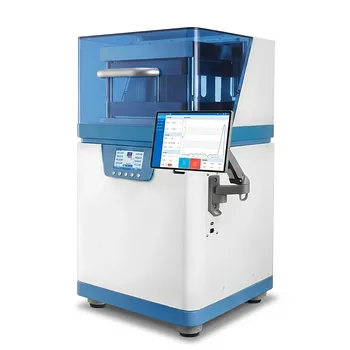
The high-pressure reactor serves as the fundamental catalyst for overcoming kinetic barriers in solvothermal synthesis. By creating a sealed, high-temperature environment, the reactor allows bismuth, molybdenum, and yttrium precursors to react at energy levels unattainable at atmospheric pressure. This specific environment is essential for ensuring that Y-doped $\text{Bi}_2\text{MoO}_6$ nanosheets nucleate uniformly and bond securely to the surface of the Calcined Mussel Shell (CMS) biomass carrier.
Core Takeaway: A high-pressure reactor is essential because it forces chemical precursors to surpass standard kinetic limits, enabling the precise nucleation and firm loading of crystalline nanosheets onto complex biomass substrates like CMS.
Overcoming Thermodynamic and Kinetic Barriers
Surpassing Atmospheric Limits
In a standard open-air environment, many chemical reactions are limited by the boiling point of the solvent and the prevailing atmospheric pressure. The high-pressure reactor creates a sealed system where the internal pressure increases as the temperature rises. This autogenous pressure allows the reaction to occur at subcritical or supercritical conditions, providing the thermal energy necessary for the precursors to transform into stable crystalline structures.
Enhancing Solubility and Diffusion
High pressure significantly increases the solubility and diffusion rates of metal ions within the solvent. In the synthesis of Y-doped $\text{Bi}_2\text{MoO}_6$, this enhanced mobility ensures that the yttrium, bismuth, and molybdenum ions are thoroughly mixed and capable of reaching the substrate surface. Increased molecular collision frequency within the reactor accelerates the chemical transformations required to form the complex composite.
Ensuring Structural Integrity of the Composite
Controlled Nucleation on CMS
The primary challenge in creating composites is ensuring the active material adheres to the carrier. The high-pressure environment facilitates uniform nucleation on the porous surface of the Calcined Mussel Shells (CMS). Without this pressure, the $\text{Bi}_2\text{MoO}_6$ might precipitate independently in the solution rather than forming the desired interfacial contact with the biomass substrate.
Achieving High Crystallinity
A high-pressure environment is critical for the growth of highly crystalline nanosheets. By maintaining a stable, closed thermal environment, the reactor promotes the directional growth of the crystal lattice. This results in structurally intact $\text{Bi}_2\text{MoO}_6$ frameworks that exhibit better electron transport and higher photocatalytic activity.
Understanding the Trade-offs and Risks
Equipment Maintenance and Safety
Operating at high pressures requires specialized hardware, typically stainless steel reactors with PTFE (Teflon) liners. While the PTFE liner protects the steel from corrosion by precursors, it has strict temperature limits (usually below 220°C). Exceeding these limits can lead to liner deformation or the release of toxic fumes, necessitating rigorous safety protocols.
Complexity of Parameter Control
The synergy between temperature, pressure, and time is delicate. Small deviations in the heating rate can lead to non-uniform crystal growth or secondary phase impurities. While high pressure increases yield, it also increases the technical complexity of the synthesis compared to atmospheric methods, requiring precise monitoring of the cooling and heating cycles.
How to Apply This to Your Project
When utilizing a high-pressure reactor for composite synthesis, your approach should vary based on your specific material requirements:
- If your primary focus is Maximum Adhesion: Ensure the CMS substrate is thoroughly dispersed in the precursor solution before sealing to maximize the pressure-driven loading of nanosheets onto the carrier surface.
- If your primary focus is High Crystallinity: Prioritize a slow cooling process (natural cooling) after the solvothermal reaction to allow the crystal lattice to stabilize under decreasing autogenous pressure.
- If your primary focus is Doping Uniformity: Use solvents like ethylene glycol or ethanol that generate consistent autogenous pressure to ensure the yttrium ions are evenly integrated into the $\text{Bi}_2\text{MoO}_6$ structure.
The high-pressure reactor is the indispensable tool that transforms a simple mixture of precursors into a sophisticated, high-performance biomass composite.
Summary Table:
| Feature | High-Pressure Reactor (Solvothermal) | Atmospheric Environment |
|---|---|---|
| Reaction Conditions | Subcritical/Supercritical (High P & T) | Limited by Solvent Boiling Point |
| Solubility & Diffusion | Significantly Enhanced | Standard Rates |
| Nucleation Quality | Uniform on Porous Substrates (CMS) | Risk of Independent Precipitation |
| Crystallinity | High; Directional Crystal Growth | Often Lower or Amorphous |
| Composite Bonding | Firm Interfacial Contact | Weak Loading/Adhesion |
Elevate Your Material Synthesis with KINTEK Precision
Achieving the delicate balance of pressure and temperature is critical for successful solvothermal synthesis. KINTEK specializes in high-performance laboratory equipment designed to help you overcome kinetic barriers and achieve superior material crystallinity.
Our advanced portfolio includes:
- High-Temperature High-Pressure Reactors and Autoclaves for precise solvothermal control.
- PTFE-Lined Stainless Steel Reactors ensuring chemical resistance and safety.
- A full range of crushing, milling, and furnace systems to prepare and treat your precursors.
Whether you are developing biomass composites or advanced photocatalysts, KINTEK provides the reliability, safety, and technical support you need to ensure consistent research outcomes.
Ready to optimize your synthesis process? Contact KINTEK today for a consultation and quote!
References
- Lu Cai, Lili Ji. Mussel Shell-Supported Yttrium-Doped Bi2MoO6 Composite with Superior Visible-Light Photocatalytic Performance. DOI: 10.3390/w15193478
This article is also based on technical information from Kintek Solution Knowledge Base .
Related Products
- Customizable Laboratory High Temperature High Pressure Reactors for Diverse Scientific Applications
- Customizable High Pressure Reactors for Advanced Scientific and Industrial Applications
- Stainless High Pressure Autoclave Reactor Laboratory Pressure Reactor
- Visual High-Pressure Reactor for In-Situ Observation
- Mini SS High Pressure Autoclave Reactor for Laboratory Use
People Also Ask
- How do high-pressure and high-temperature reactors ensure the effective treatment of lignocellulosic wastewater in WAO?
- What equipment is required for high-pressure high-temperature reactions? Master Extreme Chemistry Safely
- How do you control high pressure in a reactor? A Guide to Safe & Stable Operation
- How does initial oxygen pressure affect the wet oxidation of pharmaceutical sludge? Master Your Oxidation Depth
- Why is argon better than nitrogen for inert atmosphere? Ensure Absolute Reactivity & Stability