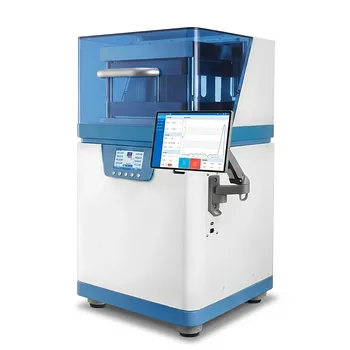
Synthesizing $Sb_2S_3$ nanoparticles requires a high-pressure reactor to overcome the thermal limitations of standard atmospheric chemistry. By providing a sealed environment, these reactors allow solvents to reach temperatures far exceeding their normal boiling points while remaining in a liquid state. This specific condition is essential for accelerating the reaction kinetics between antimony trichloride ($SbCl_3$) and thioacetamide (TAA), ensuring the controlled nucleation and growth of complex nanostructures.
A high-pressure reactor acts as a kinetic accelerator, providing the superheated environment necessary to increase precursor solubility and molecular collision frequency. This enables the precise formation of $Sb_2S_3$ nanostructures that would otherwise be impossible to synthesize at atmospheric pressure.
Overcoming Thermal Limits of Solvents
Maintaining the Liquid Phase
In a high-pressure hydrothermal or solvothermal reactor, solvents like ethylene glycol can be heated significantly past their atmospheric boiling points without vaporizing. Maintaining a liquid phase at high temperatures is critical because it preserves the density and diffusion characteristics required for chemical reactions.
Enhancing Precursor Solubility
High-temperature and high-pressure conditions significantly increase the solubility and activity of the reactants, $SbCl_3$ and TAA. This ensures that the precursors are fully dissociated and available for reaction, leading to a more efficient and complete chemical transformation.
Precision Control of Nanostructure Growth
Driving Smooth Nucleation
The pressurized environment facilitates a controlled "burst" of nucleation, where the $Sb_2S_3$ molecules begin to aggregate into solid crystals. Without the elevated pressure, the reaction kinetics would be too sluggish, resulting in poor crystalline quality and non-uniform particle sizes.
Regulating Morphology and Phase Purity
Reactors allow for the spontaneous and ordered arrangement of atoms into specific shapes, such as nanorods or nanosheets. The high-pressure environment induces the necessary kinetic conditions for the formation of stable crystalline phases without the need for subsequent high-temperature annealing.
Understanding the Trade-offs
Equipment Complexity and Safety
Operating high-pressure autoclaves requires high-strength sealing structures and specialized materials to prevent mechanical failure. The inherent risks of high-pressure systems necessitate rigorous safety protocols and specialized training for operators.
Monitoring Limitations
Because the reaction occurs inside a sealed, opaque metal vessel, real-time observation of the crystallization process is difficult. Researchers must often rely on post-synthesis analysis, which can make the initial optimization of reaction parameters more time-consuming.
Applying This to Your Synthesis Goals
How to Apply This to Your Project
To achieve the best results in $Sb_2S_3$ synthesis, you must align your reactor settings with your desired material properties.
- If your primary focus is high crystallinity: Ensure the reactor maintains a stable temperature for an extended duration to allow for the slow, ordered growth of the crystal lattice.
- If your primary focus is specific nanorod morphology: Precise control over the reaction pressure and the choice of solvent (such as ethylene glycol) is critical to direct the growth along specific crystallographic axes.
- If your primary focus is high-purity heterojunctions: Utilize high-pressure reactors to trigger rapid precursor mixing, facilitating the spontaneous arrangement of nanostructures on secondary surfaces.
By mastering the high-pressure environment, you can unlock the full potential of $Sb_2S_3$ for high-performance catalytic and electronic applications.
Summary Table:
| Key Feature | Benefit for $Sb_2S_3$ Synthesis | Impact on Final Nanostructure |
|---|---|---|
| Superheated Solvents | Maintains liquid phase well above boiling point | Increases precursor solubility and molecular collision |
| Kinetic Acceleration | Overcomes sluggish atmospheric reaction rates | Drives smooth nucleation and uniform particle growth |
| Pressure Control | Regulates atomic arrangement and phases | Enables specific morphologies like nanorods or nanosheets |
| Sealed Environment | Prevents evaporation of precursors/solvents | Ensures high purity without post-synthesis annealing |
Elevate Your Material Synthesis with KINTEK Precision
Unlock the full potential of your nanotechnology research with KINTEK’s industry-leading laboratory solutions. We specialize in providing researchers with the robust high-temperature high-pressure reactors and autoclaves necessary for the complex synthesis of $Sb_2S_3$ and other advanced nanostructures.
From our comprehensive range of high-temperature furnaces (muffle, tube, vacuum) to high-precision hydraulic presses and essential consumables like ceramics and crucibles, KINTEK offers the reliability and safety you need to push scientific boundaries.
Ready to optimize your synthesis workflow? Contact us today to discuss how our specialized equipment can enhance your lab’s efficiency and deliver superior material performance.
References
- Ping Ping Hu, Yong Lei. Hollow CuSbSy Coated by Nitrogen-Doped Carbon as Anode Electrode for High-Performance Potassium-Ion Storage. DOI: 10.3390/batteries9050238
This article is also based on technical information from Kintek Solution Knowledge Base .
Related Products
- Customizable Laboratory High Temperature High Pressure Reactors for Diverse Scientific Applications
- Customizable High Pressure Reactors for Advanced Scientific and Industrial Applications
- Stainless High Pressure Autoclave Reactor Laboratory Pressure Reactor
- Visual High-Pressure Reactor for In-Situ Observation
- Mini SS High Pressure Autoclave Reactor for Laboratory Use
People Also Ask
- How do high-pressure and high-temperature reactors ensure the effective treatment of lignocellulosic wastewater in WAO?
- What equipment is required for high-pressure high-temperature reactions? Master Extreme Chemistry Safely
- How do you control high pressure in a reactor? A Guide to Safe & Stable Operation
- How does initial oxygen pressure affect the wet oxidation of pharmaceutical sludge? Master Your Oxidation Depth
- Why is argon better than nitrogen for inert atmosphere? Ensure Absolute Reactivity & Stability