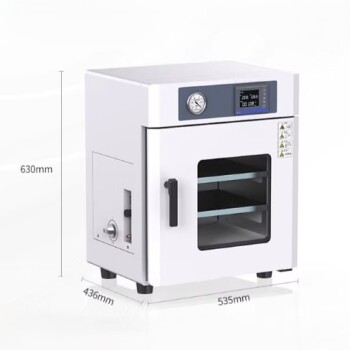
The primary function of a laboratory drying oven in the smelting process is the total elimination of surface moisture. By subjecting raw materials to a constant temperature, typically around 70 degrees Celsius for an extended period like 24 hours, the oven ensures that any water adsorbed on the surface is removed before the materials enter the furnace.
Moisture is the primary catalyst for structural defects in open-air smelting. Preheating raw materials eliminates this variable, preventing hydrogen gas formation and ensuring the density and integrity of the final stainless steel casting.
The Mechanism of Moisture Removal
Precise Temperature Regulation
To be effective, the drying process requires a stable thermal environment rather than a quick blast of heat. The laboratory oven maintains a constant temperature, often set at 70 degrees Celsius.
Duration and Saturation
Time is just as critical as temperature. The materials undergo this treatment for a specific duration, such as 24 hours. This extended timeframe ensures that moisture is driven off not just from the easy-to-reach outer layers, but from the entire surface area of the raw material.
Targeting Adsorbed Water
Raw materials naturally accumulate water molecules on their surfaces from the surrounding environment. This adsorbed moisture is the specific target of the drying oven. While it may appear dry to the naked eye, untreated material carries enough microscopic water to disrupt the smelting chemistry.
Why Preheating is Critical for Integrity
Preventing Hydrogen Generation
When moisture-laden materials are introduced to the extreme heat of smelting, the water does not simply boil away harmlessly. The evaporation process in an open-air melt leads to the dissociation of water molecules, generating hydrogen gas.
Eliminating Gas Porosity
If hydrogen gas is generated during the melt, it becomes trapped within the molten metal. As the steel cools and solidifies, this trapped gas creates voids and bubbles known as gas porosity defects.
Ensuring Structural Soundness
The presence of porosity significantly weakens the metal. By removing the moisture upstream, the drying oven prevents these defects from ever forming, thereby guaranteeing the mechanical integrity and quality of the resulting steel ingot.
Understanding the Operational Trade-offs
The Necessity in Open-Air Operations
This drying step is specifically cited as critical for open-air melting operations. In vacuum induction melting, the environment is controlled differently, but in open-air scenarios, atmospheric humidity and surface moisture are constant threats that necessitate this extra step.
Process Time vs. Material Quality
Integrating a 24-hour drying cycle adds significant lead time to the production schedule. However, this is a calculated trade-off: the time "lost" in preheating is an investment that prevents the catastrophic loss of the entire batch due to porosity defects.
Making the Right Choice for Your Goal
To apply this to your production workflow, consider the following:
- If your primary focus is Casting Integrity: Adhere strictly to the 24-hour drying cycle at constant temperatures to ensure zero moisture enters the melt.
- If your primary focus is Defect Reduction: Audit your raw materials for adsorbed moisture and verify that your oven calibration maintains a steady 70°C to prevent hydrogen-induced porosity.
By treating the laboratory drying oven as a mandatory gatekeeper rather than an optional step, you secure the fundamental quality of your stainless steel alloys.
Summary Table:
| Feature | Drying Requirement | Purpose in Smelting |
|---|---|---|
| Temperature | Constant 70°C | Ensures stable moisture removal without material degradation |
| Duration | 24 Hours | Drives off adsorbed water from entire surface area |
| Target | Adsorbed Moisture | Prevents dissociation of water into hydrogen gas |
| Impact | Defect Prevention | Eliminates gas porosity and ensures structural integrity |
Secure the Integrity of Your Alloys with KINTEK Precision
Don't let microscopic moisture compromise your melt. KINTEK provides high-performance laboratory drying ovens and thermal processing solutions tailored for metallurgical excellence. Whether you are performing open-air smelting or advanced vacuum induction melting, our comprehensive range of high-temperature furnaces (muffle, tube, vacuum, and CVD), high-pressure reactors, and crushing and milling systems ensure your raw materials meet the highest standards of purity and density.
From stainless steel casting to battery research, KINTEK's precision laboratory equipment empowers your team to eliminate structural defects and optimize production workflows.
Ready to upgrade your lab's thermal processing? Contact our technical experts today to find the perfect solution for your smelting and material research needs.
References
- Ángelo Oñate, D. Rojas. Exploring the Impact of Cooling Rate on Microstructural Features, Mechanical Properties, and Corrosion Resistance of a Novel Nb-Stabilized Super Duplex Stainless Steel in Shielded Metal Arc Welding. DOI: 10.3390/cryst13081192
This article is also based on technical information from Kintek Solution Knowledge Base .
Related Products
- Laboratory Scientific Electric Heating Blast Drying Oven
- 56L Vertical Laboratory Vacuum Drying Oven
- 23L Laboratory Vacuum Drying Oven
- High Performance Laboratory Freeze Dryer
- High Performance Laboratory Freeze Dryer for Research and Development
People Also Ask
- How does a laboratory electric drying oven contribute to the formation of the initial coating? Expert Insights
- What role does a precision laboratory drying oven play in the synthesis of GO-PANI nanocomposites? Protect Material Integrity
- What role does a laboratory drying oven play in the preparation of zinc oxide nanoparticle precursors?
- What is the necessity of using a laboratory drying oven when processing MoO3/GO composite nanopowders? Find out here.
- What is the role of a laboratory drying oven in cellulose citrate production? Ensure Material Stability & Purity