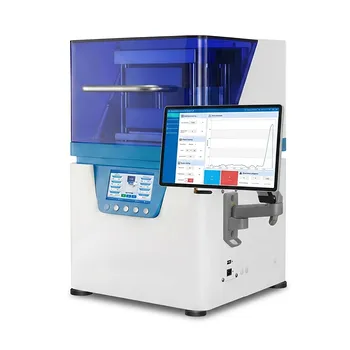
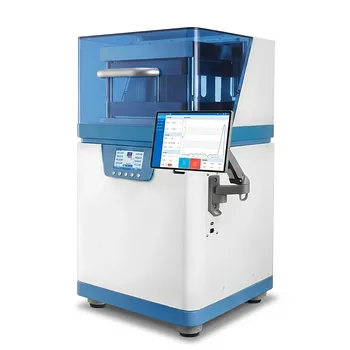
A laboratory hydraulic press is the critical tool for transforming loose $Ag^0:Ag_2Se$ hybrid powders into cohesive "green pellets" through high-pressure compaction. This process provides the necessary static force—typically up to 10 tons—to ensure the material reaches the specific density and geometric precision required for accurate thermoelectric characterization and subsequent thermal treatments.
By applying high static pressure, a hydraulic press minimizes inter-particle voids and maximizes contact area, which is essential for facilitating element diffusion during annealing and ensuring the mechanical integrity of the thermoelectric sample.
Establishing the Physical Foundation for Synthesis
Creating "Green Pellets" for Processing
The hydraulic press uses stainless steel molds to shape loose $Ag^0:Ag_2Se$ hybrid powders into standardized cylindrical pellets. This "green" state is the essential starting point for all subsequent laboratory procedures.
Without this initial compaction, the loose powder would remain chemically and physically unstable during handling. The press ensures the sample maintains a consistent geometry and mass, which is vital for repeatable experimental results.
Increasing Inter-Particle Contact Area
High-pressure compaction forces individual powder particles into intimate contact, significantly increasing the total contact surface area. This physical proximity is a prerequisite for the chemical reactions that occur during later stages.
By reducing the distance between $Ag$ and $Ag_2Se$ components, the press creates a "pressurized sedimentary state." This state mimics high-density environments, allowing for more efficient interaction between the hybrid phases.
Enhancing Thermoelectric and Chemical Properties
Promoting Mutual Diffusion During Annealing
The primary goal of preparing $Ag^0:Ag_2Se$ is often to improve its thermoelectric efficiency through annealing. The hydraulic press facilitates this by shortening the diffusion paths between elements.
When the compacted pellet is heated, the high contact area allows atoms to migrate more easily across grain boundaries. This results in a more homogeneous final product and faster reaction kinetics.
Reducing Porosity and Grain Boundary Resistance
Voids and pores within a material act as barriers to both electrical and thermal transport. A hydraulic press uses high tonnage to induce plastic deformation in the particles, squeezing out air and reducing porosity.
Achieving low porosity (often less than 5%) is critical for measuring the true conductivity of the material. Minimizing these voids prevents tortuous transport paths that would otherwise degrade the sample's thermoelectric performance.
Suppressing Volatilization and Stratification
During high-temperature treatments, certain components in thermoelectric materials can become volatile or separate into layers. The high-density packing achieved by the press effectively suppresses the volatilization of components.
By creating a tightly packed structure, the press prevents the material from stratifying within the furnace. This ensures that the chemical composition remains uniform throughout the entire volume of the pellet.
Understanding the Trade-offs
Risk of Micro-Cracking and Internal Stress
Applying excessive pressure can lead to internal stresses within the green pellet. If the pressure is released too quickly or exceeds the material's limits, micro-cracks can form, compromising mechanical strength.
Mold Wear and Contamination
Using stainless steel molds under high tonnage causes gradual wear and tear. Over time, this can lead to sample contamination or slight deviations in the pellet's dimensions if the molds are not properly maintained.
How to Apply This to Your Project
Choosing the Right Pressure for Your Goal
The amount of pressure applied should be calibrated based on your specific research objectives and the material's characteristics.
- If your primary focus is maximizing electrical conductivity: Apply higher pressures (near the 10-ton limit) to minimize grain boundary resistance and porosity.
- If your primary focus is preventing structural fractures: Use a gradual pressure release cycle to allow internal stresses to redistribute without forming cracks.
- If your primary focus is chemical homogeneity: Ensure the powders are uniformly mixed before pressing to maximize the benefits of the increased contact area during annealing.
Standardizing your pressing protocol is the most effective way to ensure the reliability and reproducibility of your $Ag^0:Ag_2Se$ thermoelectric data.
Summary Table:
| Key Function | Benefit for Ag0:Ag2Se | Impact on Characterization |
|---|---|---|
| High-Pressure Compaction | Creates cohesive "green pellets" | Ensures geometric and mass consistency |
| Porosity Reduction | Minimizes inter-particle voids | Improves electrical conductivity and transport |
| Increased Contact Area | Facilitates element diffusion | Results in a more homogeneous final product |
| Density Optimization | Suppresses component volatilization | Maintains uniform chemical composition |
Elevate Your Materials Research with KINTEK Precision
Achieving the perfect "green pellet" is critical for reliable thermoelectric characterization. KINTEK specializes in high-performance laboratory equipment designed to meet the rigorous demands of material science. Our extensive range of hydraulic presses (pellet, hot, and isostatic) provides the precise static force needed to maximize density and ensure the mechanical integrity of your $Ag^0:Ag_2Se$ samples.
Beyond compaction, KINTEK offers a comprehensive ecosystem for your lab, including high-temperature furnaces (muffle, tube, vacuum) for annealing, crushing and milling systems, and specialized ceramics and crucibles.
Ready to enhance your lab's efficiency and sample reproducibility? Contact KINTEK today to find the ideal pressing solution for your research goals!
References
- Si Yin Tee, Ming‐Yong Han. Compositionally tuned hybridization of n-type Ag<sup>0</sup> : Ag<sub>2</sub>Se under ambient conditions towards excellent thermoelectric properties at room temperature. DOI: 10.1039/d3qm00123g
This article is also based on technical information from Kintek Solution Knowledge Base .
Related Products
- Laboratory Hydraulic Press Lab Pellet Press Machine for Glove Box
- Laboratory Hydraulic Press Split Electric Lab Pellet Press
- Fully Automatic Heated Hydraulic Lab Press for Materials Sintering and Sample Preparation
- Automatic Laboratory Hydraulic Press for XRF & KBR Pellet Press
- Laboratory Hydraulic Press Lab Pellet Press for Button Battery
People Also Ask
- What is the function of a laboratory hydraulic press in W-Cu composites? Control Porosity and Material Ratio
- What is the role of a laboratory hydraulic press in the initial stages of Li6PS5Cl preparation? Key to Green Pellets
- What role does a laboratory hydraulic press play in triboelectric testing? Achieve Precision Alloy Sample Prep
- How can a laboratory hydraulic press be applied to chitosan for wastewater treatment? Optimize Pores & Strength
- How do a precision laboratory hydraulic press and specialized molds contribute to the fabrication of spherical ceramic samples? Achieving High-Density Material Precision