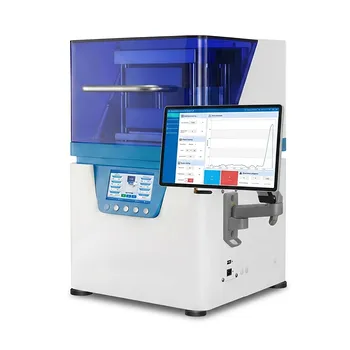
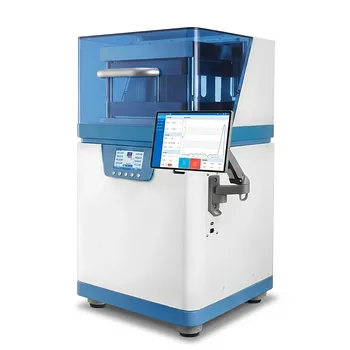
The laboratory hydraulic press is essential for achieving the high-density compaction required to transform loose electrode materials into a high-performance electrochemical unit. By applying uniform vertical pressure, the press ensures tight physical contact between the active material, conductive agents, and the current collector, which minimizes contact resistance and prevents the active material from delaminating during use.
A laboratory hydraulic press is the critical tool for ensuring both the electrical efficiency and mechanical durability of an electrode. It facilitates a cohesive interface between the active layer and the current collector, which is fundamental for stable electrochemical cycling and accurate data collection.
Optimizing Electrical Performance
Minimizing Internal Contact Resistance
The primary function of the hydraulic press is to reduce contact resistance within the electrode sheet. By applying high mechanical pressure—often ranging from 10 MPa to 80 MPa—the press forces active material particles, conductive carbon black, and binders into intimate contact. This proximity allows for a continuous conductive network, which is vital for efficient electron transport during charge and discharge cycles.
Enhancing Current Collector Interface
A zinc-ion hybrid capacitor relies on the efficient transfer of electrons between the active material and the current collector (such as copper foil, nickel foam, or stainless steel mesh). The hydraulic press ensures the active material film is firmly pressed onto the collector, eliminating gaps that would otherwise act as insulators. This tight mechanical bond is essential for maintaining high rate performance and minimizing energy loss.
Ensuring Mechanical and Structural Stability
Preventing Active Material Delamination
During the operation of quasi-solid-state capacitors, electrodes undergo mechanical stress from bending or ion insertion. Without the uniform compaction provided by a hydraulic press, the active material is prone to peeling or delaminating from the current collector. High-pressure application ensures the binder effectively anchors the composite material, providing the structural integrity needed to survive repeated electrochemical cycling.
Facilitating Particle Rearrangement
The application of consistent pressure causes the powder particles within the slurry or film to undergo structural rearrangement. This process eliminates voids and ensures that the electrode sheet has a uniform density across its entire surface. A more uniform electrode leads to more predictable ion diffusion pathways and prevents "hot spots" of high current density that could degrade the device prematurely.
Understanding the Trade-offs and Pitfalls
The Risk of Over-Compression
While high pressure is necessary, excessive force can be detrimental to electrode health. Over-compressing can damage the porosity of the active material, hindering the electrolyte's ability to penetrate the electrode and slowing down ion transport. Furthermore, extreme pressure may compromise the structural integrity of delicate current collectors like thin foils or high-porosity nickel foams.
Consequences of Under-Compression
Insufficient pressure results in a "fluffy" electrode with high interfacial resistance. In such cases, the active material may detach when exposed to the electrolyte or during the assembly of the quasi-solid-state device. This leads to inconsistent test data, poor capacity retention, and a significantly shortened cycle life for the capacitor.
How to Apply This to Your Electrode Preparation
Selecting the Right Approach for Your Goal
Achieving the perfect balance of pressure is key to maximizing the performance of your zinc-ion hybrid capacitor.
- If your primary focus is High Power Density: Use higher pressures (e.g., 40-80 MPa) to minimize resistance, ensuring that the conductive network is as dense as possible for rapid electron movement.
- If your primary focus is Long-Term Cycling Stability: Prioritize a moderate, sustained pressure (e.g., 10-20 MPa) to ensure a secure bond to the current collector without crushing the material's internal pore structure.
- If your primary focus is Consistency and Data Accuracy: Utilize a hydraulic press with a calibrated pressure gauge to ensure every electrode sheet is prepared under identical conditions, eliminating variables in your experimental results.
Properly calibrated pressure application is the definitive step that bridges the gap between raw chemical components and a robust, high-functioning energy storage device.
Summary Table:
| Feature | Function in Electrode Preparation | Impact on Capacitor Performance |
|---|---|---|
| High-Pressure Compaction | Reduces contact resistance between particles | Improves electron transport and high-rate performance |
| Interface Bonding | Secures active material to the current collector | Prevents delamination and enhances mechanical durability |
| Particle Rearrangement | Eliminates voids and ensures uniform density | Creates predictable ion pathways and prevents current 'hot spots' |
| Calibrated Control | Balances compaction force vs. material porosity | Optimizes the trade-off between energy density and ion diffusion |
Elevate Your Energy Storage Research with KINTEK
Precision is paramount in the development of next-generation quasi-solid-state zinc-ion capacitors. KINTEK specializes in high-performance laboratory equipment designed to bridge the gap between material synthesis and robust device assembly. Our range of laboratory hydraulic presses—including pellet, hot, and isostatic models—provides the uniform pressure necessary to ensure superior electrode integrity and data reproducibility.
Beyond compaction tools, KINTEK offers a comprehensive portfolio for battery and capacitor research:
- High-Temperature Furnaces: Muffle, vacuum, and CVD systems for advanced material synthesis.
- Material Processing: Crushing, milling, and sieving equipment for perfect slurry preparation.
- Electrochemical Essentials: High-quality electrolytic cells, electrodes, and specialized consumables like PTFE and ceramics.
- Thermal Management: ULT freezers and cooling solutions to maintain sample stability.
Ready to optimize your electrode preparation workflow? Contact KINTEK today to discover how our tailored laboratory solutions can enhance your research outcomes and maximize your lab's efficiency.
References
- Shengyuan Deng, Hong Seok Kang. Mg‐Doped Porous Silicon Derived from Silica Aerogels for Fast and Stable Zinc‐Ion Hybrid Capacitors with High Capacitance. DOI: 10.1002/adfm.202311259
This article is also based on technical information from Kintek Solution Knowledge Base .
Related Products
- Laboratory Hydraulic Press Lab Pellet Press Machine for Glove Box
- Laboratory Hydraulic Press Split Electric Lab Pellet Press
- Fully Automatic Heated Hydraulic Lab Press for Materials Sintering and Sample Preparation
- Laboratory Hydraulic Press Lab Pellet Press for Button Battery
- Automatic Laboratory Hydraulic Press for XRF & KBR Pellet Press
People Also Ask
- What is the function of a laboratory hydraulic press in W-Cu composites? Control Porosity and Material Ratio
- What is the role of a laboratory hydraulic press in the initial stages of Li6PS5Cl preparation? Key to Green Pellets
- What role does a laboratory hydraulic press play in triboelectric testing? Achieve Precision Alloy Sample Prep
- How can a laboratory hydraulic press be applied to chitosan for wastewater treatment? Optimize Pores & Strength
- How do a precision laboratory hydraulic press and specialized molds contribute to the fabrication of spherical ceramic samples? Achieving High-Density Material Precision