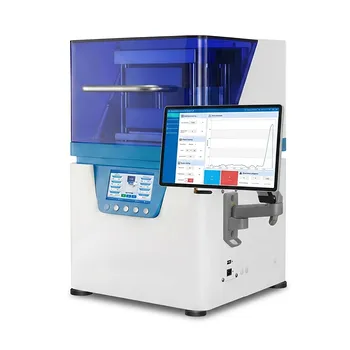
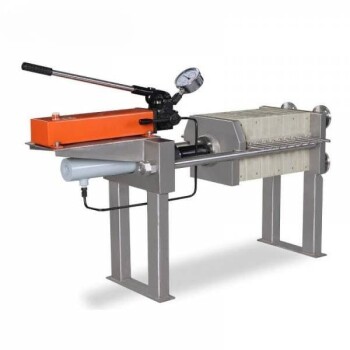
The laboratory hydraulic press is the critical bridge between a raw semi-coke powder and a readable infrared spectrum. It compresses a mixture of semi-coke and potassium bromide (KBr) into a dense, transparent pellet of uniform thickness, typically around 0.3mm. This process is mandatory to eliminate light scattering and ensure that the infrared beam can effectively penetrate the sample to identify chemical functional groups.
Core Takeaway: A hydraulic press is required to transform opaque semi-coke into a transparent medium by applying high-tonnage pressure to a KBr-diluted mixture. This preparation ensures high light transmittance and a high signal-to-noise ratio, which are essential for accurate spectral analysis.
The Role of High Pressure in Optical Clarity
Eliminating Scattering Interference
Raw semi-coke is a solid, carbonaceous material that naturally scatters infrared light rather than allowing it to pass through. By using a hydraulic press to apply high pressure (often around 5 to 6 tons), the air gaps between particles are removed. This creates a homogeneous solid that prevents light loss, resulting in a stable baseline and clear absorption peaks.
Ensuring Uniform Beam Penetration
FT-IR spectroscopy relies on the infrared beam passing through the sample to reach the detector. The press ensures the sample has a uniform thickness and density across the entire pellet. This uniformity allows the beam to penetrate the sample evenly, providing high-resolution data on the solid’s chemical structure.
Standardizing the Path Length
For quantitative and qualitative analysis, the "path length" (thickness) of the sample must be consistent. A hydraulic press, used in conjunction with precision molds, creates standardized pellets. This consistency is vital for comparing different semi-coke samples or monitoring changes in functional groups during chemical interactions.
Technical Requirements for Semi-Coke Preparation
The KBr Dilution Method
Because semi-coke is highly absorbent, it must be diluted in an infrared-transparent medium like spectroscopic-grade Potassium Bromide (KBr). A common ratio is 1 part sample to 100 parts KBr. The hydraulic press then fuses these two materials into a single, semi-transparent disc.
Precision Pressure and Duration
The quality of the pellet depends on the uniformity of the force applied. Maintaining high pressure for a specific duration—such as 10 minutes—allows the KBr to undergo plastic flow. This ensures the final pellet is not just a compressed powder, but a dense, glass-like solid.
Achieving High Signal-to-Noise Ratios
Properly pressed pellets result in a higher signal-to-noise ratio. This is critical when analyzing semi-coke, as it allows researchers to distinguish between actual chemical functional groups and background electronic noise. It also makes it possible to detect subtle hydrogen bond formations or intermolecular interactions.
Understanding the Trade-offs and Pitfalls
The Risk of Moisture Absorption
Potassium Bromide is highly hygroscopic, meaning it rapidly absorbs moisture from the air. If the pressing process is not done quickly or in a controlled environment, water vapor can become trapped in the pellet. This creates "water bands" in the spectrum that can mask the actual chemical signals of the semi-coke.
Consequences of Improper Pressure
Applying too little pressure results in a cloudy or opaque pellet that blocks the infrared beam entirely. Conversely, excessive pressure or uneven distribution can crack the pellet or damage the precision die set. Both scenarios lead to poor spectral quality and unusable data.
Sample Concentration Sensitivity
If the semi-coke concentration is too high within the KBr mixture, the pellet will remain too dark for the IR beam to penetrate. Finding the correct dilution balance is a prerequisite to using the hydraulic press effectively.
How to Apply This to Your Analysis
To obtain the highest quality FT-IR results for semi-coke, tailor your pressing technique to your specific analytical goals.
- If your primary focus is qualitative functional group identification: Ensure the pellet is as transparent as possible by using a 1:100 dilution ratio and maintaining pressure for at least 10 minutes.
- If your primary focus is quantitative comparison between samples: Use a precision-calibrated hydraulic press to ensure every pellet is pressed at the exact same tonnage and for the same duration to maintain a consistent path length.
- If your primary focus is analyzing moisture-sensitive interactions: Preheat your KBr powder and perform the pressing process in a low-humidity environment to prevent spectral interference from water vapor.
Mastering the use of the hydraulic press transforms semi-coke from an unreadable solid into a clear window into its molecular architecture.
Summary Table:
| Parameter | Recommended Value/Action | Why It Matters |
|---|---|---|
| Sample Dilution | 1:100 (Semi-coke to KBr) | Prevents opacity; allows IR beam penetration |
| Applied Pressure | 5 to 6 Tons | Eliminates air gaps and scattering interference |
| Pressing Duration | ~10 Minutes | Ensures plastic flow for a glass-like, uniform pellet |
| Pellet Thickness | Approx. 0.3 mm | Standardizes path length for quantitative accuracy |
| Environment | Low Humidity | Prevents KBr moisture absorption and water bands |
Elevate Your Spectroscopy Precision with KINTEK
High-quality FT-IR results start with flawless sample preparation. KINTEK specializes in high-performance laboratory hydraulic presses (manual, pellet, and hot presses) designed to deliver the precise, uniform pressure needed for transparent semi-coke pellets.
Beyond pressing, we provide a comprehensive suite of laboratory solutions, including:
- Crushing & Milling Systems: For optimal sample particle size.
- High-Temperature Furnaces: Muffle and vacuum systems for material processing.
- Precision Consumables: Spectroscopic-grade KBr, ceramics, and high-quality dies.
Whether you are analyzing molecular architecture or monitoring chemical interactions, KINTEK’s equipment ensures the stability and signal-to-noise ratio your research demands. Contact our experts today to find the perfect press for your lab!
References
- Maofei Niu, Weihao Xu. Effects of Pressurized Pyrolysis on the Chemical and Porous Structure Evolution of Coal Core during Deep Underground Coal Gasification. DOI: 10.1021/acsomega.3c03327
This article is also based on technical information from Kintek Solution Knowledge Base .
Related Products
- Laboratory Hydraulic Press Lab Pellet Press Machine for Glove Box
- Laboratory Hydraulic Press Split Electric Lab Pellet Press
- Fully Automatic Heated Hydraulic Lab Press for Materials Sintering and Sample Preparation
- Laboratory Hydraulic Press Lab Pellet Press for Button Battery
- Automatic Laboratory Hydraulic Press for XRF & KBR Pellet Press
People Also Ask
- What is the function of a laboratory hydraulic press in W-Cu composites? Control Porosity and Material Ratio
- What is the role of a laboratory hydraulic press in the initial stages of Li6PS5Cl preparation? Key to Green Pellets
- What role does a laboratory hydraulic press play in triboelectric testing? Achieve Precision Alloy Sample Prep
- How can a laboratory hydraulic press be applied to chitosan for wastewater treatment? Optimize Pores & Strength
- How do a precision laboratory hydraulic press and specialized molds contribute to the fabrication of spherical ceramic samples? Achieving High-Density Material Precision