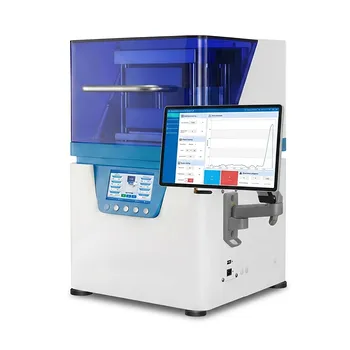
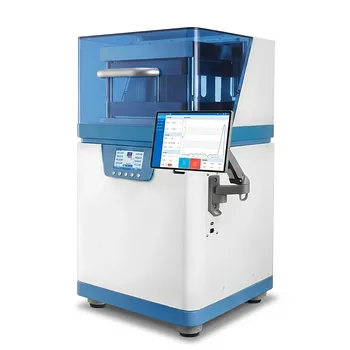
The laboratory hydraulic press is the fundamental tool for transforming loose precursor powders into dense, reactive green bodies. By applying several tons of pressure, the press reduces the physical distance between particles and maximizes the contact area between chemical reactants. This high-pressure environment is the prerequisite for the efficient solid-state diffusion required to form a stable, disordered rock-salt (DRX) crystal lattice during calcination.
A laboratory hydraulic press provides the necessary mechanical force to eliminate voids and optimize particle-to-particle contact, ensuring that elements can migrate at the atomic level to create a uniform and stable cathode material.
The Role of High Pressure in Solid-State Chemistry
Facilitating Atomic Diffusion
The formation of disordered rock-salt structures requires elements like manganese, titanium, lithium, oxygen, and fluorine to diffuse fully into a single crystal lattice.
A hydraulic press compresses the precursor powders to a point where the atomic diffusion distance is significantly shortened. This proximity allows these diverse elements to move and react efficiently during high-temperature calcination.
Maximizing Interfacial Contact Area
Solid-state reactions occur at the interfaces where powder particles meet.
By applying high-pressure compaction, the press increases the total contact area between different precursors. This ensures that the chemical reaction is not stalled by physical gaps, leading to a more complete and faster phase formation.
Ensuring Structural Integrity and Precision
Eliminating Internal Voids and Entrapped Air
Loose powders contain significant amounts of air and large gaps, known as porosity.
The hydraulic press uses stable, high-tonnage pressure (often reaching up to 200 kN) to pack particles tightly and force out entrapped air. This creates a dense, "green" body that is far less likely to exhibit cracking or structural failure during the firing process.
Improving Reproducibility and Uniformity
For technical research, consistency is as important as the result itself.
Hydraulic presses provide precise application of pressure (e.g., 10 MPa), which ensures that every sample has the same initial density and dimensions. This uniformity allows researchers to accurately compare how different temperatures or compositions affect the final material's performance.
Understanding the Trade-offs
Risk of Die Damage and Sample Sticking
While high pressure is necessary, exceeding the load limits of the mold or die can lead to mechanical failure. Additionally, some precursor powders may stick to the die faces under extreme pressure, which can cause surface defects on the green body when it is ejected.
Over-Compaction and Strain
Excessive pressure can occasionally lead to laminar cracking or internal stresses within the pellet. If the pressure is released too quickly, the stored elastic energy can cause the green body to expand and fracture, a phenomenon known as "springback."
How to Apply This to Your Research
Successful preparation of disordered rock-salt cathodes depends on matching your compaction strategy to your specific material goals.
- If your primary focus is phase purity: Prioritize maximizing the contact area by using higher tonnages to ensure all elements can diffuse into the lattice.
- If your primary focus is mechanical stability: Focus on the rate of pressure release to prevent internal stresses and cracking in the dense green body.
- If your primary focus is experimental reproducibility: Use a digital hydraulic press with precise pressure control to ensure every pellet starts with the exact same density.
By mastering the compaction process, you create the physical environment necessary for complex chemical synthesis to succeed at the atomic level.
Summary Table:
| Key Role in DRX Synthesis | Practical Benefit | Critical Control Factor |
|---|---|---|
| Particle Compaction | Minimizes atomic diffusion distance for solid-state reaction | Applied Tonnage (kN) |
| Void Elimination | Removes entrapped air to prevent cracking during firing | Green Body Density |
| Interfacial Contact | Maximizes surface area contact between precursor elements | Die Surface Finish |
| Process Precision | Ensures experimental reproducibility and sample uniformity | Pressure Release Rate |
Elevate Your Material Synthesis with KINTEK Precision
Achieving the perfect disordered rock-salt (DRX) cathode starts with superior sample preparation. KINTEK specializes in high-performance laboratory equipment designed for the rigorous demands of battery research. Our range of hydraulic presses (pellet, hot, and isostatic) ensures uniform density and structural integrity for your green bodies, while our crushing and milling systems and high-temperature furnaces (muffle, vacuum, and CVD) provide a complete workflow for advanced material calcination.
Whether you are a researcher focused on phase purity or a lab manager requiring high-tonnage reliability, KINTEK delivers the tools you need to minimize experimental variables and maximize results.
Ready to optimize your lab's output? Contact our technical experts today to find the perfect compaction solution for your research.
References
- Ying Chen, Chun Huang. Realising higher capacity and stability for disordered rocksalt oxyfluoride cathode materials for Li ion batteries. DOI: 10.1039/d3ra05684h
This article is also based on technical information from Kintek Solution Knowledge Base .
Related Products
- Laboratory Hydraulic Press Lab Pellet Press Machine for Glove Box
- Laboratory Hydraulic Press Split Electric Lab Pellet Press
- Fully Automatic Heated Hydraulic Lab Press for Materials Sintering and Sample Preparation
- Laboratory Hydraulic Press Lab Pellet Press for Button Battery
- Automatic Laboratory Hydraulic Press for XRF & KBR Pellet Press
People Also Ask
- What is the function of a laboratory hydraulic press in W-Cu composites? Control Porosity and Material Ratio
- What is the role of a laboratory hydraulic press in the initial stages of Li6PS5Cl preparation? Key to Green Pellets
- What role does a laboratory hydraulic press play in triboelectric testing? Achieve Precision Alloy Sample Prep
- How can a laboratory hydraulic press be applied to chitosan for wastewater treatment? Optimize Pores & Strength
- How do a precision laboratory hydraulic press and specialized molds contribute to the fabrication of spherical ceramic samples? Achieving High-Density Material Precision