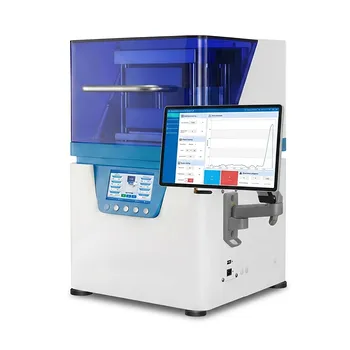
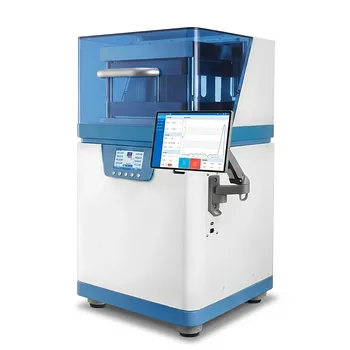
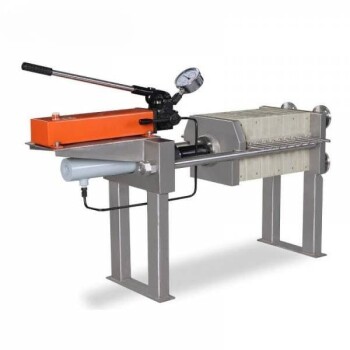
The laboratory hydraulic press is essential for sample characterization because it transforms loose, pulverized material into standardized, dense pellets or discs. This process ensures consistent sample morphology and density, which are critical for high-precision analytical techniques like X-ray fluorescence (XRF) and infrared spectroscopy.
By converting powders into uniform geometric shapes, a laboratory hydraulic press minimizes physical inconsistencies and maximizes the signal-to-noise ratio in analytical instrumentation. This standardization is the foundation for obtaining repeatable, accurate data regarding the chemical composition and mechanical properties of fuel and ash.
Enhancing Analytical Signal Integrity
Optimization of Signal-to-Noise Ratios
Pulverized coal or ash in its raw form has irregular particle distributions that scatter radiation inconsistently. Standardizing sample morphology through compression ensures that the analytical beam interacts with a flat, uniform surface. This significantly improves the signal-to-noise ratio in techniques such as infrared spectroscopy and X-ray fluorescence (XRF).
Accuracy in Elemental Detection
High-pressure compression allows for the precise detection of inorganic element content. By creating a fixed geometric shape, the press ensures that the instrument "sees" the same density of material across every trial. This consistency is what allows researchers to achieve the high repeatability required for peer-reviewed results or industrial quality control.
Achieving Physical and Structural Uniformity
Ensuring Consistent Sample Density
A hydraulic press applies static pressure to mixtures (such as soil mixed with Palm Oil Fuel Ash) to create specimens with identical initial densities. This eliminates preparation errors that would otherwise skew results in Unconfined Compressive Strength (UCS) testing. Without uniform density, it is impossible to determine if a material’s strength comes from its composition or simply how tightly it was packed.
Eliminating Physical Defects
In specialized measurements like those involving a Vector Network Analyzer, physical defects or thickness variations can cause massive data errors. Using precision molds and hydraulic pressure ensures uniform thickness and density throughout the specimen. This level of control prevents inconsistencies that would otherwise interfere with measuring bulk resistivity or dielectric properties.
Removal of Interstitial Air
High-pressure forming (often reaching tens of tons) effectively expels air trapped between particles. This process enhances intermolecular forces and establishes a dense "green body." For ceramic or fuel powders, this dense packing is a prerequisite for successful recrystallization and sintering during subsequent thermal processing.
Understanding the Trade-offs
Pressure Sensitivity and Sample Integrity
While high pressure is necessary for density, exceeding a material's limit can cause lamination or capping, where the pellet splits into layers upon release. Finding the specific pressure—such as the 20 MPa often used for fuel powders—is a balancing act between mechanical strength and structural damage.
Risk of Cross-Contamination
Because the press uses steel molds and dies, there is a persistent risk of trace metal contamination if equipment is not meticulously cleaned. Additionally, some soft samples may adhere to the die face, requiring the use of binding agents which, while helpful for stability, can introduce unwanted chemical signatures into the characterization data.
How to Apply This to Your Characterization Project
Recommendations Based on Analysis Goals
- If your primary focus is Chemical Spectroscopy (XRF/XRD): Prioritize the use of a hydraulic press to create a perfectly flat, mirror-like surface to minimize beam scattering.
- If your primary focus is Thermal or Mechanical Testing: Use a press to reach a specific "green body" density, ensuring the sample has the structural integrity to survive high-temperature sintering.
- If your primary focus is Electrical Property Measurement: Focus on maintaining precise, uniform thickness across the entire diameter of the disc to avoid impedance inaccuracies.
By mastering the application of static pressure, you ensure that your analytical results reflect the true nature of the material rather than the inconsistencies of its preparation.
Summary Table:
| Key Benefit | Role in Sample Preparation | Impact on Analytical Results |
|---|---|---|
| Signal Optimization | Creates flat, uniform surfaces | Maximizes signal-to-noise ratio in XRF/XRD |
| Density Control | Ensures consistent material packing | Eliminates preparation errors in UCS/mechanical tests |
| Air Removal | Expels interstitial air under high pressure | Establishes dense "green bodies" for sintering |
| Morphology Fixation | Standardizes geometric shapes | Guarantees high repeatability across analytical trials |
Elevate Your Analytical Precision with KINTEK
Achieving repeatable results in fuel and ash characterization starts with perfect sample preparation. KINTEK specializes in high-performance laboratory hydraulic presses (pellet, hot, and isostatic) designed to provide the precise uniform density and morphology required for XRF, XRD, and spectroscopy.
Beyond pelletizing, our expertise covers your entire workflow—from crushing and milling systems to high-temperature furnaces (muffle, vacuum, tube) and essential PTFE or ceramic consumables. Whether you are conducting battery research or environmental testing, we provide the tools to ensure your data reflects the true nature of your materials.
Ready to eliminate sample variability? Contact KINTEK today to find the ideal pressing and preparation solution for your laboratory.
References
- Tianyu Liu, Qian Liu. Ash Fouling Behavior During the Combustion of Bituminous Coal and High-Ca Pyrolytic Biochar Under Air and Oxyfuel Atmosphere. DOI: 10.2139/ssrn.4374547
This article is also based on technical information from Kintek Solution Knowledge Base .
Related Products
- Laboratory Hydraulic Press Lab Pellet Press Machine for Glove Box
- Laboratory Hydraulic Press Split Electric Lab Pellet Press
- Fully Automatic Heated Hydraulic Lab Press for Materials Sintering and Sample Preparation
- Laboratory Hydraulic Press Lab Pellet Press for Button Battery
- Automatic Laboratory Hydraulic Press for XRF & KBR Pellet Press
People Also Ask
- What is the function of a laboratory hydraulic press in W-Cu composites? Control Porosity and Material Ratio
- What is the role of a laboratory hydraulic press in the initial stages of Li6PS5Cl preparation? Key to Green Pellets
- What role does a laboratory hydraulic press play in triboelectric testing? Achieve Precision Alloy Sample Prep
- How can a laboratory hydraulic press be applied to chitosan for wastewater treatment? Optimize Pores & Strength
- How do a precision laboratory hydraulic press and specialized molds contribute to the fabrication of spherical ceramic samples? Achieving High-Density Material Precision