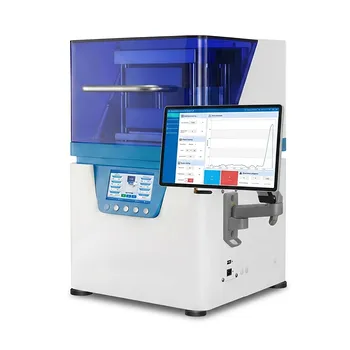
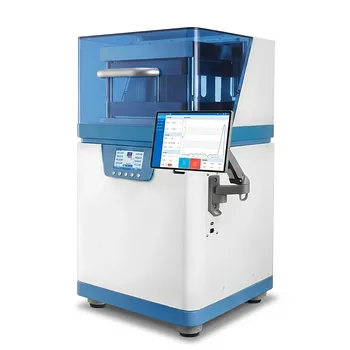
The laboratory hydraulic press is indispensable for ilmenite reduction because it facilitates solid-state kinetics through physical densification.
By applying high pressures (typically around 100 MPa), the press transforms loose powders into pellets with extremely high physical contact density. This ensures that the ilmenite and carbon reductant remain in intimate contact, significantly shortening diffusion paths and promoting efficient carbothermal reduction at temperatures reaching 1550°C.
Core Takeaway: Pelletization via a hydraulic press optimizes the chemical interface between solid reactants, transforming a loose mixture into a stable, high-density matrix that ensures uniform heat transfer and prevents material loss or stratification during high-temperature processing.
Enhancing Solid-State Reaction Kinetics
Minimizing Diffusion Distances
In solid-state reactions, the speed of the process is often limited by how far atoms must travel to meet a reactant. Pelletization compresses the powder, significantly reducing the void space and shortening the diffusion paths between the ilmenite and the carbon reductant.
Maximizing Particle Contact Area
A hydraulic press applies consistent tonnage to ensure that the surfaces of the individual particles are forced together. This creates a high-density contact structure that allows for faster chemical exchanges at the high temperatures required for carbothermal reduction.
Lowering Activation Barriers
Because the particles are in such intimate contact, the reaction can often proceed more completely or at slightly lower temperatures than loose powder. This improves the phase purity of the final reduced product and minimizes the presence of unreacted intermediate components.
Maintaining Sample Stability and Uniformity
Preventing Stratification and Material Loss
During high-temperature experiments, loose powders are prone to drifting or stratifying due to density differences between components. Pelletizing the mixture locks the ilmenite and carbon into a fixed orientation, preventing them from separating within the furnace.
Ensuring Uniform Heat and Gas Diffusion
A pellet provides a standardized geometry that allows for consistent heat conduction throughout the sample. This uniformity is vital for obtaining accurate kinetic data, as it ensures that the core of the sample reaches the target temperature at the same rate as the surface.
Simulating Industrial Conditions
Many industrial processes for mineral processing involve agglomeration or briquetting of ores before they enter a kiln. Using a hydraulic press in the lab allows researchers to simulate these industrial-scale physical specifications on a controllable, small-scale level.
Understanding the Trade-offs
The Risk of Over-Compaction
While high density is generally beneficial, excessive pressure can lead to internal stress and cracking within the pellet. If a pellet is too dense, it may inhibit the escape of byproduct gases (like CO or CO₂), potentially creating internal pressure that ruptures the sample.
Die Wear and Contamination
The high pressures required for ilmenite mixtures can cause significant mechanical wear on the steel dies used in the press. Over time, this can lead to microscopic metal contamination in the sample or variations in the final pellet dimensions.
Non-Uniform Density Gradients
Pressure is not always distributed perfectly throughout a pellet, often resulting in density gradients where the edges are denser than the core. These variations can lead to "edge effects" in the reduction experiment, where the outer layer of the pellet reduces faster than the center.
How to Apply This to Your Project
When preparing ilmenite mixtures for reduction, your choice of pressing parameters should align with your specific experimental objectives.
- If your primary focus is kinetic accuracy: Use a precision hydraulic press to ensure every pellet has identical dimensions and density to eliminate variables in heat and mass transfer.
- If your primary focus is industrial simulation: Match the pelletizing pressure to the mechanical strength required for industrial-scale handling, usually focusing on "green strength" and durability.
- If your primary focus is maximum reduction efficiency: Prioritize the highest possible contact density (e.g., 100 MPa) to minimize diffusion distances, provided the pellet remains gas-permeable.
By carefully controlling the pelletization process, you transform a simple mixture into a standardized reactor that yields reliable, repeatable, and scientifically sound results.
Summary Table:
| Key Benefit | Mechanism | Impact on Experiment |
|---|---|---|
| Enhanced Kinetics | Minimizes diffusion distances | Faster, more complete carbothermal reduction |
| Physical Stability | Prevents stratification | Eliminates material loss and ensures sample integrity |
| Uniformity | Standardized geometry | Consistent heat conduction and reliable kinetic data |
| Industrial Realism | Simulates briquetting | Provides scalable data for mineral processing |
| Phase Purity | Maximizes particle contact | Reduces activation barriers and intermediate impurities |
Optimize Your Sample Preparation with KINTEK
Precision in pelletization is the foundation of reliable mineral reduction data. KINTEK specializes in high-performance laboratory equipment designed to meet the rigorous demands of material science and mineral processing.
Whether you need a manual, automatic, or isostatic hydraulic press to achieve perfect physical densification, or high-temperature furnaces (muffle, tube, or vacuum) for your reduction experiments, KINTEK offers the complete solution. Our portfolio also includes premium crushing and milling systems, PTFE and ceramic consumables, and crucibles to ensure your samples remain uncontaminated and your results repeatable.
Ready to elevate your lab's efficiency and accuracy? Contact our experts today to find the ideal pressing and heating solutions for your specific research needs!
References
- N. A. Nasrun, Sheikh Abdul Rezan. Phase Reduction and Thermodynamic Analysis of Ilmenite Ore by Carbothermal-Iodination using Different Carbon Reductants. DOI: 10.58915/ijneam.v16idecember.409
This article is also based on technical information from Kintek Solution Knowledge Base .
Related Products
- Laboratory Hydraulic Press Lab Pellet Press Machine for Glove Box
- Laboratory Hydraulic Press Split Electric Lab Pellet Press
- Fully Automatic Heated Hydraulic Lab Press for Materials Sintering and Sample Preparation
- Automatic Laboratory Hydraulic Press for XRF & KBR Pellet Press
- Laboratory Hydraulic Press Lab Pellet Press for Button Battery
People Also Ask
- What is the function of a laboratory hydraulic press in W-Cu composites? Control Porosity and Material Ratio
- What is the role of a laboratory hydraulic press in the initial stages of Li6PS5Cl preparation? Key to Green Pellets
- What role does a laboratory hydraulic press play in triboelectric testing? Achieve Precision Alloy Sample Prep
- How can a laboratory hydraulic press be applied to chitosan for wastewater treatment? Optimize Pores & Strength
- How do a precision laboratory hydraulic press and specialized molds contribute to the fabrication of spherical ceramic samples? Achieving High-Density Material Precision