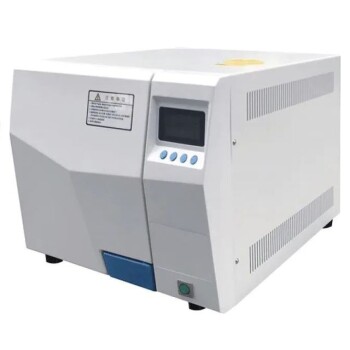
A laboratory oven serves as the critical stabilization bridge between wet chemical impregnation and high-temperature activation. It is strictly required to dry catalyst slurries—often at 110 °C overnight—to slowly remove solvents and physically stabilize the material before it undergoes calcination.
The drying phase is not merely about moisture removal; it is a structural preservation strategy. By ensuring the controlled evaporation of solvents, the oven prevents the destruction of the catalyst's microporous architecture and guarantees the uniform distribution of active components.
Preserving Microscopic Integrity
Preventing Structural Collapse
The primary danger during catalyst preparation is rapid vaporization. If a wet catalyst is introduced directly to high-temperature calcination or nitridation, the remaining solvent turns to steam almost instantly.
This rapid expansion exerts immense pressure on the catalyst carrier. Without a preliminary oven-drying step, this pressure causes the collapse of the delicate microporous structure, rendering the carrier ineffective.
Protecting Membrane Surfaces
For membrane and seed preparations, the oven plays a similar protective role. By maintaining temperatures between 100 °C and 150 °C, the oven removes physically adsorbed water from deep within the pores.
This ensures that subsequent high-heat or plasma testing does not cause physical damage or cracking in the membrane surface due to escaping steam.
Ensuring Chemical Performance
Preventing Particle Agglomeration
The speed of drying directly impacts the dispersion of active ingredients. Slow drying in a laboratory oven prevents the active components from migrating and clumping together.
If the solvent is removed too quickly, active particles tend to aggregate. This agglomeration reduces the surface area available for reactions, significantly lowering the catalytic efficiency.
Maintaining Chemical Equilibrium
Residual moisture acts as a contaminant in sensitive chemical processes. For example, in workflows involving ammonia (NH3) nitridation, excess water can interfere with the reaction's chemical equilibrium.
A dedicated drying step at moderate temperatures (e.g., 80 °C) ensures that the material is chemically neutral and dry, allowing the subsequent reaction to proceed as intended without interference.
Understanding the Trade-offs
The Risk of Rushing
There is often a temptation to accelerate the workflow by increasing the oven temperature or shortening the drying time. However, this negates the purpose of the equipment.
Higher temperatures may speed up evaporation but risk triggering the very agglomeration you are trying to avoid. The process must remain slow enough to keep active components anchored in their correct positions on the porous carrier.
Surface vs. Deep Pore Drying
Simple air drying is rarely sufficient for porous materials. While the surface may appear dry, moisture often remains trapped in the internal pore structure.
Only a sustained thermal cycle in a laboratory oven can ensure the complete removal of physically adsorbed water from the internal microstructure.
Making the Right Choice for Your Workflow
To maximize the effectiveness of your catalyst preparation, tailor your drying protocol to your specific end goal:
- If your primary focus is Structural Integrity: Prioritize a slow, overnight drying cycle (e.g., 110 °C) to prevent pore collapse during calcination.
- If your primary focus is Chemical Purity: Ensure the drying temperature is sufficient to remove all adsorbed water (up to 150 °C) to prevent interference with subsequent reaction equilibria.
The laboratory oven is the gatekeeper of quality, ensuring your catalyst is physically robust and chemically active before it ever faces extreme heat.
Summary Table:
| Feature | Drying Function | Impact on Catalyst |
|---|---|---|
| Structural Preservation | Controlled solvent evaporation | Prevents pore collapse and maintains carrier integrity. |
| Active Component Dispersion | Slow thermal stabilization | Prevents particle agglomeration and maximizes surface area. |
| Moisture Removal | Targeted heating (110°C - 150°C) | Eliminates physically adsorbed water to prevent cracking. |
| Chemical Equilibrium | Pre-calcination prep | Ensures a neutral chemical environment for high-heat reactions. |
Elevate Your Research with KINTEK Precision Solutions
Don't let improper drying compromise your catalyst's performance. At KINTEK, we specialize in providing high-performance laboratory equipment tailored for advanced material science and chemical engineering.
Our extensive portfolio—ranging from precision laboratory ovens and vacuum furnaces to high-temperature reactors, autoclaves, and crushing systems—is designed to ensure the microscopic integrity of your samples. Whether you are focused on catalyst impregnation, battery research, or material calcination, KINTEK offers the uniform heating and durability your workflow demands.
Ready to optimize your lab's efficiency and results?
Contact our technical experts today to find the perfect equipment solution.
References
- Hamed Nayebzadeh, Mohammad Tabasizadeh. Application of microwave irradiation for fabrication of sulfated ZrO2–Al2O3 nanocomposite via combustion method for esterification reaction: process condition evaluation. DOI: 10.1007/s40097-019-0304-y
This article is also based on technical information from Kintek Solution Knowledge Base .
Related Products
- Laboratory Scientific Electric Heating Blast Drying Oven
- 56L Vertical Laboratory Vacuum Drying Oven
- 23L Laboratory Vacuum Drying Oven
- 1200℃ Muffle Furnace Oven for Laboratory
- 1700℃ Muffle Oven Furnace for Laboratory
People Also Ask
- How does a laboratory electric drying oven contribute to the formation of the initial coating? Expert Insights
- What role does a precision laboratory drying oven play in the synthesis of GO-PANI nanocomposites? Protect Material Integrity
- What role does a laboratory drying oven play in the preparation of zinc oxide nanoparticle precursors?
- What is the necessity of using a laboratory drying oven when processing MoO3/GO composite nanopowders? Find out here.
- What is the role of a laboratory drying oven in cellulose citrate production? Ensure Material Stability & Purity