Compacting mixed powders into blocks using a laboratory pellet press is essential for optimizing heat transfer and ensuring structural uniformity during the synthesis of porous carbon. By applying controlled pressure—typically around 8 MPa—researchers reduce the voids between particles and increase the contact density between the carbon source and the template. This physical transformation ensures that the carbon precursor, such as sucrose, forms a continuous, uniform layer around the template during the critical dehydration and condensation phases of pyrolysis.
Core Takeaway: A pellet press converts loose powder into a dense, standardized form to eliminate thermal gradients and facilitate a uniform chemical reaction between the carbon precursor and the template, ultimately determining the quality of the resulting porous structure.
Optimizing Thermal and Chemical Kinetics
Enhancing Heat Transfer Efficiency
In loose powder form, trapped air acts as an insulator, leading to uneven heating during high-temperature pyrolysis. Compressing the powder into a block increases the bulk density, allowing heat to conduct more efficiently and uniformly throughout the material.
Promoting Uniform Precursor Coating
During the initial heating phase, carbon sources like sucrose undergo dehydration to form a "caramel" state. A pellet press ensures the carbon source is in direct, high-density contact with the calcium carbonate template, allowing it to coat the template surfaces evenly rather than pooling or forming irregular clusters.
Facilitating Atomic Diffusion
Increasing the contact area between raw material particles significantly shortens the distance required for atomic diffusion. This proximity is vital for solid-state reactions, as it allows the chemical transformation to proceed more completely and often at lower temperatures than would be possible with loose powders.
Ensuring Experimental Consistency and Reliability
Standardizing Bulk Density
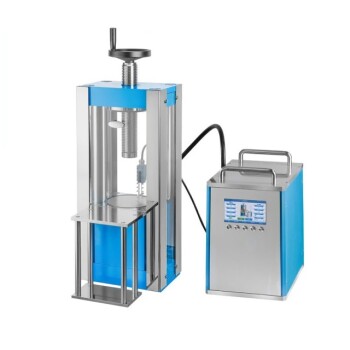
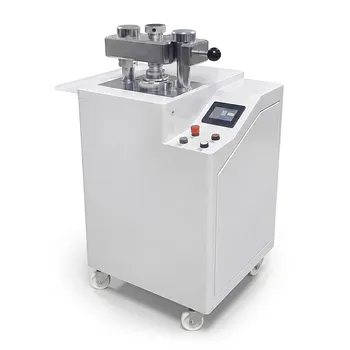
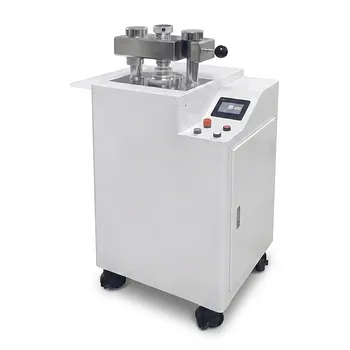
Using a hydraulic press allows researchers to create pellets with uniform dimensions and consistent density. This standardization reduces deviations in mass transfer resistance and ensures that experimental results are repeatable across different batches.
Managing Reactor Dynamics
Dense pellets prevent fine powders from being entrained by gas flows within the pyrolysis reactor, which could otherwise clog analytical systems or lead to material loss. Furthermore, uniform blocks help maintain stable back pressure and gas distribution within the reaction bed.
Controlling Volume Shrinkage
Pre-pressing powders helps expel air and establishes a high initial packing density. This reduces the total volume of shrinkage that occurs during pyrolysis and sintering, preventing the final carbon structure from deforming or cracking due to uneven loading.
Understanding the Trade-offs and Risks
The Risk of Template Damage
While high pressure increases density, excessive force can prematurely crush fragile template materials like certain carbonates or delicate salts. If the template's structure is compromised during pressing, the resulting pore architecture of the carbon will be irregular or collapsed.
Balancing Porosity and Density
There is a fundamental trade-off between the density of the green pellet and the final porosity of the carbon. Over-compaction can sometimes hinder the escape of volatile gasses during pyrolysis, potentially leading to internal structural defects or "bloating" as gasses struggle to diffuse out of a too-dense block.
Handling and Mechanical Stability
Pellets pressed at too low a pressure may remain friable, crumbling during handling or when introduced into the reactor. Conversely, extremely dense pellets may experience "spring-back" or lamination (layering) if the pressure is released too quickly or if the powder lacks sufficient binding properties.
How to Apply Compaction to Your Synthesis Goal
Choosing the Right Approach for Your Project
The specific pressure and pellet dimensions you choose should align with your material characteristics and your final reactor requirements.
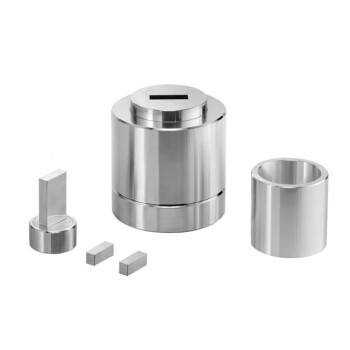
- If your primary focus is high structural uniformity: Use a standardized mold (e.g., 10mm-15mm) and a consistent pressure of 8-10 MPa to ensure an even coating of the template by the carbon source.
- If your primary focus is preventing material loss in gas-flow reactors: Compress the powder into larger pellets and sieve any resulting fragments to ensure the reaction bed remains stable under high gas velocity.
- If your primary focus is minimizing reaction temperatures: Maximize the contact area by using higher pressures (up to 20 MPa), provided your template material can withstand the mechanical stress without deforming.
- If your primary focus is preventing pellet cracking: Implement a slow pressure release (dwell time) after compaction to allow internal air to escape and reduce the likelihood of lamination or structural failure.
Mastering the compaction stage transforms a simple mixture of powders into a high-performance material by controlling the physical environment in which the chemical synthesis occurs.
Summary Table:
| Key Benefit | Impact on Synthesis | Importance for Porous Carbon |
|---|---|---|
| Enhanced Heat Transfer | Eliminates insulating air pockets | Ensures uniform heating and prevents thermal gradients |
| Uniform Precursor Coating | Increases contact density between materials | Facilitates a continuous carbon layer around the template |
| Atomic Diffusion | Shortens distance between particles | Promotes complete chemical transformation at lower temperatures |
| Reactor Dynamics | Prevents powder entrainment | Maintains stable gas distribution and prevents material loss |
| Structural Control | Minimizes volume shrinkage | Prevents cracking and deforming during final carbonization |
Elevate Your Material Synthesis with KINTEK Precision
Achieving the perfect porous carbon structure requires more than just a recipe—it demands precision at every stage. KINTEK specializes in high-performance laboratory equipment designed to meet the rigorous standards of advanced material research.
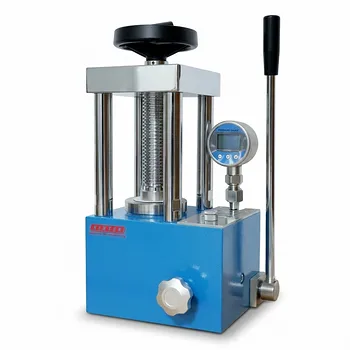
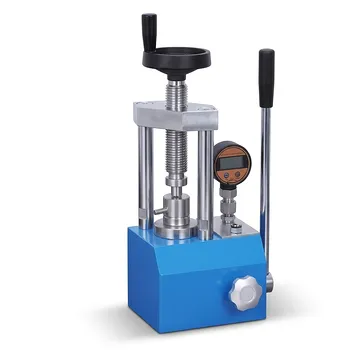
From our robust hydraulic pellet presses (including manual, hot, and isostatic models) that ensure uniform density, to our comprehensive range of high-temperature furnaces (muffle, tube, vacuum, and CVD) for precise pyrolysis, we provide the tools you need for repeatable, high-quality results. Our portfolio also includes essential crushing, milling, and sieving systems to prepare your precursors with absolute consistency.
Ready to optimize your synthesis process and improve structural uniformity?
Contact KINTEK Experts Today to find the ideal equipment solutions for your laboratory's unique requirements!
References
- Rui Liu, Qiqi Zhang. Preparation of N-Doped Layered Porous Carbon and Its Capacitive Deionization Performance. DOI: 10.3390/ma16041435
This article is also based on technical information from Kintek Solution Knowledge Base .
Related Products
- XRF Boric Acid Lab Powder Pellet Pressing Mold for Laboratory Use
- XRF & KBR steel ring lab Powder Pellet Pressing Mold for FTIR
- XRF & KBR plastic ring lab Powder Pellet Pressing Mold for FTIR
- Automatic Laboratory Hydraulic Pellet Press Machine for Lab Use
- Laboratory Hydraulic Pellet Press for XRF KBR FTIR Lab Applications
People Also Ask
- What is the purpose of using a mold for pellet pressing when preparing catalyst test samples? Ensure Data Consistency
- What is the XRF method of sampling? Achieve Accurate Elemental Analysis with Proper Sample Prep
- What is the XRF pressed pellet method? A Fast, Cost-Effective Sample Prep Guide
- How are samples prepared for XRF analysis? Achieve Accurate and Reliable Results
- How do you make XRF pellets? A 4-Step Guide to Flawless Sample Preparation