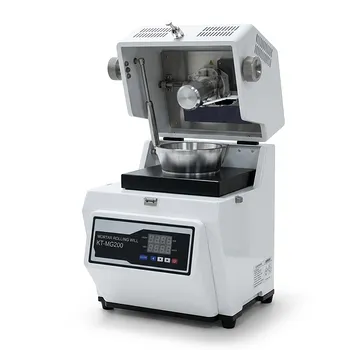
The inherent heterogeneity of Municipal Solid Waste (MSW) makes it resistant to simple reduction methods. A multi-stage crushing and grinding system is necessary to dismantle the complex structure of plastics, paper, and fabrics through a gradient process. This systematic reduction transforms inconsistent debris into a homogenized powder, which is a non-negotiable requirement for accurate scientific analysis and fuel characterization.
By progressively reducing particle size from coarse chunks to fine powder, multi-stage systems neutralize the variability of waste materials. This homogenization is the single most critical factor for ensuring representative sampling and repeatability in thermodynamic analysis.
Addressing the Complexity of MSW
The Challenge of Mixed Materials
MSW is a highly complex, non-homogeneous structure. It is composed of diverse materials with varying physical properties, including rigid plastics, fibrous papers, and woven fabrics.
Why Uniformity is Elusive
Because these materials react differently to stress, a single mechanical action cannot reduce them uniformly. Without a specialized system, the feedstock remains inconsistent, leading to unreliable data and processing inefficiencies.
The Mechanics of the Multi-Stage Gradient
To achieve true homogenization, the material must undergo a specific gradient process. This involves stepping down the particle size in controlled phases.
Phase 1: Coarse and Medium Crushing
The process begins with coarse crushing, reducing the raw waste to approximately 2 cm. This is immediately followed by medium crushing, which further reduces the material to roughly 0.5 cm.
Phase 2: Fine Blade Grinding
The final and most critical step is fine blade grinding. This stage pulverizes the 0.5 cm granules down to a mere 0.1 cm.
The Result: Homogenized Powder
This multi-step approach ensures that the final output is not just small pieces of trash, but a homogenized powder. This powder creates a uniform blend where the properties of the mix are consistent throughout the batch.
The Critical Role in Analysis
Enabling Representative Sampling
In scientific analysis, you often rely on tiny samples to represent tons of waste. The homogenized powder ensures that any small sample taken is truly representative of the bulk material.
Ensuring Measurement Repeatability
Reliable data depends on the ability to repeat an experiment and get the same result. The uniformity provided by the multi-stage system allows for measurement repeatability in thermodynamic analyses.
Supporting TGA and DSC
Advanced techniques like Thermogravimetric Analysis (TGA) and Differential Scanning Calorimetry (DSC) require precise inputs. The 0.1 cm powder form provides the consistency needed for these instruments to accurately characterize the fuel's thermal properties.
Operational Considerations and Trade-offs
Energy Intensity vs. Data Quality
Implementing a multi-stage system increases energy consumption and processing time compared to simple shredding. However, this is a necessary trade-off to obtain the data precision required for high-level fuel certification.
Equipment Maintenance
Processing abrasive and varied MSW materials through fine blades causes significant wear. Operators must plan for regular maintenance to ensure the system maintains the 0.1 cm tolerance required for valid results.
Making the Right Choice for Your Goal
Whether you are characterizing fuel properties or preparing for industrial conversion, the level of processing must match your objective.
- If your primary focus is Thermodynamic Analysis (TGA/DSC): You must utilize the full multi-stage grinding process to achieve a 0.1 cm homogenized powder for maximum measurement repeatability.
- If your primary focus is Logistics and Handling: You may only require the initial crushing stages to prepare feedstock for a high-pressure pellet press to improve density for transport.
Precision in your grinding process is the prerequisite for reliability in your fuel analysis.
Summary Table:
| Processing Stage | Target Particle Size | Primary Function |
|---|---|---|
| Coarse Crushing | ~2.0 cm | Initial reduction of raw waste debris |
| Medium Crushing | ~0.5 cm | Preparing material for fine pulverization |
| Fine Blade Grinding | ~0.1 cm | Creating homogenized powder for TGA/DSC analysis |
| Resulting State | Homogenized Powder | Ensures representative sampling and repeatability |
Maximize the Precision of Your MSW Analysis with KINTEK
Don't let material heterogeneity compromise your research results. KINTEK specializes in high-performance crushing and milling systems, sieving equipment, and hydraulic pellet presses designed to transform complex Municipal Solid Waste into perfectly homogenized samples. Whether you are conducting TGA/DSC thermal characterization or preparing feedstock for energy conversion, our precision tools ensure the measurement repeatability your laboratory demands.
From advanced grinding solutions to essential consumables like PTFE products and crucibles, KINTEK provides the end-to-end support needed for superior fuel analysis. Contact us today to optimize your lab's workflow!
References
- Gizem Ayas, Hakan F. Öztop. Thermal analysis of different Refuse Derived Fuels samples. DOI: 10.2298/tsci201010249a
This article is also based on technical information from Kintek Solution Knowledge Base .
Related Products
- Laboratory Grinding Mill Mortar Grinder for Sample Preparation
- Three-dimensional electromagnetic sieving instrument
- High Energy Planetary Ball Mill Milling Machine for Laboratory
- High Energy Planetary Ball Mill Milling Machine for Laboratory
People Also Ask
- What laboratory apparatus is used for grinding? Match the Right Mill to Your Sample Material
- What is the function of a laboratory grinding mill? Achieve Precise Sample Preparation for Accurate Results
- What is the purpose of using a laboratory grinder and standard sieves? Unlock Precise Rice Husk Pretreatment
- What is the role of laboratory-grade grinders and sieves in sample prep? Ensure High-Precision Corrosion Analysis
- What is the purpose of using a laboratory grinder with specific mesh sieves for oat straw? Optimize Pellet Quality