The necessity of a multi-stage process lies in the extreme material complexity of electronic waste (E-waste), which combines elastic plastics, malleable metals, and brittle ceramics into a single stream. A sequential approach—utilizing a hammer mill for coarse crushing, a knife mill for intermediate grinding, and a vibratory disc mill for fine pulverization—is the only reliable method to reduce this heterogeneous mixture into a uniform powder below 233 microns.
Core Takeaway E-waste is too mechanically diverse for a single reduction technique to handle effectively. A three-stage milling sequence ensures that incompatible materials are progressively reduced to a homogenous powder, which is critical for representative sampling and efficient acid digestion.
The Challenge of Material Complexity
A Mix of Mechanical Properties
E-waste is not a single material; it is a composite of metals, plastics, and ceramics. Each of these responds differently to physical force.
Why Single-Stage Milling Fails
A device designed to shatter brittle ceramics often fails to cut elastic plastics, while a cutter designed for plastics may be damaged by hard metals. Attempting to reduce bulk E-waste in a single step results in incomplete separation and non-uniform particle sizes.
The Three-Stage Reduction Strategy
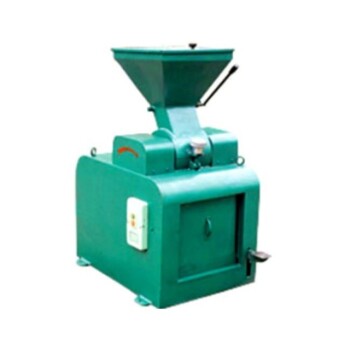
Stage 1: The Hammer Mill (Primary Crushing)
The process begins with the hammer mill. This robust equipment relies on high-impact force to shatter bulky, rigid components.
It is specifically effective at breaking down the initial structural integrity of hard casings, circuit boards, and ceramic components into manageable, coarse fragments.
Stage 2: The Knife Mill (Intermediate Grinding)
Once the material is coarsely crushed, it is passed to a knife mill. This stage is critical for addressing the plastic and polymer components of the waste.
While impact mills might merely deform elastic materials, the shearing action of the knife mill effectively cuts these polymers, reducing the mixture to a granular consistency suitable for the final stage.
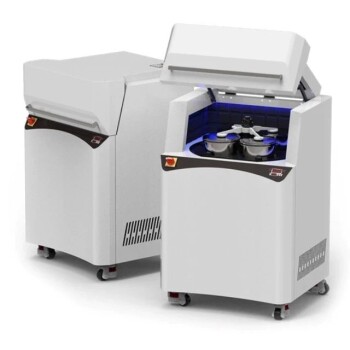
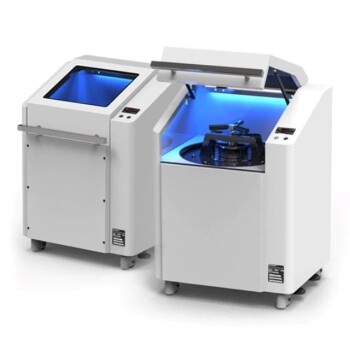
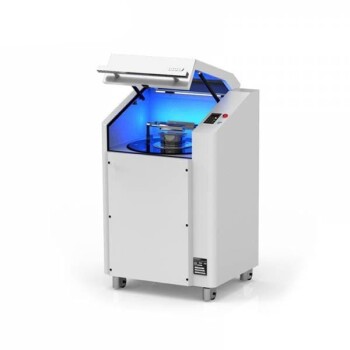
Stage 3: The Vibratory Disc Mill (Fine Grinding)
The final step utilizes a vibratory disc mill. This stage applies intense friction and impact to grind the granular mix into a fine, homogenous powder.
The specific goal here is to achieve a particle size below 233 microns. This ultra-fine consistency is required to ensure that the different material types are indistinguishable from one another.
Why Uniformity Drives Accuracy
Guaranteeing Sampling Representativeness
If E-waste is not ground to a fine powder, the sample will segregate. You might accidentally analyze a "nugget" of copper while missing the surrounding plastic, skewing your data.
By reducing the mixture to below 233 microns, the multi-stage process ensures that even a tiny sub-sample perfectly represents the composition of the entire bulk waste.
Maximizing Acid Digestion Efficiency
Chemical analysis typically requires dissolving the sample in acid. Large particles react slowly and often incompletely.
The fine powder produced by the vibratory disc mill maximizes the surface area exposed to the acid. This ensures complete dissolution, which is fundamental to maintaining the accuracy of elemental analysis.
Understanding the Trade-offs
Equipment Complexity and Maintenance
Running three distinct milling technologies increases the operational footprint. It requires managing three sets of maintenance schedules and cleaning protocols to prevent cross-contamination between batches.
Risk of Contamination
While not explicitly detailed in the primary text, it is understood that rigorous milling involves contact between the sample and the grinding media.
Operators must be aware that the grinding tools themselves (hammers, knives, discs) experience wear. This can introduce trace elements into the sample, potentially affecting ultra-trace level analysis if the grinding material matches the target analyte.
Making the Right Choice for Your Goal
To ensure your E-waste analysis yields valid data, align your process with these objectives:
- If your primary focus is Sampling Accuracy: Ensure the final vibratory disc stage runs long enough to eliminate all visible granularity, guaranteeing a homogenous mix.
- If your primary focus is Chemical Recovery: Verify that particle sizes are consistently below 233 microns to prevent incomplete digestion during the acid phase.
The reliability of your analytical data is directly proportional to the quality of your physical sample preparation.
Summary Table:
| Milling Stage | Equipment Used | Primary Mechanism | Material Focus | Resulting Particle Size |
|---|---|---|---|---|
| Stage 1: Primary | Hammer Mill | High-impact force | Hard casings & ceramics | Coarse fragments |
| Stage 2: Intermediate | Knife Mill | Shearing/Cutting | Elastic plastics & polymers | Granular consistency |
| Stage 3: Fine | Vibratory Disc Mill | Friction & Impact | Mixed heterogeneous granules | Fine powder (<233 µm) |
Optimize Your E-Waste Analysis with KINTEK Precision
Achieving representative sampling for complex electronic waste requires the right mechanical sequence. KINTEK specializes in high-performance laboratory equipment, offering the robust crushing and milling systems and sieving equipment needed to reach the critical <233-micron threshold.
Whether you are performing acid digestion or elemental analysis, our solutions—from hydraulic presses for pelletizing to high-temperature furnaces for ash testing—ensure your lab achieves maximum accuracy.
Ready to elevate your material preparation? Contact our specialists today to find the perfect milling configuration for your research goals.
References
- Simon Carter, Julia Waack. Atomic spectrometry update: review of advances in the analysis of metals, chemicals and materials. DOI: 10.1039/d0ja90067b
This article is also based on technical information from Kintek Solution Knowledge Base .
Related Products
- Vibrating Disc Mill Small Laboratory Grinding Machine
- Disc Cup Vibrating Mill Multi-Platform for Lab
- Laboratory Disc Cup Vibratory Mill for Sample Grinding
- Lab Vibration Mill
- High Energy Vibratory Laboratory Ball Mill Grinding Mill Single Tank Type
People Also Ask
- What role do disc mills play in the wet or dry pretreatment of lignocellulosic waste? Scalable Biomass Solutions
- What is the function of a laboratory grinding mill? Achieve Precise Sample Preparation for Accurate Results
- What is the function of an industrial vibratory mill? Optimize Fe-Cr-Al Alloy Powder Production
- What laboratory apparatus is used for grinding? Match the Right Mill to Your Sample Material
- Why use stainless steel jars and balls for solid-state battery slurries? Maximize Dispersion and Conductivity