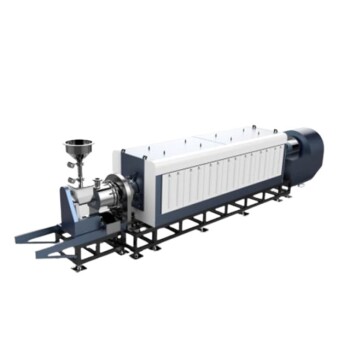
The selection of a Quartz Reactor for carbochlorination is driven by two critical material properties: thermal stability and chemical inertness. It is specifically chosen because it can withstand reaction temperatures between 400°C and 750°C while remaining impervious to the highly corrosive chlorine gas used in the process. This prevents the reactor vessel from degrading or contaminating the sensitive rare earth oxides during the experiment.
The aggressive environment of carbochlorination requires a vessel that does not participate in the reaction. Quartz provides a chemically inert barrier that maintains structural integrity under high heat while ensuring the elemental purity of the final rare earth product.
Mastering the Thermal Environment
Withstanding High Reaction Temperatures
The carbochlorination of rare earth oxides is a high-energy process. It typically occurs within a temperature range of 400°C to 750°C.
Maintaining Structural Integrity
Standard materials often soften or warp under these sustained thermal loads. Quartz retains its rigidity and form throughout this specific heating cycle, ensuring the reactor design remains stable during operation.
Combating Chemical Corrosion
Resistance to Chlorine Gas
Chlorine gas is highly reactive and corrosive, particularly to metals at high temperatures. A key engineering challenge in this process is preventing the vessel itself from corroding.
Inert Reaction Surface
Quartz exhibits superior resistance to chlorine gas corrosion. By not reacting with the process gases, the reactor ensures that the containment vessel does not degrade over time, extending the lifespan of the equipment.
Ensuring Experimental Integrity
Preventing Sample Contamination
In rare earth processing, purity is paramount. If the reactor vessel reacts with the chemicals, it introduces impurities into the rare earth oxide and activated carbon mixture.
The Role of the Quartz Crucible
To further secure the sample, a Quartz Crucible is often positioned at the base of the reactor to hold the mixture. This dual layer of quartz—both the reactor body and the crucible—guarantees that the elemental purity of the sample is maintained throughout the chlorination stage.
Understanding the Trade-offs
Mechanical Fragility
While quartz is thermally and chemically robust, it is mechanically brittle compared to metal alloys. Operators must handle the reactor and crucible with care to avoid impact damage or chipping.
Thermal Shock Risks
Although quartz handles high temperatures well, sudden, extreme shifts in temperature can cause stress. It is vital to ramp temperatures up and down within the recommended process windows to maintain the integrity of the vessel.
Making the Right Choice for Your Process
Depending on your specific experimental goals, the prioritization of quartz offers distinct advantages:
- If your primary focus is Purity: Quartz is essential because it prevents chemical leaching from the vessel walls, ensuring the rare earth oxides remain uncontaminated.
- If your primary focus is Equipment Longevity: The resistance to chlorine corrosion means the reactor will not need frequent replacement due to chemical wear, unlike metal alternatives.
By leveraging the high-temperature stability and chemical inertness of quartz, you ensure a controlled, pure, and effective carbochlorination process.
Summary Table:
| Feature | Quartz Reactor Performance | Benefit for Carbochlorination |
|---|---|---|
| Temperature Range | 400°C to 750°C | Maintains structural integrity during high-energy reactions |
| Chemical Resistance | High (Inert to Chlorine Gas) | Prevents vessel corrosion and equipment degradation |
| Purity Level | Superior | Eliminates sample contamination from vessel leaching |
| Containment | Dual-layer (Reactor + Crucible) | Ensures elemental purity of rare earth products |
Elevate Your Rare Earth Research with KINTEK Precision
Don't let equipment corrosion or sample contamination compromise your experimental integrity. KINTEK specializes in high-performance laboratory solutions tailored for extreme environments. Whether you require high-temperature quartz reactors, specialized crucibles, or high-pressure autoclaves, our comprehensive range of equipment—including atmosphere furnaces, crushing systems, and chemical-resistant ceramics—is designed to meet the rigorous demands of rare earth processing.
Ready to optimize your carbochlorination process? Contact our technical experts today to find the perfect quartz solutions and laboratory consumables for your specific research goals.
References
- Alexandra Anderson, Brajendra Mishra. Investigation of the Carbochlorination Process for Conversion of Cerium and Neodymium Oxides into Their Chlorides. DOI: 10.1007/s40831-015-0023-7
This article is also based on technical information from Kintek Solution Knowledge Base .
Related Products
- Visual High-Pressure Reactor for In-Situ Observation
- Laboratory Rapid Thermal Processing (RTP) Quartz Tube Furnace
- Electric Rotary Kiln Small Rotary Furnace for Activated Carbon Regeneration
- Customizable Laboratory High Temperature High Pressure Reactors for Diverse Scientific Applications
- Customizable High Pressure Reactors for Advanced Scientific and Industrial Applications
People Also Ask
- How do high-pressure reactors enhance biochar redox activity? Optimize Surface Functionalization and Energy Density
- What is the purpose of a high-pressure reactor in oleophilic GO modification? Optimize Grafting and Oil Dispersion.
- How does a high-pressure reactor facilitate reductive amidation? Maximize Yield & Speed in Tandem Reactions
- How does a high-pressure reactor assist in catalytic hydrogenation of 2,6-dimethylnitrobenzene? Optimize Your Process
- What is the significance of using a high-pressure reactor for the treatment of rice husk? Boost Furfural Yield & Speed