Knowledge Why is a Rotary Vane Pump often called a 'Roughing Pump'? Understanding Its Critical Role in Vacuum Systems
Author avatar

Tech Team · Kintek Solution

Updated 2 days ago

Why is a Rotary Vane Pump often called a 'Roughing Pump'? Understanding Its Critical Role in Vacuum Systems


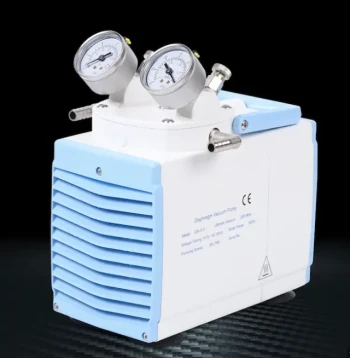
The term "roughing pump" refers to the specific operational role a Rotary Vane Pump plays within a larger vacuum system. It is called this because its primary function is to perform the initial pumpdown, "roughing out" the bulk volume of air to transition a chamber from atmospheric pressure down to a "rough" vacuum level, typically around 1 micron (0.001 Torr).

Core Takeaway High-vacuum pumps are highly sensitive and cannot operate at atmospheric pressure without sustaining damage. A Rotary Vane Pump is designated as a "roughing pump" because it serves as the essential first stage, lowering the pressure to a safe threshold where a secondary high-vacuum pump can take over.

The Mechanics of the Roughing Stage

Bridging the Gap from Atmosphere

Vacuum systems rarely operate with a single pump if high vacuum is required. The process begins at atmospheric pressure, which is too dense for high-performance pumps to handle.

The Rotary Vane Pump is mechanically robust enough to handle this dense air. It physically sweeps the majority of gas molecules out of the chamber, effectively bridging the gap between ambient air and a low-pressure environment.

Defining "Rough" Vacuum

The target of this initial stage is not a perfect void, but rather a specific pressure level known as "rough vacuum."

As indicated by standard operating procedures, this level is generally around 1 micron or 0.001 Torr. Once this target is reached, the "roughing" phase is considered complete.

Why "Roughing" is Critical for System Safety

The Limitations of High-Vacuum Pumps

Secondary pumps, such as turbomolecular pumps, are designed for precision rather than volume. They operate on principles that require molecules to be spaced far apart.

If a high-vacuum pump were activated at atmospheric pressure, the aerodynamic forces and friction from the dense air would cause catastrophic mechanical failure.

The Handoff Process

The roughing pump acts as a gatekeeper. It operates alone until the system pressure drops to the safe operational range of the secondary pump.

Only after the roughing pump has achieved the necessary vacuum level does the high-vacuum pump engage to finish the job.

Understanding the Limitations

The Vacuum Floor

While Rotary Vane Pumps are excellent at moving bulk air, they have a distinct performance limit.

A critical trade-off is that a roughing pump cannot achieve high vacuum on its own. It will hit a "floor" at the rough vacuum level (approx. 0.001 Torr) and will not be able to lower the pressure further, regardless of how long it runs.

Dependence on Secondary Systems

Because of this floor, a roughing pump is insufficient for applications requiring ultra-clean or ultra-low pressure environments.

It must be paired with a distinct high-vacuum pump to bridge the final gap from 0.001 Torr down to deep vacuum levels.

Making the Right Choice for Your Goal

To determine how to utilize a Rotary Vane Pump in your setup, consider your target pressure:

  • If your primary focus is a basic vacuum (approx. 0.001 Torr): You can utilize the Rotary Vane Pump as a standalone unit, as it is capable of reaching this level without assistance.
  • If your primary focus is high vacuum (below 0.001 Torr): You must use the Rotary Vane Pump purely as a "roughing" or backing pump to support a secondary turbomolecular pump.

The "roughing" designation is not a judgment of quality, but a definition of the pump's vital foundational role in achieving high vacuum.

Summary Table:

Feature Roughing Pump (Rotary Vane) High-Vacuum Pump (e.g., Turbomolecular)
Starting Pressure Atmospheric pressure Rough vacuum (~0.001 Torr)
Primary Function Initial pumpdown (bulk air removal) Achieving ultra-low pressure
Mechanism Mechanically robust vanes/sweeping Precision molecular momentum
Risk Factor Limited vacuum depth Damaged by atmospheric pressure
Operational Goal Achieve ~1 micron (0.001 Torr) Deep vacuum below 0.001 Torr

Optimize Your Vacuum Performance with KINTEK

Don’t risk your high-vacuum equipment with an unreliable startup process. KINTEK provides robust laboratory solutions, including high-performance rotary vane pumps and high-temperature systems, designed to ensure a safe and efficient transition to high vacuum.

Whether you are managing complex CVD/PECVD processes, dental applications, or battery research, our technical experts can help you select the ideal roughing pump and secondary vacuum systems for your specific needs. From high-pressure reactors to precision milling and cooling solutions, KINTEK is your partner in laboratory excellence.

Contact our experts today to find the perfect vacuum configuration for your lab.

Related Products

People Also Ask

Related Products

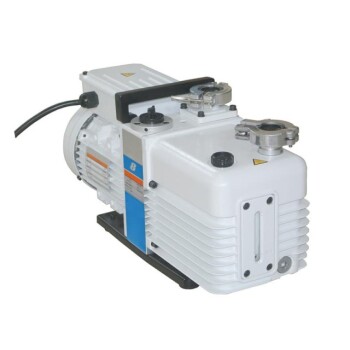
Laboratory Rotary Vane Vacuum Pump for Lab Use

Laboratory Rotary Vane Vacuum Pump for Lab Use

Experience high vacuum pumping speed and stability with our UL-certified Rotary Vane Vacuum Pump. Two-shift gas ballast valve and dual oil protection. Easy maintenance and repair.

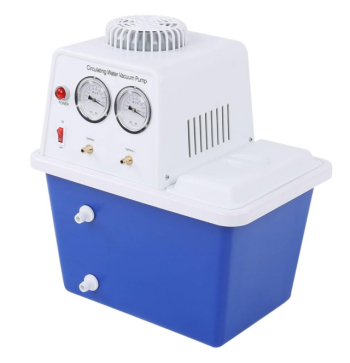
Circulating Water Vacuum Pump for Laboratory and Industrial Use

Circulating Water Vacuum Pump for Laboratory and Industrial Use

Efficient circulating water vacuum pump for labs - oil-free, corrosion-resistant, quiet operation. Multiple models available. Get yours now!

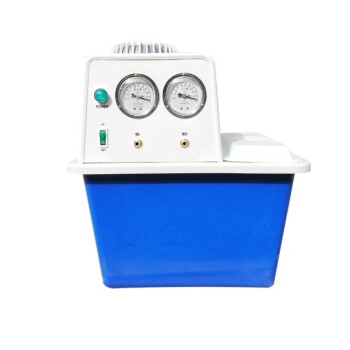
Laboratory Benchtop Water Circulating Vacuum Pump for Lab Use

Laboratory Benchtop Water Circulating Vacuum Pump for Lab Use

Need a water circulating vacuum pump for your lab or small-scale industry? Our Benchtop Water Circulating Vacuum Pump is perfect for evaporation, distillation, crystallization, and more.

Oil Free Diaphragm Vacuum Pump for Laboratory and Industrial Use

Oil Free Diaphragm Vacuum Pump for Laboratory and Industrial Use

Oil-free diaphragm vacuum pump for labs: clean, reliable, chemical-resistant. Ideal for filtration, SPE, and rotary evaporation. Maintenance-free operation.

Heated Hydraulic Press Machine with Heated Plates for Vacuum Box Laboratory Hot Press

Heated Hydraulic Press Machine with Heated Plates for Vacuum Box Laboratory Hot Press

Enhance your lab's precision with our lab press for vacuum box. Press pills and powders with ease and precision in a vacuum environment, reducing oxidation and improving consistency. Compact and easy to use with a digital pressure gauge.

Vacuum Hot Press Furnace Machine for Lamination and Heating

Vacuum Hot Press Furnace Machine for Lamination and Heating

Experience clean and precise lamination with Vacuum Lamination Press. Perfect for wafer bonding, thin-film transformations, and LCP lamination. Order now!

Electric Heated Hydraulic Vacuum Heat Press for Lab

Electric Heated Hydraulic Vacuum Heat Press for Lab

The Electric Vacuum Heat Press is a specialized heat press equipment that operates in a vacuum environment, utilizing advanced infrared heating and precise temperature control for high quality, rugged and reliable performance.

30T 40T Split Automatic Heated Hydraulic Press Machine with Heated Plates for Laboratory Hot Press

30T 40T Split Automatic Heated Hydraulic Press Machine with Heated Plates for Laboratory Hot Press

Discover our split automatic heated lab press 30T/40T for precise sample preparation in material research, pharmacy, ceramics, and electronics industries. With a small footprint and heating up to 300°C, it's perfect for processing under vacuum environment.

Vacuum Bellows for Efficient Connection and Stable Vacuum in High-Performance Systems

Vacuum Bellows for Efficient Connection and Stable Vacuum in High-Performance Systems

Discover high-quality vacuum bellows for stable vacuum in high-performance systems. Made from 304 and 316 stainless steel, these bellows ensure efficient connections and excellent sealing. Ideal for

Vacuum Cold Mounting Machine for Sample Preparation

Vacuum Cold Mounting Machine for Sample Preparation

Vacuum Cold Mounting Machine for precise sample prep. Handles porous, fragile materials with -0.08MPa vacuum. Ideal for electronics, metallurgy, and failure analysis.

Laboratory Hydraulic Press Lab Pellet Press for Button Battery

Laboratory Hydraulic Press Lab Pellet Press for Button Battery

Efficiently prepare samples with our 2T Button Battery Press. Ideal for material research labs and small-scale production. Small footprint, lightweight, and vacuum-compatible.

Stainless Steel Quick Release Vacuum Chain Three-Section Clamp

Stainless Steel Quick Release Vacuum Chain Three-Section Clamp

Discover our stainless steel quick release clamp vacuum clamp, Ideal for high vacuum applications, Strong connections, reliable sealing, Easy installation, and durable design.

Graphite Vacuum Continuous Graphitization Furnace

Graphite Vacuum Continuous Graphitization Furnace

High-temperature graphitization furnace is a professional equipment for graphitization treatment of carbon materials. It is a key equipment for the production of high-quality graphite products. It has high temperature, high efficiency and uniform heating. It is suitable for various high-temperature treatments and graphitization treatments. It is widely used in metallurgy, electronics, aerospace, etc. industry.

Vacuum Heat Treat Sintering Brazing Furnace

Vacuum Heat Treat Sintering Brazing Furnace

A vacuum brazing furnace is a type of industrial furnace used for brazing, a metalworking process that joins two pieces of metal using a filler metal that melts at a lower temperature than the base metals. Vacuum brazing furnaces are typically used for high-quality applications where a strong, clean joint is required.

304 316 Stainless Steel Vacuum Ball Valve Stop Valve for High Vacuum Systems

304 316 Stainless Steel Vacuum Ball Valve Stop Valve for High Vacuum Systems

Discover 304/316 stainless steel vacuum ball valves, Ideal for high vacuum systems, Ensure precise control and durability. Explore now!

Small Vacuum Heat Treat and Tungsten Wire Sintering Furnace

Small Vacuum Heat Treat and Tungsten Wire Sintering Furnace

The small vacuum tungsten wire sintering furnace is a compact experimental vacuum furnace specially designed for universities and scientific research institutes. The furnace features a CNC welded shell and vacuum piping to ensure leak-free operation. Quick-connect electrical connections facilitate relocation and debugging, and the standard electrical control cabinet is safe and convenient to operate.

Vacuum Cold Trap Chiller Indirect Cold Trap Chiller

Vacuum Cold Trap Chiller Indirect Cold Trap Chiller

Boost vacuum system efficiency and prolong pump life with our Indirect Cold Trap. Built-in chilling system with no need for fluid or dry ice. Compact design and easy to use.

Vacuum Heat Treat Furnace with Ceramic Fiber Liner

Vacuum Heat Treat Furnace with Ceramic Fiber Liner

Vacuum furnace with polycrystalline ceramic fiber insulation liner for excellent heat insulation and uniform temperature field. Choose from 1200℃ or 1700℃ max. working temperature with high vacuum performance and precise temperature control.

Graphite Vacuum Furnace Bottom Discharge Graphitization Furnace for Carbon Materials

Graphite Vacuum Furnace Bottom Discharge Graphitization Furnace for Carbon Materials

Bottom-out graphitization furnace for carbon materials, ultra-high temperature furnace up to 3100°C, suitable for graphitization and sintering of carbon rods and carbon blocks. Vertical design, bottom discharging, convenient feeding and discharging, high temperature uniformity, low energy consumption, good stability, hydraulic lifting system, convenient loading and unloading.

1200℃ Controlled Atmosphere Furnace Nitrogen Inert Atmosphere Furnace

1200℃ Controlled Atmosphere Furnace Nitrogen Inert Atmosphere Furnace

Discover our KT-12A Pro Controlled atmosphere furnace - high precision, heavy duty vacuum chamber, versatile smart touch screen controller, and excellent temperature uniformity up to 1200C. Ideal for both laboratory and industrial application.


Leave Your Message