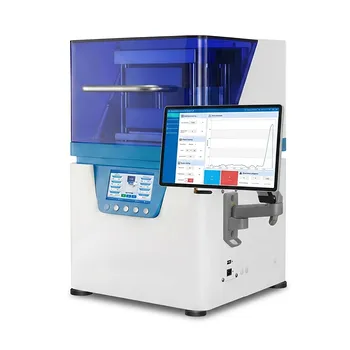
The requirement of 60 MPa for nickel-based composites serves as the critical threshold for structural viability. This specific pressure is necessary to overcome internal friction between powder particles, inducing the plastic deformation and mechanical interlocking required to form a "green compact." Without this baseline force, the sample would lack the mechanical integrity to survive handling or maintain its geometric shape during the transition to a sintering furnace.
Core Takeaway: Applying 60 MPa transforms loose powder into a cohesive solid by maximizing particle contact and providing the essential structural strength needed for post-press processing and successful high-temperature sintering.
The Mechanics of Powder Densification
Overcoming Inter-Particle Friction
At the microscopic level, nickel-based powders resist movement due to surface friction and irregular particle shapes. 60 MPa of vertical pressure provides the energy required to overcome these resistive forces, allowing particles to slide and rearrange into a more compact configuration.
Inducing Plastic Deformation
To create a stable sample at room temperature, particles must do more than move; they must deform. The hydraulic press forces these particles to undergo plastic deformation, where they physically lock into one another to create a self-supporting "green body."
Eliminating Macro-Porosity
Initial compaction at this pressure level begins the process of eliminating large air gaps between particles. Reducing these voids is the first step in ensuring the final composite reaches its theoretical density during the subsequent thermal treatment.
Establishing the Foundation for Sintering
Maximizing Contact Area for Atomic Diffusion
High-temperature sintering relies on the movement of atoms across particle boundaries. By applying 60 MPa, the press increases the physical contact area between nickel and composite particles, which acts as a bridge for atomic diffusion during the heating phase.
Ensuring Interface Integrity
In composite materials, the interface between the nickel matrix and secondary reinforcements is a common point of failure. Precise pressure ensures that the matrix fully encapsulates reinforcements, eliminating residual air at the interface that could lead to structural defects or weak spots.
Preventing Structural Distortion
A sample with insufficient initial density is prone to warping or cracking as it shrinks during sintering. Establishing a uniform green density at 60 MPa provides the structural foundation necessary to prevent distortions when the material is subjected to temperatures as high as 1500°C.
Understanding the Trade-offs
Balancing Pressure and Mold Wear
While higher pressures (up to 800 MPa) can further increase density, they also accelerate the wear and tear on high-precision molds. 60 MPa is often selected as an optimized balance point that provides sufficient handling strength without compromising the longevity of laboratory equipment.
The Risk of Lamination Defects
Applying excessive pressure can lead to "capping" or lamination, where the sample splits into layers due to stored elastic energy. Maintaining a controlled, specific pressure like 60 MPa helps avoid these internal stresses that can cause the sample to fail immediately upon being ejected from the mold.
Diminishing Returns on Density
There is a point of diminishing returns where increasing pressure yields negligible gains in initial density. For many nickel-based mixtures, 60 MPa achieves the preliminary densification required to move to the next stage, where heat—rather than force—becomes the primary driver of density.
How to Apply This to Your Project
Selecting the Right Pressure Strategy
- If your primary focus is handling and transport: Ensure a minimum of 60 MPa to provide the mechanical interlocking required to move the green compact without breakage.
- If your primary focus is maximizing final hardness: Consider higher pressures (300-500 MPa) to maximize particle contact area and facilitate faster atomic diffusion during sintering.
- If your primary focus is preventing structural cracks: Maintain a moderate, consistent pressure and focus on the uniformity of the powder fill within the mold to avoid internal stress gradients.
Achieving the correct compaction pressure is the fundamental first step in transforming raw powders into high-performance engineering materials.
Summary Table:
| Phase | Physical Mechanism | Resulting Benefit |
|---|---|---|
| Compaction | Overcoming inter-particle friction | High-density particle rearrangement |
| Interlocking | Inducing plastic deformation | Stable "green compact" for handling |
| Densification | Eliminating macro-porosity | Prevents warping/cracking during sintering |
| Sintering Prep | Maximizing atomic contact area | Facilitates faster diffusion & bonding |
| Optimization | Balancing pressure & mold wear | Extends equipment life & avoids lamination |
Elevate Your Material Research with KINTEK Precision
Achieving the perfect green compact requires more than just pressure—it requires precision and consistency. At KINTEK, we specialize in high-performance laboratory hydraulic presses (pellet, hot, and isostatic) engineered to deliver the exact force needed for your nickel-based composites and advanced powder metallurgy.
Our expertise extends across your entire research workflow. We provide a comprehensive range of equipment, including:
- Sintering Solutions: High-temperature muffle, vacuum, and atmosphere furnaces to finalize your composite's density.
- Sample Preparation: Precision crushing, milling, and sieving systems for superior powder quality.
- Essential Consumables: High-durability dies, ceramics, and crucibles tailored for high-pressure environments.
Ready to ensure the structural integrity of your samples? Contact our technical team today to discover how KINTEK’s laboratory solutions can transform your material science outcomes!
References
- Atteeq Uz Zaman, Muhammad Ramzan Abdul Karim. Development and Characterization of Boron-Nitride Reinforced Nickel Matrix Composites. DOI: 10.1051/matecconf/202338102009
This article is also based on technical information from Kintek Solution Knowledge Base .
Related Products
- Laboratory Hydraulic Press Lab Pellet Press Machine for Glove Box
- Laboratory Hydraulic Press Split Electric Lab Pellet Press
- Fully Automatic Heated Hydraulic Lab Press for Materials Sintering and Sample Preparation
- Laboratory Hydraulic Press Lab Pellet Press for Button Battery
- Automatic Laboratory Hydraulic Press for XRF & KBR Pellet Press
People Also Ask
- What is the function of a laboratory hydraulic press in W-Cu composites? Control Porosity and Material Ratio
- What is the role of a laboratory hydraulic press in the initial stages of Li6PS5Cl preparation? Key to Green Pellets
- What role does a laboratory hydraulic press play in triboelectric testing? Achieve Precision Alloy Sample Prep
- How can a laboratory hydraulic press be applied to chitosan for wastewater treatment? Optimize Pores & Strength
- How do a precision laboratory hydraulic press and specialized molds contribute to the fabrication of spherical ceramic samples? Achieving High-Density Material Precision