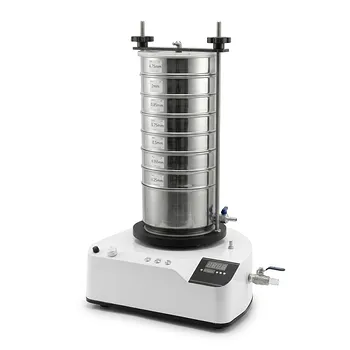
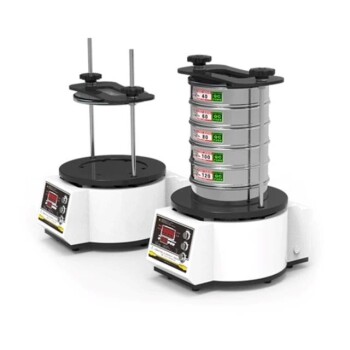
A standard mesh sieving system is fundamental to the polyester methanolysis process because it strictly controls the physical dimensions of the PET powder entering the reactor. This mechanical standardization is the only way to ensure that the chemical reaction rates remain consistent, eliminating variables that could otherwise render experimental data useless.
Standardization of particle size is a prerequisite for accurate chemical kinetics. By ensuring every particle reacts at the same speed, researchers can guarantee reproducible data and optimal process efficiency.
The Critical Role of Particle Uniformity
Eliminating Diffusion Limitations
In solid-liquid reactions like methanolysis, the reaction rate is often governed by how quickly the liquid (methanol) can penetrate the solid (PET).
If particles vary in size, the rate at which methanol diffuses into the material changes drastically. A standard sieving system removes these discrepancies, ensuring that diffusion limitations are constant across the entire sample batch.
Achieving Synchronized Degradation
When a reaction begins, the goal is for the entire batch of material to degrade simultaneously.
Sieving guarantees that all particles possess similar surface-to-volume ratios. This ensures that every particle achieves synchronized degradation progress under the same temperature and pressure parameters.
Ensuring Scientific Rigor
The Foundation of Repeatability
Scientific experiments rely on the ability to produce the same result under the same conditions.
Without a sieving system, random variations in particle distribution would introduce noise into the data. Sieving provides a consistent baseline, allowing researchers to ensure the repeatability of experimental data across multiple trials.
Common Pitfalls of Irregular Particle Sizes
The Risk of Over-Reaction
Without sieving, a batch will contain "fines" (extremely small particles) mixed with larger chunks.
These small particles react almost instantly. If the process runs long enough to break down larger particles, these fines may undergo over-reaction, potentially leading to unwanted byproducts or degradation of the monomer.
The Problem of Insufficient Processing
Conversely, overly large particles introduce the risk of incomplete reactions.
If the reaction time is set for the average particle size, the largest particles in an unsieved batch will suffer from insufficient processing. This results in unreacted material remaining in the system, reducing overall yield and efficiency.
Optimizing Your Experimental Design
To ensure your polyester methanolysis reactions yield reliable and high-quality results, consider the following approach to material preparation:
- If your primary focus is Kinetics Data: Use a tight mesh range to ensure strict uniformity, allowing you to isolate chemical reaction rates from physical diffusion issues.
- If your primary focus is Process Efficiency: Prioritize removing the largest particles to prevent unreacted waste and ensuring fines are minimized to avoid side reactions.
Precision in the physical preparation of raw materials is the invisible factor that determines the chemical success of the reaction.
Summary Table:
| Factor | Impact of Standardized Sieving | Consequence of Irregular Sizes |
|---|---|---|
| Diffusion Rate | Uniform liquid penetration | Varied and unpredictable reaction speeds |
| Degradation | Synchronized material breakdown | Mix of over-reaction and unreacted solids |
| Data Integrity | High repeatability and low noise | Unreliable, inconsistent experimental results |
| Product Quality | Pure monomer yield | Formation of unwanted byproducts |
| Efficiency | Optimized process timelines | Reduced yield due to insufficient processing |
Elevate Your Material Research with KINTEK Precision
Consistency in particle size is the foundation of scientific rigor. At KINTEK, we understand that high-quality chemical reactions begin with superior physical preparation. Our comprehensive range of sieving equipment and crushing systems ensures your raw materials meet the exact specifications required for polyester methanolysis and advanced chemical kinetics.
Beyond material preparation, KINTEK specializes in providing the end-to-end tools your lab needs, from high-temperature high-pressure reactors and autoclaves to PTFE products, ceramics, and crucibles. Whether you are optimizing process efficiency or isolating kinetic data, our experts are ready to equip your facility with durable, high-performance laboratory solutions.
Ready to eliminate variables and achieve reproducible results? Contact KINTEK today to discuss your equipment needs
References
- Emma McCrea, Małgorzata Swadźba‐Kwaśny. Methanolysis of polyethylene terephthalate (PET) using non-stoichiometric protic ionic liquids. DOI: 10.1039/d5su00316d
This article is also based on technical information from Kintek Solution Knowledge Base .
Related Products
- Custom PTFE Teflon Parts Manufacturer for PTFE Mesh F4 Sieve
- Mesh belt controlled atmosphere furnace
- Three-dimensional electromagnetic sieving instrument
- Laboratory Test Sieves and Sieving Machines
- Laboratory Vibratory Sieve Shaker Machine for Dry and Wet Three-Dimensional Sieving
People Also Ask
- What are the primary reasons for selecting PTFE as a matrix? Enhance Composites with Carbon Nanotube Reinforcement
- How is PTFE utilized for insulation in Alloy 22 corrosion setups? Ensure Signal Purity & Accuracy
- Is PTFE corrosion resistant? Discover the Ultimate Chemical Resistance for Your Lab
- What are the specific applications of PTFE in micro-batch slug flow systems? Enhance Your Microfluidic Reaction Purity
- What is the mesh size of a sieve? A Guide to Particle Size and Sieve Selection