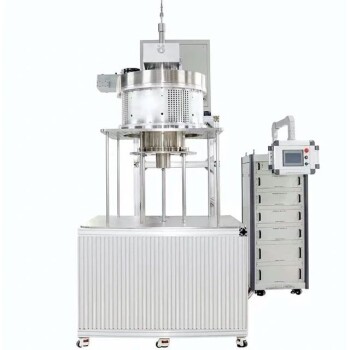
In high-power density plasma Chemical Vapor Deposition (CVD), the substrate stage cooling system acts as the critical regulator between energy input and material synthesis. Because high-power microwave plasma generates massive thermal loads—often reaching 6 kW—an advanced cooling system is required to actively dissipate excess heat. Its primary function is to lock the substrate temperature within the precise processing window of 740 to 890 °C, preventing uncontrolled overheating.
High-power plasma enables rapid growth but creates a thermal environment that is naturally destructive to the substrate. The cooling system provides the necessary thermal management to stabilize growth kinetics, ensuring that the high energy input results in film deposition rather than material degradation.
Managing Extreme Thermal Loads
The Challenge of High Energy Input
High-power microwave plasma systems are designed to deliver intense energy to the reaction chamber. This process generates significant waste heat, creating thermal loads that can reach 6 kW.
The Role of Active Cooling
Passive heat dissipation is insufficient to handle this magnitude of energy. Without an active, advanced cooling system in the substrate stage, the temperature would rise continuously. The cooling stage acts as a heat sink, rapidly removing energy to maintain thermal equilibrium.
Preserving Material Quality
Defining the Growth Window
For high-quality deposition, such as diamond growth, the chemical reactions are highly temperature-sensitive. The substrate must be maintained strictly between 740 and 890 °C.
Stabilizing Reaction Kinetics
If the temperature drifts outside this range, the fundamental growth kinetics change. The cooling system ensures these temperatures remain constant, allowing for predictable and uniform film formation.
The Risks of Inadequate Thermal Control
Preventing Film Degradation
Overheating is the primary enemy of film quality. If the cooling system fails to manage the 6 kW load, the film quality degrades rapidly, leading to defects or the formation of unwanted material phases.
Avoiding Mechanical Failure
Thermal stress is a physical consequence of poor temperature management. Inadequate cooling can lead to significant thermal gradients, causing the substrate or the film to crack under stress.
Optimizing Your Thermal Management Strategy
To ensure high-quality CVD results, align your cooling capabilities with your specific process goals:
- If your primary focus is maximizing growth rate: Ensure your cooling system has the capacity to dissipate peak thermal loads (up to 6 kW) to allow for higher power plasma operation without overheating.
- If your primary focus is crystal quality: Prioritize a system with tight feedback loops to maintain the substrate strictly within the 740–890 °C range to ensure stable kinetics.
Effective thermal management transforms the destructive power of high-energy plasma into a precise environment for superior material growth.
Summary Table:
| Feature | Requirement/Impact |
|---|---|
| Power Load Handling | Up to 6 kW of thermal energy dissipation |
| Optimal Growth Window | Precise control between 740 °C and 890 °C |
| Core Function | Active heat sinking to stabilize reaction kinetics |
| Failure Risk | Film degradation, defects, and substrate cracking |
| Growth Benefit | Enables high-speed deposition without thermal stress |
Maximize Your Material Synthesis with Precision Thermal Control
High-power density plasma CVD requires more than just energy; it demands an expert thermal management strategy to protect your research and production. KINTEK specializes in advanced laboratory equipment, including high-performance CVD and PECVD systems, ensuring your substrate stage cooling is robust enough to handle loads up to 6 kW while maintaining strict temperature windows.
From high-temperature furnaces and vacuum reactors to crushing and milling systems and isostatic presses, KINTEK provides the comprehensive tools needed for superior material growth. Don't let uncontrolled thermal stress compromise your film quality—leverage our expertise to optimize your deposition processes.
Ready to elevate your lab's performance? Contact KINTEK today to discuss our customized cooling solutions and laboratory equipment tailored to your specific research goals.
References
- Oleg Babčenko, Alexander Kromka. GROWTH AND PROPERTIES OF DIAMOND FILMS PREPARED ON 4-INCH SUBSTRATES BY CAVITY PLASMA SYSTEMs. DOI: 10.37904/nanocon.2020.3701
This article is also based on technical information from Kintek Solution Knowledge Base .
Related Products
- Chemical Vapor Deposition CVD Equipment System Chamber Slide PECVD Tube Furnace with Liquid Gasifier PECVD Machine
- Multi Heating Zones CVD Tube Furnace Machine Chemical Vapor Deposition Chamber System Equipment
- Customer Made Versatile CVD Tube Furnace Chemical Vapor Deposition Chamber System Equipment
- Split Chamber CVD Tube Furnace with Vacuum Station Chemical Vapor Deposition System Equipment Machine
- HFCVD Machine System Equipment for Drawing Die Nano-Diamond Coating
People Also Ask
- What are the advantages of chemical vapor deposition? Achieve Superior Thin Films for Your Lab
- What types of substrates are used in CVD to facilitate graphene films? Optimize Graphene Growth with the Right Catalyst
- What is the chemical vapor deposition growth process? Build Superior Thin Films from the Atom Up
- How expensive is chemical vapor deposition? Understanding the True Cost of High-Performance Coating
- Why is Chemical Vapor Deposition (CVD) equipment uniquely suited for constructing hierarchical superhydrophobic structures?