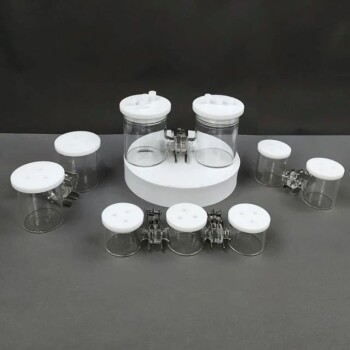
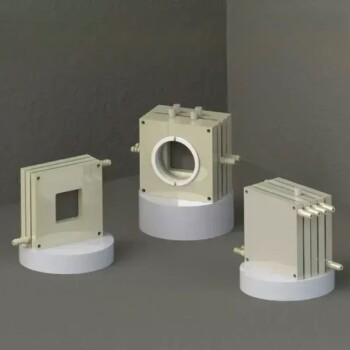
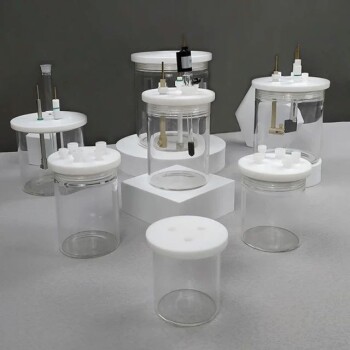
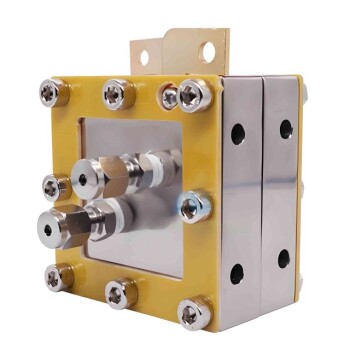
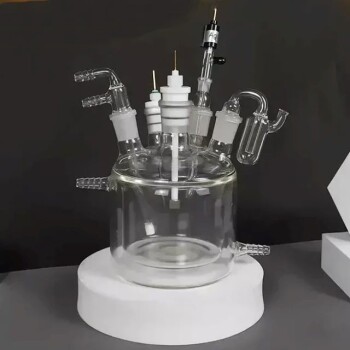
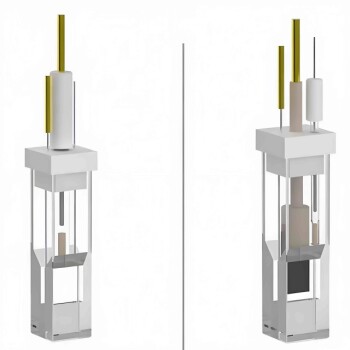
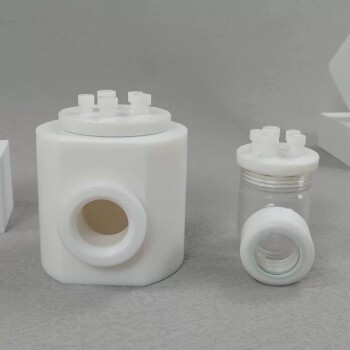
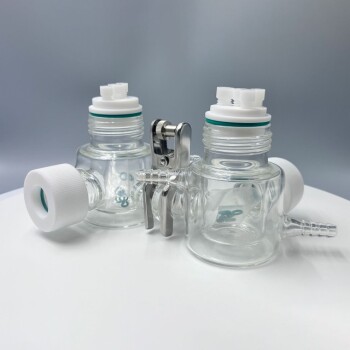
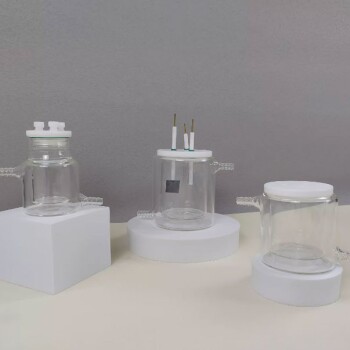
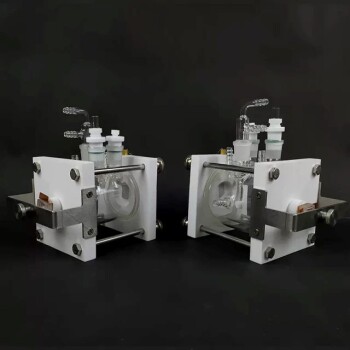
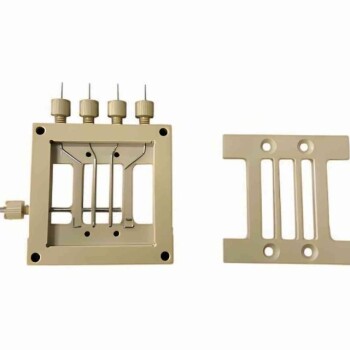
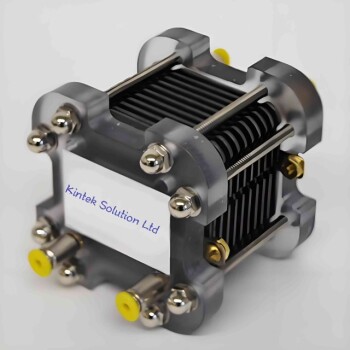
A three-electrode electrolytic cell system is utilized primarily to isolate the performance of the working electrode from external electrical interference. By physically separating the reference, working, and counter electrodes, this configuration ensures that the measured potential reflects only the specific catalytic processes occurring at the working electrode surface, rather than artifacts caused by the counter electrode.
The three-electrode setup decouples current flow from voltage measurement, preventing counter electrode polarization from skewing the data and ensuring the recorded overpotential represents the material's intrinsic catalytic activity.
Achieving True Potential Measurement
Eliminating Polarization Errors
In simpler two-electrode systems, the electrode that completes the circuit is also used to measure voltage. As current flows, that second electrode creates its own voltage drop (polarization), which contaminates the measurement.
Decoupling the Reference
The three-electrode system solves this by introducing a reference electrode that carries zero current. This physical isolation allows you to monitor the potential at the research interface independently, without the influence of the counter electrode's changing conditions.
Measuring Intrinsic Performance
The ultimate goal is to understand how your specific catalyst behaves. By isolating the working electrode, you ensure that the current density and overpotential data captured are accurate representations of the catalyst's intrinsic properties, not system noise.
The Mechanics of the Setup
The Working Electrode
This is the component hosting the material you are testing (the catalyst). In this configuration, all voltage measurements are taken relative to its surface to capture the hydrogen evolution reaction (HER) dynamics.
The Counter Electrode
The counter electrode (often Platinum) completes the electrical circuit. While it is essential for allowing current to flow, the three-electrode setup renders its potential changes irrelevant to your voltage measurement.
The Reference Electrode
Components like saturated silver/silver chloride act as the stable yardstick. Because they are isolated from the current path, they provide a constant potential baseline against which the working electrode is measured.
The Role of the Acidic Environment
Reducing Background Noise
Conducting tests in a standard acidic electrolyte, such as 0.5 M H2SO4, is critical for data clarity. The primary reference notes that this stable environment significantly reduces background noise during electrochemical testing.
Standardizing Baselines
Using a standardized acidic medium ensures that the proton supply is consistent. This consistency allows researchers to attribute changes in performance directly to the catalyst's surface chemistry rather than fluctuations in the electrolyte.
Understanding the Trade-offs
Complexity of Alignment
While accurate, this system requires precise physical positioning. If the reference electrode is placed too far from the working electrode, you may introduce uncompensated resistance (iR drop) into your data.
Reference Electrode Stability
The accuracy of the entire system hinges on the stability of the reference electrode. If the reference electrode drifts or becomes contaminated by the acidic electrolyte, the "intrinsic" data you collect will be fundamentally flawed.
Making the Right Choice for Your Goal
To get the most out of a three-electrode system for HER testing, align your setup with your specific research objectives:
- If your primary focus is precise kinetic analysis: Ensure the reference electrode is positioned as close to the working electrode as possible (using a Luggin capillary) to minimize resistance errors.
- If your primary focus is material characterization: Use a standard, high-purity acidic electrolyte to ensure that any recorded overpotential is solely a result of the catalyst's surface structure and not solution impurities.
The three-electrode system is the industry standard because it transforms a chaotic electrical environment into a controlled, isolate-able experiment.
Summary Table:
| Component | Primary Function | Key Benefit in HER Testing |
|---|---|---|
| Working Electrode | Hosts the catalyst material | Captures intrinsic catalytic dynamics & overpotential |
| Counter Electrode | Completes the electrical circuit | Prevents polarization interference with measurements |
| Reference Electrode | Provides stable potential baseline | Decouples current flow from voltage measurement |
| Acidic Electrolyte | Conductive medium (e.g., H2SO4) | Standardizes proton supply and reduces background noise |
Elevate Your Electrochemical Research with KINTEK
Precision in Hydrogen Evolution Reaction (HER) testing starts with high-quality equipment. KINTEK specializes in advanced laboratory solutions, providing researchers with high-performance electrolytic cells and electrodes designed to minimize iR drop and maximize data accuracy.
Whether you are performing precise kinetic analysis or material characterization, our comprehensive portfolio—including high-temperature furnaces, high-pressure reactors, and specialized battery research tools—is engineered to meet the rigorous demands of modern electrochemistry.
Ready to optimize your lab's performance? Contact us today to discover how our expert-grade consumables and systems can deliver the intrinsic data accuracy your research deserves.
References
- Jie Chen, Junying Zhang. Synergetic effect of phosphorus-dopant and graphene-covering layer on hydrogen evolution activity and durability of NiCo2S4 electrocatalysts. DOI: 10.1007/s40843-023-2546-3
This article is also based on technical information from Kintek Solution Knowledge Base .
Related Products
- H Type Electrolytic Cell Triple Electrochemical Cell
- Electrolytic Electrochemical Cell Gas Diffusion Liquid Flow Reaction Cell
- Electrolytic Electrochemical Cell with Five-Port
- PTFE Electrolytic Cell Electrochemical Cell Corrosion-Resistant Sealed and Non-Sealed
- Customizable PEM Electrolysis Cells for Diverse Research Applications
People Also Ask
- What is a H type cell? A Guide to Divided Electrochemical Cells for Accurate Experiments
- How should the electrolyte be prepared and added to the H-type electrolytic cell? Best Practices for Purity and Safety
- What is the technical necessity of using an H-type electrolytic cell for NO3RR tests? Protect Your Ammonia Yields
- How does the design of an H-type electrolytic cell benefit the neutral water electrolysis process for metal recovery?
- What is the primary function of an H-type electrolytic cell in NitRR? Ensure Accurate Product Yields