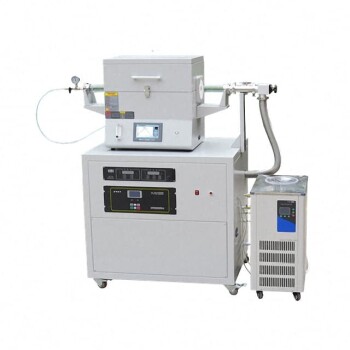
The necessity of using a tube furnace or atmosphere furnace lies in its ability to provide a continuous, stable oxygen flow throughout the heating process. This specific atmosphere control is critical for facilitating the oxidative decomposition of organic precursors in the LLZTO coating while simultaneously preventing the chemical reduction of the NCM523 cathode particles.
Core Takeaway Success in coating NCM523 with LLZTO relies on precise chemical management at high temperatures. The furnace does not just provide heat; it acts as a chemical reactor that supplies the oxygen necessary to remove organic impurities and preserve the correct stoichiometric ratio of the final oxide coating.
The Critical Role of Oxygen Control
Facilitating Precursor Decomposition
The LLZTO coating begins as a precursor mixture containing metal alkoxides and organic ligands. These organic components must be completely removed to form a pure ceramic coating.
A standard static air environment is often insufficient for this task. The furnace must provide a reactive atmosphere—specifically a continuous flow of oxygen—to drive the oxidative decomposition of these organic materials.
Preventing Cathode Reduction
High-nickel cathodes like NCM523 are sensitive to high temperatures and prone to reduction reactions. This means they can lose oxygen from their crystal lattice during heating, damaging their electrochemical performance.
By maintaining a stable, oxygen-rich environment, the furnace suppresses these reduction reactions. The external oxygen pressure effectively stabilizes the cathode material during the annealing phase.
Ensuring Material Quality and Stability
Achieving Accurate Stoichiometry
The ultimate goal of the heat treatment is to create a final oxide coating with a precise stoichiometric ratio.
Variations in the atmosphere can lead to incomplete oxidation or phase separation. A controlled atmosphere furnace ensures that every particle is exposed to consistent conditions, guaranteeing the chemical composition of the coating matches the intended design.
Uniformity Across the Batch
Unlike static heating methods, atmosphere furnaces—particularly tube furnaces—allow gas to flow over the sample bed.
This ensures that the reaction byproducts (such as carbon dioxide from the decomposed ligands) are flushed away and replaced with fresh oxygen. This prevents local "dead zones" where coating quality might degrade.
Understanding the Trade-offs
Complexity and Automation
While necessary for quality, using controlled atmosphere furnaces introduces operational complexity. As noted in general heat treatment principles, these systems often require high degrees of mechanization and automation.
Operational Precision
A single cycle may involve dozens of coordinated actions to manage gas flow, pressure, and temperature profiles.
This increases the equipment cost and the skill level required for operation compared to simple muffle furnaces. However, this complexity is the price paid for the chemical precision required by advanced battery materials.
Making the Right Choice for Your Goal
- If your primary focus is Electrochemical Performance: Prioritize a furnace with high-precision mass flow controllers to ensure the oxygen environment prevents NCM surface degradation.
- If your primary focus is Coating Purity: Ensure the furnace design allows for high gas turnover rates to effectively flush out the decomposition products of organic ligands.
Selecting the right furnace is not just about temperature; it is about defining the chemical environment that dictates the success of your material synthesis.
Summary Table:
| Feature | Role in LLZTO/NCM523 Heat Treatment |
|---|---|
| Oxygen Flow | Facilitates oxidative decomposition of organic precursors |
| Atmosphere Control | Prevents chemical reduction of high-nickel NCM523 cathodes |
| Gas Turnover | Flushes out CO2 and byproducts to prevent local degradation |
| Thermal Stability | Maintains precise stoichiometric ratios for ceramic coatings |
Elevate Your Battery Research with KINTEK Precision
Achieving the perfect LLZTO coating on NCM523 particles requires more than just heat; it requires a meticulously controlled chemical environment. KINTEK specializes in advanced atmosphere and tube furnaces equipped with high-precision mass flow controllers designed specifically for sensitive battery material synthesis.
From CVD and vacuum systems to specialized crushing, milling, and hydraulic presses, KINTEK provides the comprehensive toolkit needed for high-performance electrode development. Our high-temperature solutions ensure your materials maintain their electrochemical integrity and stoichiometric accuracy.
Ready to optimize your material synthesis? Contact KINTEK today to consult with our experts on the ideal furnace configuration for your laboratory!
Related Products
- 1200℃ Controlled Atmosphere Furnace Nitrogen Inert Atmosphere Furnace
- 1700℃ Controlled Atmosphere Furnace Nitrogen Inert Atmosphere Furnace
- 1400℃ Controlled Atmosphere Furnace with Nitrogen and Inert Atmosphere
- Controlled Nitrogen Inert Hydrogen Atmosphere Furnace
- Mesh belt controlled atmosphere furnace
People Also Ask
- Can you braze copper to brass without flux? Yes, but only under these specific conditions.
- What is the role of the furnace atmosphere? Master Precise Metallurgical Control for Your Heat Treatment
- What is a controlled atmosphere furnace for heat treatment? Master Surface Chemistry and Metallurgy
- What is a controlled atmosphere furnace? Achieve Purity and Precision in High-Temp Processing
- What is the function of a high-precision controlled atmosphere furnace for Alloy 617? Simulate Extreme VHTR Conditions