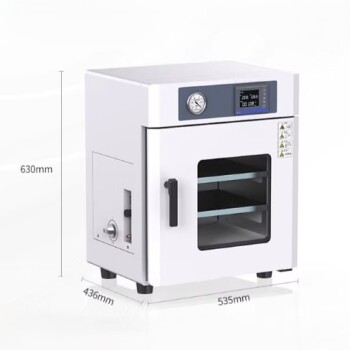
The use of a vacuum drying oven is essential in processing lithium manganese silicate (Li2MnSiO4) precursor slurries to ensure both chemical stability and process efficiency. Specifically, it allows for the rapid removal of ethanol solvents at controlled low temperatures, typically around 90°C. This method creates a protective environment that prevents oxidation and contamination, yielding a dry powder with the high uniformity required for battery applications.
By significantly lowering the solvent's boiling point, vacuum drying decouples heat from evaporation speed. This allows you to dry sensitive materials rapidly without subjecting them to the thermal stress or atmospheric exposure that degrades material performance.
The Mechanics of Efficient Solvent Removal
Accelerated Evaporation at Low Temperatures
The primary function of the vacuum oven in this context is to manipulate the physical properties of the solvent, specifically ethanol.
By reducing the pressure within the chamber, the boiling point of the ethanol is lowered significantly.
This allows the solvent to evaporate rapidly even at moderate temperatures, such as 90°C, which would be inefficient under standard atmospheric pressure.
Reducing Processing Time
Efficiency is a critical factor in precursor synthesis.
The vacuum environment increases the rate of evaporation, thereby drastically shortening the overall drying time.
This ensures that the transition from a wet slurry to a dry powder occurs quickly, preventing bottlenecks in the production line.
Preserving Chemical and Structural Integrity
Preventing Unnecessary Oxidation
Lithium manganese silicate precursors can be sensitive to environmental factors.
A vacuum oven eliminates the presence of air during the heating process.
This effectively prevents the precursor powder from undergoing oxidation, which preserves the chemical valency and activity of the manganese and other components.
Avoiding Contamination
Achieving high purity is non-negotiable for battery materials.
Because the drying occurs in a sealed, evacuated chamber, the slurry is isolated from airborne impurities and moisture.
This isolation results in a final dry powder that is free from external contaminants.
Ensuring Component Uniformity
The drying method directly impacts the physical quality of the final powder.
According to the primary technical reference, vacuum drying leads to a dry powder with "uniform components."
This uniformity is vital for ensuring consistent electrochemical performance in the final battery cell.
Understanding the Trade-offs
While vacuum drying is superior for this specific application, it requires precise control over process parameters.
Sensitivity to Temperature and Pressure
While the vacuum allows for lower temperatures, sticking to the specific target (e.g., 90°C for this material) is critical.
Deviating significantly could either fail to remove the solvent completely or, conversely, apply unnecessary thermal stress if the temperature is raised too high to compensate for poor vacuum levels.
The equipment is also generally more complex to operate and maintain than standard convection ovens, requiring strict adherence to seal integrity to prevent leaks that would reintroduce oxygen.
Making the Right Choice for Your Goal
When setting up your processing line for Li2MnSiO4, align your drying parameters with your specific quality metrics.
- If your primary focus is Chemical Purity: Prioritize the vacuum level to ensure total exclusion of oxygen, preventing oxidation of the manganese component.
- If your primary focus is Process Throughput: Optimize the temperature-to-pressure ratio (around 90°C) to maximize the solvent evaporation rate without degrading the material.
Mastering the vacuum drying stage is the key to transforming a raw precursor slurry into a high-performance, contaminant-free cathode material.
Summary Table:
| Feature | Vacuum Drying (at 90°C) | Atmospheric Drying |
|---|---|---|
| Oxidation Risk | Near Zero (Air-free environment) | High (Exposure to oxygen) |
| Solvent Removal | Rapid (Lowered boiling point) | Slow/Inefficient |
| Material Purity | High (Sealed isolation) | Moderate (Risk of airborne contaminants) |
| Component Uniformity | Excellent (Controlled evaporation) | Variable |
| Thermal Stress | Low (Low-temp processing) | High (Requires more heat for evaporation) |
Elevate Your Battery Research with KINTEK Precision
Precise control over your material's environment is the difference between a failed experiment and a high-performance battery cell. KINTEK specializes in advanced laboratory solutions designed for the rigorous demands of material science. From our high-performance vacuum drying ovens and high-temperature furnaces to our precision crushing and milling systems and battery research consumables, we provide the tools necessary to maintain the chemical integrity of sensitive precursors like lithium manganese silicate.
Don't let oxidation or contamination compromise your results. Our team is ready to help you select the ideal drying, heating, or processing equipment tailored to your specific application.
Ready to optimize your lab's efficiency? Contact KINTEK today for a consultation!
Related Products
- 56L Vertical Laboratory Vacuum Drying Oven
- 23L Laboratory Vacuum Drying Oven
- Laboratory Scientific Electric Heating Blast Drying Oven
- Benchtop Laboratory Vacuum Freeze Dryer
- Dental Porcelain Zirconia Sintering Ceramic Vacuum Press Furnace
People Also Ask
- Why is a laboratory vacuum drying oven recommended for rice straw residues? Protect Your Biomass Integrity
- What role does a laboratory vacuum drying oven play in the preparation of modified multi-walled carbon nanotubes?
- What is the importance of using a laboratory vacuum drying oven? Preserving Slow-Release Microcapsule Integrity
- Why is a Laboratory Vacuum Drying Oven recommended for PBAT microspheres? Protect Sensitive Polymer Integrity
- What role does a laboratory vacuum drying oven play in processing nanoparticle powder samples? Protect Sample Integrity