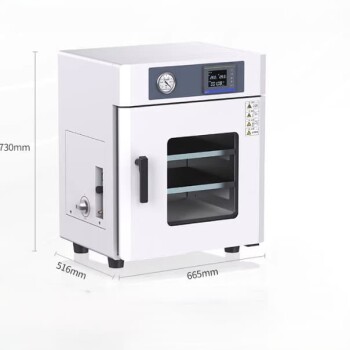
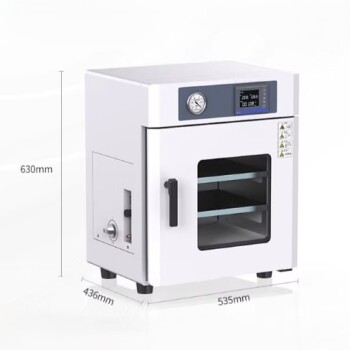
The primary purpose of using a vacuum oven below 100°C is to lower the boiling point of solvents, enabling their complete removal without subjecting the delicate polymer matrix to destructive thermal stress. This process preserves the chemical integrity of heat-sensitive polymers (like PEO) while ensuring a homogeneous distribution of ceramic fillers and eliminating performance-killing air bubbles.
Core Takeaway In solution casting, the goal is not just to dry the material, but to lock in a specific micro-structure. A vacuum environment fundamentally alters the physics of evaporation, allowing you to achieve a dense, void-free, and chemically stable membrane at temperatures (typically 50–60°C) that would otherwise be insufficient to remove solvents and moisture.
Preserving Material Integrity via Thermal Control
The most critical challenge in creating polymer-ceramic composite electrolytes is that the processing requirements often conflict with the material's thermal limits. Vacuum drying resolves this conflict.
Preventing Polymer Degradation
Many polymer matrices used in electrolytes, particularly Polyethylene Oxide (PEO), are sensitive to high temperatures. Subjecting these materials to temperatures above 100°C to force solvent evaporation can lead to thermal degradation. This breaks down the polymer chains, reducing the membrane's mechanical strength and inhibiting its ability to transport ions effectively.
Lowering Solvent Boiling Points
Organic solvents like acetonitrile or DME are commonly used in the casting solution. Under atmospheric pressure, removing these completely might require temperatures near or above their standard boiling points. By applying a vacuum, you significantly lower the vapor pressure required for boiling. This allows solvents to evaporate rapidly and thoroughly at much lower temperatures (e.g., 50°C to 60°C), bypassing the need for high heat.
Controlling Phase Separation
High heat does not just dry; it excites molecular movement. Excessive heat can cause rapid, uncontrolled phase separation between the polymer and the ceramic filler. By keeping the temperature low, the vacuum oven maintains a stable environment where the polymer and ceramic can settle into a uniform, cohesive structure as the solvent leaves.
Enhancing Structural and Electrochemical Quality
Beyond thermal protection, the physical application of negative pressure plays a distinct role in shaping the membrane's physical architecture.
Eliminating Voids and Bubbles
Trapped air and solvent pockets are the enemies of ionic conductivity. During atmospheric drying, bubbles can easily become trapped in the viscous slurry, creating voids that act as insulators against ion flow. The vacuum environment physically pulls these trapped gases out of the solution before the membrane solidifies, ensuring a dense, continuous pathway for ions.
Ensuring Uniform Filler Distribution
Ceramic fillers must be dispersed evenly to prevent "hot spots" or brittle zones. A controlled, low-temperature vacuum process prevents the turbulent evaporation associated with high-temperature boiling. This gentle removal of solvent ensures that ceramic particles remain uniformly suspended in the matrix rather than agglomerating or settling unevenly.
Removing Trace Moisture
Lithium salts and PEO are highly hygroscopic (water-absorbing). Even trace amounts of water can react with lithium salts to form harmful by-products like hydrofluoric acid (HF), which corrodes battery components. A vacuum oven is far more effective than a standard oven at desorbing moisture from the deep pores of the material, ensuring the chemical stability required for long-term cycling.
Understanding the Trade-offs
While vacuum drying is essential, it introduces specific processing variables that must be managed to avoid defects.
The Risk of Surface Skinning
If the vacuum is applied too aggressively at the start, the surface of the membrane may dry and "skin over" instantly. This creates a hard shell that traps solvent underneath, leading to internal blistering or structural weakness. The process often requires a gradual ramp-up of vacuum or temperature to ensure drying happens from the inside out.
Process Duration
Low-temperature vacuum drying is not a rapid process. References indicate that thorough drying at 60°C can take several days to ensure zero residual solvent. Attempting to rush this process by raising the temperature defeats the purpose of the vacuum and risks damaging the polymer network.
Making the Right Choice for Your Goal
The specific parameters you choose for your vacuum oven should depend on the primary failure mode you are trying to avoid in your electrolyte membrane.
- If your primary focus is High Ionic Conductivity: Prioritize longer drying times under high vacuum to ensure absolute removal of residual solvents and moisture, which block ion transport.
- If your primary focus is Mechanical Flexibility: Keep temperatures strictly at the lower end (e.g., 50°C) to prevent any cross-linking or stiffening of the polymer chains caused by thermal stress.
- If your primary focus is Chemical Stability: Ensure the vacuum cycle includes a final phase to specifically target adsorbed moisture, preventing the formation of hydrofluoric acid by-products.
Summary: You use a vacuum oven not simply to dry the membrane faster, but to dry it gently enough to preserve the delicate conductive network required for a high-performance solid-state battery.
Summary Table:
| Feature | Advantage of Vacuum Drying (<100°C) | Impact on Electrolyte Quality |
|---|---|---|
| Thermal Stress | Lowers solvent boiling point to protect polymers | Prevents chain degradation & maintains flexibility |
| Structural Integrity | Pulls trapped gases and solvent pockets out | Creates dense, void-free, high-conductivity membranes |
| Phase Stability | Prevents rapid, turbulent solvent evaporation | Ensures uniform distribution of ceramic fillers |
| Moisture Control | Effective desorption of hygroscopic moisture | Inhibits formation of corrosive HF by-products |
Elevate Your Material Research with KINTEK
Precision is paramount when processing delicate polymer-ceramic composites. KINTEK specializes in high-performance laboratory equipment designed to meet the rigorous demands of solid-state battery research. From advanced vacuum ovens that ensure void-free drying to high-temperature high-pressure reactors, ball milling systems for uniform filler dispersion, and hydraulic presses for membrane fabrication, we provide the tools you need for excellence.
Ready to optimize your drying protocols and enhance ionic conductivity? Contact KINTEK Experts Today to find the perfect equipment solution for your lab.
Related Products
- 56L Vertical Laboratory Vacuum Drying Oven
- 23L Laboratory Vacuum Drying Oven
- Vacuum Heat Treat Sintering Brazing Furnace
- 2200 ℃ Graphite Vacuum Heat Treat Furnace
- Dental Porcelain Zirconia Sintering Ceramic Vacuum Press Furnace
People Also Ask
- Why is a laboratory vacuum drying oven recommended for rice straw residues? Protect Your Biomass Integrity
- What role does a laboratory vacuum drying oven play in the preparation of modified multi-walled carbon nanotubes?
- What is the importance of using a laboratory vacuum drying oven? Preserving Slow-Release Microcapsule Integrity
- Why is a Laboratory Vacuum Drying Oven recommended for PBAT microspheres? Protect Sensitive Polymer Integrity
- What role does a laboratory vacuum drying oven play in processing nanoparticle powder samples? Protect Sample Integrity