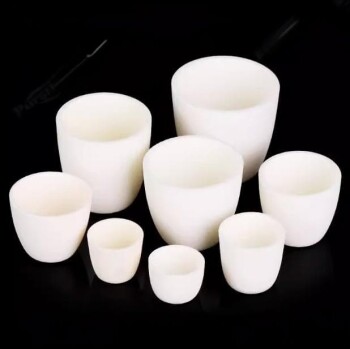
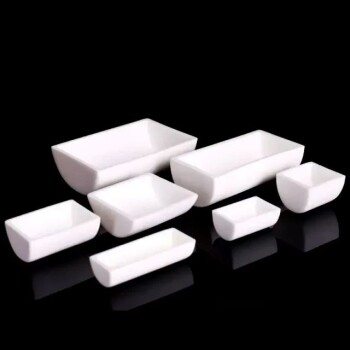
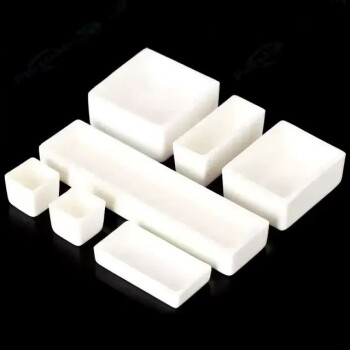
The selection of an alumina crucible is driven by the specific need for extreme chemical inertness. It serves as a necessary barrier against contamination during the high-temperature synthesis of halogenated MXenes. Specifically, it is chosen because it withstands the aggressive corrosive environment created by molten copper halides at 700°C without reacting with the precursors.
Core Insight: Success in molten salt etching requires the reaction vessel to be an "invisible" participant. Alumina is selected because it remains chemically neutral even under extreme heat and corrosion, ensuring the final material is pure MXene rather than a byproduct of vessel degradation.
The Challenge of Molten Salt Environments
Surviving High Thermal Stress
The reaction between Ti3AlC2 and copper halides requires a process temperature of 700°C.
At this temperature, many standard laboratory materials would soften, deform, or lose their structural integrity.
The alumina crucible is chosen first for its excellent high-temperature resistance, allowing it to maintain its shape and containment properties throughout the heating cycle.
Resisting Corrosive Attacks
Molten salts, particularly copper halides, create a highly corrosive environment.
During the etching process, these molten salts attack the Ti3AlC2 precursor to facilitate the reaction.
A standard reaction vessel might succumb to this chemical attack, degrading rapidly and causing a containment failure. Alumina possesses the specific chemical stability required to resist this corrosion.
Ensuring Product Purity
The Risk of Precursor Interaction
The primary goal of this reaction is to synthesize halogenated MXene.
If the crucible material were to react with the molten copper halides or the Ti3AlC2, it would introduce foreign elements into the mix.
Alumina as a Neutral Agent
Because the alumina crucible does not react with the precursors, it prevents the introduction of impurities.
This inertness is critical for ensuring the purity of the final synthesized product, allowing researchers to isolate the specific properties of the MXene without interference from the vessel material.
The Criticality of Material Selection
The Consequence of Incompatibility
While the reference highlights the success of alumina, it implies the failure of less stable alternatives.
Using a vessel with lower chemical stability would not just damage the equipment; it would chemically alter the results.
Stability is Non-Negotiable
In this specific reaction, chemical stability is not just a safety feature; it is a quality control requirement.
The choice of alumina guarantees that the chemistry occurring inside the vessel is limited strictly to the intended reactants (Ti3AlC2 and copper halides).
Making the Right Choice for Your Goal
Ensuring Synthesis Success
- If your primary focus is Chemical Purity: Ensure your vessel is chemically inert to the specific molten salts used (in this case, copper halides) to prevent contamination of the final MXene.
- If your primary focus is Thermal Integrity: Verify that the crucible material is rated well above the reaction temperature (700°C) to prevent structural failure during the process.
The integrity of your reaction vessel is just as important as the purity of your reagents.
Summary Table:
| Feature | Requirement for MXene Synthesis | Alumina Performance |
|---|---|---|
| Temperature Resistance | Stable at 700°C | Excellent (up to 1750°C) |
| Chemical Inertness | Neutral to Copper Halides | High resistance to salt corrosion |
| Contamination Control | Zero byproduct introduction | Maintains high product purity |
| Durability | Resists aggressive etching environments | Long-lasting structural integrity |
Elevate Your Materials Synthesis with KINTEK Precision
Don't let vessel degradation compromise your research results. KINTEK specializes in high-performance laboratory equipment and consumables designed for the most demanding environments. Whether you are performing high-temperature molten salt etching or complex CVD/PECVD processes, our premium alumina crucibles, ceramics, and high-temperature furnaces ensure maximum chemical inertness and thermal stability.
From high-pressure reactors to advanced crushing and milling systems, we provide the tools necessary for pure, repeatable results in battery research and materials science.
Ready to optimize your lab's performance? Contact KINTEK today to discover how our comprehensive range of high-temperature solutions and laboratory consumables can bring unparalleled precision to your next project.
Related Products
- Arc-Shaped Alumina Ceramic Crucible High Temperature Resistant for Engineering Advanced Fine Ceramics
- Alumina Al2O3 Ceramic Crucible Semicircle Boat with Lid for Engineering Advanced Fine Ceramics
- Engineering Advanced Fine Ceramics Alumina Crucibles (Al2O3) for Thermal Analysis TGA DTA
- Engineering Advanced Fine Ceramics Alumina Al2O3 Crucible With Lid Cylindrical Laboratory Crucible
- Engineering Advanced Fine Alumina Al2O3 Ceramic Crucible for Laboratory Muffle Furnace
People Also Ask
- Why Use Alumina Crucibles & Powder Burial for NaSICON? Ensure Phase Purity and Prevent Elemental Volatilization
- What is the primary purpose of using alumina crucibles for LLTO ceramics? Optimize Your High-Temperature Sintering
- Why are alumina crucibles and mother powder essential for LATP sintering? Optimize Your Solid Electrolyte Performance
- Why are high-purity alumina crucibles used for liquid lead corrosion experiments? Ensure Data Accuracy at 550°C
- Primary considerations for choosing alumina crucibles and quartz tubes in indium intercalation: Ensure Material Purity