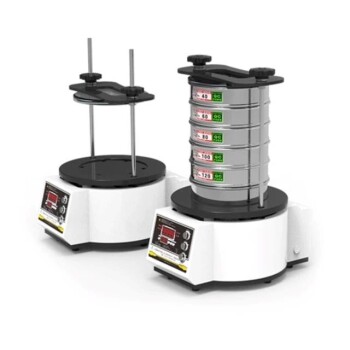
Precision sieving is the critical bridge between raw material processing and predictable chemical performance. High-precision equipment is required to classify waste tire char (typically < 80 µm) and biomass (< 200 µm) to ensure the accuracy of combustion and pyrolysis tests. By standardizing particle size, operators eliminate experimental errors caused by inconsistent heat transfer and volatile release rates, providing a stable baseline for scientific and industrial analysis.
The necessity of high-precision sieving lies in achieving particle uniformity to standardize heat and mass transfer across the material. This control is fundamental for ensuring repeatable experimental data, optimizing chemical activation, and preventing physical defects during downstream manufacturing or sintering processes.
Standardizing Thermal and Chemical Kinetics
Ensuring Uniform Heat Transfer
In processes like pyrolysis and combustion, heat must penetrate the material evenly to ensure a complete reaction. High-precision sieving ensures that every particle in a batch has a similar volume-to-surface-area ratio, preventing "cold spots" in larger chunks.
When particle sizes vary, smaller particles may overheat or combust prematurely, while larger particles remain unreacted. This discrepancy leads to inaccurate data regarding volatile matter release and overall energy yield.
Optimizing Volatile Release Rates
The rate at which gases are liberated from biomass and tire char is highly dependent on the distance those gases must travel to reach the particle surface. Precise classification ensures that the diffusion path is consistent across the entire sample.
Without this control, the kinetic data derived from the material is skewed. Uniformity is the only way to ensure that the observed reaction rates reflect the material’s chemistry rather than its physical dimensions.
Enhancing Interaction and Structure
Maximizing Specific Surface Area
Refining materials to a specific micron level significantly increases the specific surface area available for contact with chemical activators. In the production of activated carbon or biochar, this allows agents like zinc chloride to penetrate the particle matrix uniformly.
This deep penetration is essential for inducing an efficient pore structure during carbonization. High-precision sieving prevents the "shielding effect" where the outer layers of a large particle are over-processed while the core remains untouched.
Improving Material Density and Pelleting
For biomass intended for fuel pellets, sieving optimizes the filling and self-locking effects within pellet mill die holes. A specific particle size distribution (often between 250 µm and 2 mm depending on the application) allows particles to interlock more effectively.
This physical optimization results in higher pellet formation rates and increased physical density. Consistent sizing ensures that the final product is durable and has the high energy density required for transport and industrial use.
Understanding the Trade-offs
The Cost of Over-Processing
While high precision is beneficial, grinding materials to an excessively fine state requires significant energy consumption. There is a point of diminishing returns where the energy cost of further refinement outweighs the gains in reaction efficiency.
Mechanical Limitations and Maintenance
High-precision sieves, especially those with very fine meshes (under 100 µm), are prone to blinding or clogging. Maintaining these systems requires specialized equipment, such as ultrasonic cleaners or high-frequency vibration, which increases the complexity of the processing line.
Making the Right Choice for Your Goal
How to Apply This to Your Project
Achieving the right particle size distribution is a balance between technical requirements and operational costs.
- If your primary focus is Research and Combustion Analysis: You must prioritize high-precision sieving to ensure waste tire char is < 80 µm and biomass is < 200 µm to eliminate experimental error.
- If your primary focus is Chemical Activation and Adsorption: Use precision sieving to maximize specific surface area, ensuring activators can uniformly reach the particle core for optimal pore formation.
- If your primary focus is Industrial Pelleting and Densification: Focus on optimizing the particle size distribution to achieve the best self-locking effect in the die, which maximizes the physical density of the final fuel product.
- If your primary focus is Large-Scale Sintering or Kiln Processing: Use strict sieving control to prevent large-diameter particles from causing local chemical imbalances, such as lime excess or unreacted mineral aggregates.
Precise particle size control is the foundational step that transforms raw waste into a predictable, high-value industrial feedstock.
Summary Table:
| Application | Key Benefit of Precision Sieving | Critical Particle Size |
|---|---|---|
| Research & Combustion | Standardizes heat transfer; eliminates experimental error | Tire Char < 80 µm; Biomass < 200 µm |
| Chemical Activation | Maximizes specific surface area for uniform pore formation | Micron-level refinement |
| Industrial Pelleting | Optimizes self-locking effect for higher density | 250 µm to 2 mm |
| Pyrolysis / Kinetic Study | Ensures consistent volatile release rates | High-uniformity distribution |
Optimize Your Material Processing with KINTEK
Precision is the foundation of repeatable scientific results and industrial efficiency. At KINTEK, we specialize in providing the high-performance laboratory equipment required to transform raw waste into high-value feedstocks.
Whether you are conducting precise combustion analysis or scaling up chemical activation, our comprehensive portfolio has you covered:
- Sieving & Milling: High-precision sieving equipment and advanced crushing and milling systems for perfect particle distribution.
- Thermal Processing: High-temperature furnaces (muffle, tube, vacuum, CVD) and high-pressure reactors/autoclaves to test your standardized materials.
- Material Preparation: Hydraulic pellet presses, ceramics, and crucibles designed for rigorous lab environments.
Ready to eliminate experimental error and maximize your yields? Contact our experts today to find the perfect sieving and thermal solution for your biomass or tire char project!
References
- K. V. Slyusarsky, Kirill B. Larionov. Ignition and Emission Characteristics of Waste Tires Pyrolysis Char Co-Combustion with Peat and Sawdust. DOI: 10.3390/en16104038
This article is also based on technical information from Kintek Solution Knowledge Base .
Related Products
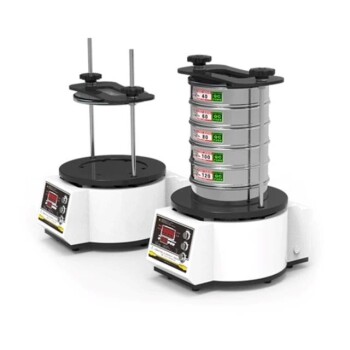
- Three-dimensional electromagnetic sieving instrument
- Laboratory Vibratory Sieve Shaker Machine for Dry and Wet Three-Dimensional Sieving
- High Precision Diamond Wire Cutting Machine Laboratory Saw Precision Wire EDM Cutting Machine
- Laboratory Test Sieves and Sieving Machines
- Laboratory Test Sieves and Vibratory Sieve Shaker Machine
People Also Ask
- Why is sieving equipment essential for the classification of processed bio-activated carbon? Optimize Performance
- What are the limitations of sieving? Understanding the Constraints of Particle Size Analysis
- What are advantages and disadvantages of sieving method? A Guide to Reliable & Cost-Effective Particle Sizing
- How is sieving important? The Critical Role of Particle Size Analysis in Quality Control
- What is sieving and how does it work? A Guide to Accurate Particle Size Analysis