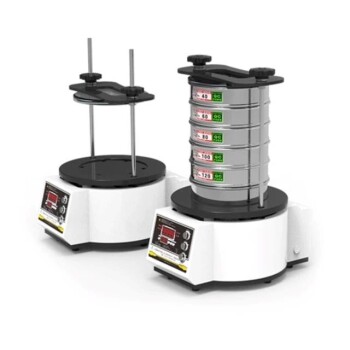
High-precision sieving is the fundamental requirement for eliminating physical variables during the thermal and chemical processing of sludge and coal. By strictly controlling particle size within narrow distribution ranges—such as 80–120 μm—this equipment ensures that heat and mass transfer rates remain constant across all samples. This level of control is essential for obtaining repeatable kinetic data and ensuring that industrial reactions, such as combustion or sintering, proceed uniformly.
Core Takeaway: Precision sieving provides a standardized physical baseline by neutralizing variations in heating rates and internal temperature gradients. This consistency is the prerequisite for accurate mathematical modeling and the prevention of structural defects in final processed materials.
Standardizing Thermal and Kinetic Data
Eliminating Heat Transfer Variables
The particle size of coal and sludge directly dictates how quickly the material reaches reaction temperatures. High-precision sieving ensures that every particle experiences the same heating rate, which eliminates internal temperature gradients that would otherwise skew experimental results.
Ensuring Repeatability in Analysis
Data obtained through thermogravimetric analysis (TGA) or microscopy relies on the assumption of physical homogeneity. By using precise ranges like 40–63 μm or 80–120 μm, researchers can produce repeatable devolatilization and combustion data that is not corrupted by size-driven inconsistencies.
Validating Mathematical Models
Reliable kinetic modeling requires a uniform input to predict how a material will behave under stress or heat. High-precision sieving allows for the verification of combustion characteristics by providing a sample that matches the idealized parameters used in computational simulations.
Optimizing Industrial Reaction Efficiency
Preventing Localized Chemical Imbalances
In high-temperature environments like kilns, oversized particles can lead to "local lime excess" or the formation of hard, unreacted aggregates. Strict sieving ensures that raw materials react completely, preventing the synthesis of unintended mineral phases and maintaining the efficiency of the kiln.
Maximizing Reactive Specific Surface Area
Finer, uniform particles significantly increase the surface area available for contact with chemical activators or oxygen. This is particularly critical in processes like carbonization or ash fusion analysis, where physical homogeneity determines the accuracy of the final composition report.
Enhancing Structural Integrity of Final Products
Research indicates that using precision-sieved, finer starting materials leads to higher strength and lower water absorption in artificial aggregates. Uniformity in the precursor powder prevents "open-pore" defects that are typically caused by the presence of oversized, inconsistent particles.
Understanding the Trade-offs
Cost vs. Precision
High-precision sieving equipment requires a higher initial investment and more frequent maintenance than standard industrial screens. The meshes are often delicate and require specific cleaning protocols to prevent "blinding" or clogging, which can slow down throughput in high-volume environments.
Throughput Limitations
Achieving a narrow particle size distribution (e.g., 45–75 μm) is a time-intensive process compared to bulk grading. While essential for quality and research, it can become a bottleneck in production if the sieving capacity is not correctly scaled to the crushing system's output.
Equipment Wear and Calibration
Standard sieves, such as 200-mesh or 300-μm variants, lose accuracy over time due to mechanical wear and wire deformation. Regular calibration against certified standards is necessary to ensure the "high-precision" label remains factually accurate throughout the equipment's lifecycle.
How to Apply This to Your Project
Making the Right Choice for Your Goal
To maximize the effectiveness of your material processing, align your sieving strategy with your specific technical objective:
- If your primary focus is Kinetic Modeling: Use high-precision sieving to isolate extremely narrow ranges (e.g., 40–63 μm) to eliminate variables in volatile release rates.
- If your primary focus is Industrial Sintering: Prioritize the removal of all oversized particles to prevent the formation of unreacted mineral aggregates and lime deficiency.
- If your primary focus is Chemical Activation: Utilize fine-mesh sieving (e.g., 300 μm) to maximize surface area, ensuring uniform penetration of activators like zinc chloride.
- If your primary focus is Material Strength: Focus on achieving a consistent, fine particle distribution to reduce water absorption and prevent structural defects in the final aggregate.
By treating particle size as a controllable physical constant rather than a variable, you ensure that your process results are driven by chemistry and physics rather than random mechanical inconsistencies.
Summary Table:
| Key Aspect | Benefit of High-Precision Sieving | Impact on Material Processing |
|---|---|---|
| Thermal Analysis | Uniform heating rates & mass transfer | Eliminates skewed kinetic data in TGA/microscopy |
| Industrial Sintering | Prevention of localized chemical imbalances | Avoids structural defects and unreacted aggregates |
| Chemical Activation | Maximized specific surface area | Ensures uniform penetration of oxygen or activators |
| Modeling & Research | Standardized physical baseline | Validates mathematical models with repeatable results |
Optimize Your Material Consistency with KINTEK Precision
Don't let particle size variables compromise your research accuracy or industrial product integrity. KINTEK specializes in providing the high-performance tools necessary for rigorous material preparation. From high-precision sieving equipment and crushing and milling systems to high-temperature furnaces (muffle, tube, vacuum) and high-pressure reactors, we offer the complete ecosystem for advanced sludge and coal processing.
Why partner with KINTEK?
- Precision-Engineered Sieves: Achieve narrow distribution ranges (e.g., 40–120 μm) for repeatable kinetic data.
- Integrated Solutions: Seamlessly transition from milling to sieving and high-temperature thermal treatment.
- Expert Support: Our team helps you select the right mesh sizes and equipment scales to maximize throughput without sacrificing accuracy.
Ensure your process results are driven by science, not mechanical inconsistency. Contact our technical experts today to find the perfect equipment for your project!
References
- Xinsha Zhang, Guangsuo Yu. Structural characterization of char during co-gasification from torrefied sludge and Yangchangwan bituminous coal. DOI: 10.1007/s40789-023-00638-w
This article is also based on technical information from Kintek Solution Knowledge Base .
Related Products
- Three-dimensional electromagnetic sieving instrument
- High Precision Diamond Wire Cutting Machine Laboratory Saw Precision Wire EDM Cutting Machine
- Laboratory Vibratory Sieve Shaker Machine for Dry and Wet Three-Dimensional Sieving
- 12 Inch 24 Inch High Precision Automatic Diamond Wire Cutting Machine Laboratory Saw Precision Wire EDM Cutting Machine
- Laboratory Test Sieves and Sieving Machines
People Also Ask
- Why is sieving equipment essential for the classification of processed bio-activated carbon? Optimize Performance
- What are the limitations of sieving? Understanding the Constraints of Particle Size Analysis
- What are advantages and disadvantages of sieving method? A Guide to Reliable & Cost-Effective Particle Sizing
- How is sieving important? The Critical Role of Particle Size Analysis in Quality Control
- What is sieving and how does it work? A Guide to Accurate Particle Size Analysis