Knowledge Why is 10 MPa pressure necessary for all-solid-state lithium coin cells? Enhance Interfacial Contact and Performance
Author avatar

Tech Team · Kintek Solution

Updated 4 days ago

Why is 10 MPa pressure necessary for all-solid-state lithium coin cells? Enhance Interfacial Contact and Performance


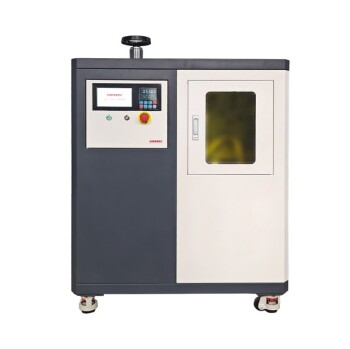
Applying high pressure is a fundamental requirement for the successful assembly of all-solid-state lithium coin cells. By exerting approximately 10 MPa using laboratory equipment like a hydraulic press, you force the solid electrolyte and electrode materials into precise physical contact, effectively eliminating the microscopic gaps that naturally exist between solid layers.

Core Takeaway In the absence of liquid electrolytes to wet surfaces, high pressure is the only mechanism available to bridge the gap between solid components. This mechanical force significantly reduces interfacial impedance, transforming loose layers into a cohesive system capable of efficient charge and discharge.

The Problem: The Solid-Solid Interface

Overcoming Physical Roughness

Unlike liquid electrolytes, which naturally flow into pores and wet electrode surfaces, solid electrolytes are rigid. Without sufficient pressure, microscopic voids remain between the electrolyte membrane and the electrodes.

Eliminating Interface Gaps

These voids act as barriers to connectivity. Applying pressure eliminates these interface gaps, achieving intimate contact at the atomic or molecular level.

Reducing Interfacial Impedance

The primary result of closing these gaps is a drastic reduction in resistance. Precise contact lowers the solid-solid interface impedance, which is a major bottleneck in solid-state battery performance.

The Mechanism: How Pressure Improves Performance

Densification of Materials

Beyond the interface, pressure is required to mold and pelletize the materials themselves. High-tonnage pressure densifies electrolyte powders (such as Li6PS5Cl-based composites) into low-porosity membranes.

Facilitating Ion Transport

Lithium ions require a continuous material pathway to move effectively. By densifying the material and bonding the layers, pressure ensures the smooth transport of lithium ions across the interfaces.

Improving Cycle and Rate Performance

The combination of low impedance and efficient ion transport directly translates to battery metrics. Better contact leads to enhanced charge/discharge capabilities, cycle stability, and rate performance.

Common Pitfalls to Avoid

Inconsistent Pressure Application

The pressure must be applied uniformly. Uneven pressure leads to localized voids, creating "hot spots" of high resistance that can degrade cell performance quickly.

Balancing Contact with Structural Integrity

While high pressure is necessary, it must be controlled. The goal is to achieve intimate contact without damaging the material structure of the battery components.

Making the Right Choice for Your Goal

To optimize your assembly process, align your pressing strategy with your specific research objectives:

  • If your primary focus is Rate Performance: Prioritize reducing interfacial impedance to the lowest possible value to facilitate rapid ion flow.
  • If your primary focus is Cycle Stability: Ensure your pressure application achieves maximum material densification to maintain structural integrity over repeated usage.

Ultimately, the application of pressure is not merely a manufacturing step; it is the critical enabler that turns separate solid components into a functioning electrochemical cell.

Summary Table:

Feature Impact of High Pressure (e.g., 10 MPa) Benefit to Battery Performance
Interface Voids Eliminates microscopic gaps between solid layers Achieves intimate atomic-level contact
Interfacial Impedance Drastically reduces resistance at solid-solid junctions Enhances charge/discharge efficiency
Material Density Densifies electrolyte powders into low-porosity membranes Prevents structural degradation during cycling
Ion Transport Creates continuous material pathways Improves rate performance and power density

Elevate Your Battery Research with KINTEK Precision

Achieving the perfect 10 MPa interface requires more than just force—it requires precision. KINTEK specializes in high-performance laboratory equipment designed specifically for advanced energy research. Our comprehensive range of manual and automatic hydraulic presses (pellet, hot, isostatic) ensures uniform pressure application to eliminate interfacial impedance and maximize the cycle stability of your all-solid-state cells.

From crushing and milling systems for material preparation to glovebox-compatible battery research tools and consumables, KINTEK provides the end-to-end solutions needed to transform raw powders into high-performance electrochemical systems.

Ready to optimize your cell assembly? Contact our technical experts today to find the ideal pressing solution for your laboratory.

Related Products

People Also Ask

Related Products

Customizable Laboratory High Temperature High Pressure Reactors for Diverse Scientific Applications

Customizable Laboratory High Temperature High Pressure Reactors for Diverse Scientific Applications

High-pressure lab reactor for precise hydrothermal synthesis. Durable SU304L/316L, PTFE liner, PID control. Customizable volume & materials. Contact us!

Stainless High Pressure Autoclave Reactor Laboratory Pressure Reactor

Stainless High Pressure Autoclave Reactor Laboratory Pressure Reactor

Discover the versatility of Stainless High Pressure Reactor - a safe and reliable solution for direct and indirect heating. Built with stainless steel, it can withstand high temperatures and pressures. Learn more now.

Mini SS High Pressure Autoclave Reactor for Laboratory Use

Mini SS High Pressure Autoclave Reactor for Laboratory Use

Mini SS High Pressure Reactor - Ideal for medicine, chemical, and scientific research industries. Programmed heating temp and stirring speed, up to 22Mpa pressure.

High Pressure Laboratory Autoclave Reactor for Hydrothermal Synthesis

High Pressure Laboratory Autoclave Reactor for Hydrothermal Synthesis

Discover the applications of Hydrothermal Synthesis Reactor - a small, corrosion-resistant reactor for chemical labs. Achieve rapid digestion of insoluble substances in a safe and reliable way. Learn more now.

Manual High Temperature Heated Hydraulic Press Machine with Heated Plates for Lab

Manual High Temperature Heated Hydraulic Press Machine with Heated Plates for Lab

The High Temperature Hot Press is a machine specifically designed for pressing, sintering and processing materials in a high temperature environment. It is capable of operating in the range of hundreds of degrees Celsius to thousands of degrees Celsius for a variety of high temperature process requirements.

Automatic High Temperature Heated Hydraulic Press Machine with Heated Plates for Lab

Automatic High Temperature Heated Hydraulic Press Machine with Heated Plates for Lab

The High Temperature Hot Press is a machine specifically designed for pressing, sintering and processing materials in a high temperature environment. It is capable of operating in the range of hundreds of degrees Celsius to thousands of degrees Celsius for a variety of high temperature process requirements.

Visual High-Pressure Reactor for In-Situ Observation

Visual High-Pressure Reactor for In-Situ Observation

The visual high-pressure reactor uses transparent sapphire or quartz glass, maintaining high strength and optical clarity under extreme conditions for real-time reaction observation.

Automatic Laboratory Heat Press Machine

Automatic Laboratory Heat Press Machine

Precision automatic heat press machines for labs—ideal for material testing, composites, and R&D. Customizable, safe, and efficient. Contact KINTEK today!

Automatic Heated Hydraulic Press Machine with Heated Plates for Laboratory Hot Press

Automatic Heated Hydraulic Press Machine with Heated Plates for Laboratory Hot Press

The Automatic High Temperature Heat Press is a sophisticated hydraulic hot press designed for efficient temperature control and product quality processing.

Heated Hydraulic Press Machine with Heated Plates Split Manual Laboratory Hot Press

Heated Hydraulic Press Machine with Heated Plates Split Manual Laboratory Hot Press

Efficiently prepare your samples with our Split Manual Heated Lab Press. With a pressure range up to 40T and heating plates up to 300°C, it's perfect for various industries.

Warm Isostatic Press WIP Workstation 300Mpa for High Pressure Applications

Warm Isostatic Press WIP Workstation 300Mpa for High Pressure Applications

Discover Warm Isostatic Pressing (WIP) - A cutting-edge technology that enables uniform pressure to shape and press powdered products at a precise temperature. Ideal for complex parts and components in manufacturing.

Automatic Heated Hydraulic Press Machine with Heated Plates for Laboratory Hot Press 25T 30T 50T

Automatic Heated Hydraulic Press Machine with Heated Plates for Laboratory Hot Press 25T 30T 50T

Efficiently prepare your samples with our Automatic Heated Lab Press. With a pressure range up to 50T and precise control, it's perfect for various industries.

Double Plate Heating Press Mold for Lab

Double Plate Heating Press Mold for Lab

Discover precision in heating with our Double Plate Heating Mold, featuring high-quality steel and uniform temperature control for efficient lab processes. Ideal for various thermal applications.

Manual Lab Heat Press

Manual Lab Heat Press

Manual hydraulic presses are mainly used in laboratories for various applications such as forging, molding, stamping, riveting and other operations. It allows the creation of complex shapes while saving material.

Anti-Cracking Press Mold for Lab Use

Anti-Cracking Press Mold for Lab Use

The anti-cracking press mold is a specialized equipment designed for molding various shapes and sizes of film using high pressure and electric heating.

Square Bidirectional Pressure Mold for Lab Use

Square Bidirectional Pressure Mold for Lab Use

Discover precision in molding with our Square Bidirectional Pressure Mold. Ideal for creating diverse shapes and sizes, from squares to hexagons, under high pressure and uniform heating. Perfect for advanced material processing.

Round Bidirectional Press Mold for Lab

Round Bidirectional Press Mold for Lab

The round bidirectional press mold is a specialized tool used in high-pressure molding processes, particularly for creating intricate shapes from metal powders.

Square Lab Press Mold for Laboratory Applications

Square Lab Press Mold for Laboratory Applications

Create uniform samples easily with Square Lab Press Mold - available in various sizes. Ideal for battery, cement, ceramics, and more. Custom sizes available.

Double Layer Five-Port Water Bath Electrolytic Electrochemical Cell

Double Layer Five-Port Water Bath Electrolytic Electrochemical Cell

Experience optimal performance with our Water Bath Electrolytic Cell. Our double-layer, five-port design boasts corrosion resistance and longevity. Customizable to fit your specific needs. View specs now.

Super Sealed Electrolytic Electrochemical Cell

Super Sealed Electrolytic Electrochemical Cell

Super-sealed electrolytic cell offers enhanced sealing capabilities, making it ideal for experiments that require high airtightness.


Leave Your Message