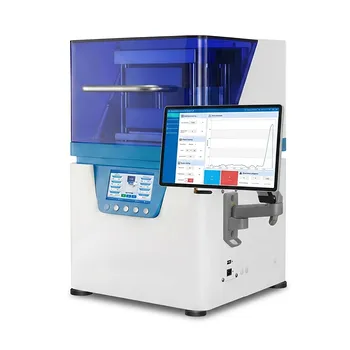
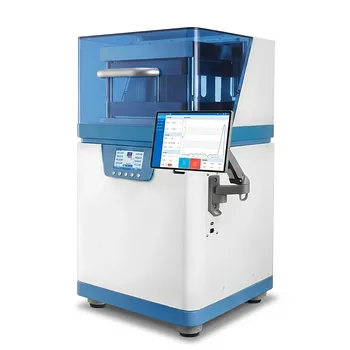
Compacting raw material powders is a foundational step in titanium-aluminum alloy preparation. This process uses a laboratory hydraulic press to establish a tight physical contact network between particles, ensuring that chemical reactions and atomic diffusion occur efficiently within set temperature and time parameters.
The core purpose of pressing powders into a dense "green mass" is to maximize particle-to-particle contact area and control porosity. This optimization accelerates reaction kinetics, provides structural integrity for handling, and ensures uniform heat and mass transfer during subsequent high-temperature processing.
Enhancing Reaction Kinetics and Diffusion
Maximizing Particle Contact Surface
The primary objective of using a hydraulic press is to transform loose powder into a cohesive unit by increasing the contact pressure between individual particles. By minimizing the distance between titanium and aluminum atoms, you significantly accelerate the atomic diffusion required for alloying.
Accelerating Chemical Reduction
In processes like magnesiothermic reduction, a dense green body facilitates the rapid penetration of molten salts and reductants. This tight network ensures the reaction proceeds thoroughly throughout the entire volume of the material rather than just on the surface.
Inducing Plastic Deformation
High pressure (often exceeding 380 MPa) causes softer metallic particles, such as aluminum, to undergo plastic deformation. These particles flatten and create mechanical interlocking, which fills internal voids and creates a stable precursor for vacuum melting or sintering.
Establishing Structural Integrity and Handling
Providing Mechanical Strength
A "green mass" must possess sufficient mechanical strength (often targeted at 10 kg/cm² or higher) to withstand handling and furnace loading. Without this compaction, the preform may fragment or crumble, leading to material loss or obstructed reaction paths.
Controlling Porosity and Capillary Action
Pressing creates a specific capillary system within the material. This controlled porosity is essential for the efficient mass transfer of reductant vapors and the removal of reaction by-products, preventing "dead zones" where reactions remain incomplete.
Eliminating Trapped Atmosphere
Uniaxial pressing effectively expels trapped air between powder particles. Removing this air increases the initial packing density and prevents unwanted oxidation or gas pockets during subsequent high-temperature vacuum treatments.
Optimizing Thermal and Electrical Properties
Improving Thermal Conduction
A dense compact establishes a solid foundation for heat conduction. Because particles are in intimate physical contact, heat moves uniformly through the billet, which is critical for consistent results during vacuum hot-press sintering or differential scanning calorimetry (DSC).
Reducing Contact Resistance
For applications involving electrical or thermal analysis, compaction reduces contact resistance. This ensures that thermal effects triggered by solid-state diffusion are measured accurately, providing a clear picture of the alloy's phase transitions.
Understanding the Trade-offs
Over-Compaction and Porosity Closure
While high density is generally beneficial, excessive pressure can lead to closed porosity. If the pores become completely sealed, reductant vapors cannot reach the center of the mass, and reaction by-products cannot escape, leading to trapped impurities.
Density Gradients and Internal Stress
Uniaxial pressing can create density gradients where the top and bottom of the cylinder are denser than the center. These variations can lead to non-uniform reaction rates or warping and cracking during the sintering phase.
How to Apply This to Your Project
Recommendations for Powder Compaction
- If your primary focus is magnesiothermic reduction: Prioritize a pressure that balances high contact area with enough open porosity to allow molten salt penetration.
- If your primary focus is vacuum arc melting: Use maximum pressure to achieve the highest possible green density (e.g., 99%+) to minimize voids and ensure a stable ingot.
- If your primary focus is structural sintering: Focus on achieving uniform mechanical interlocking of particles to prevent the green body from fragmenting during furnace transition.
- If your primary focus is thermal analysis (DSC): Apply precise, repeatable pressure to ensure consistent contact resistance across different samples for accurate data comparison.
By mastering the transition from loose powder to a dense green body, you ensure the structural and chemical success of your titanium-aluminum alloy.
Summary Table:
| Key Objective | Primary Benefit | Why It Matters for Ti-Al Alloys |
|---|---|---|
| Reaction Kinetics | Maximizes particle contact | Accelerates atomic diffusion and chemical reduction. |
| Structural Integrity | Increases mechanical strength | Prevents fragmentation during handling and furnace loading. |
| Porosity Control | Manages capillary action | Facilitates reductant penetration and byproduct removal. |
| Thermal Properties | Improves heat conduction | Ensures uniform heating and prevents warping during sintering. |
| Atmosphere Control | Expels trapped air | Minimizes oxidation and internal gas pockets. |
Elevate Your Alloy Research with KINTEK Precision
Achieving the perfect green mass is the first step toward high-performance titanium-aluminum alloys. KINTEK specializes in high-quality laboratory equipment designed to meet the rigorous demands of material science. Our range of laboratory hydraulic presses (pellet, hot, and isostatic) ensures uniform compaction and superior structural integrity for your samples.
Beyond compaction, KINTEK provides a complete ecosystem for alloy preparation, including:
- High-Temperature Furnaces: Vacuum, muffle, and sintering furnaces for precise thermal processing.
- Processing Tools: Advanced crushing, milling systems, and sieving equipment.
- Essential Consumables: High-purity ceramics, crucibles, and PTFE products.
Ready to optimize your lab's efficiency and achieve consistent, high-quality results? Contact KINTEK today to discuss your specific application and find the ideal equipment for your research goals.
References
- Jialong Kang, Xuewei Lv. A New Method for Preparing Titanium Aluminium Alloy Powder. DOI: 10.3390/met13081436
This article is also based on technical information from Kintek Solution Knowledge Base .
Related Products
- Laboratory Hydraulic Press Lab Pellet Press Machine for Glove Box
- Laboratory Hydraulic Press Split Electric Lab Pellet Press
- Fully Automatic Heated Hydraulic Lab Press for Materials Sintering and Sample Preparation
- Laboratory Hydraulic Press Lab Pellet Press for Button Battery
- Automatic Laboratory Hydraulic Press for XRF & KBR Pellet Press
People Also Ask
- What is the function of a laboratory hydraulic press in W-Cu composites? Control Porosity and Material Ratio
- What is the role of a laboratory hydraulic press in the initial stages of Li6PS5Cl preparation? Key to Green Pellets
- What role does a laboratory hydraulic press play in triboelectric testing? Achieve Precision Alloy Sample Prep
- How can a laboratory hydraulic press be applied to chitosan for wastewater treatment? Optimize Pores & Strength
- How do a precision laboratory hydraulic press and specialized molds contribute to the fabrication of spherical ceramic samples? Achieving High-Density Material Precision