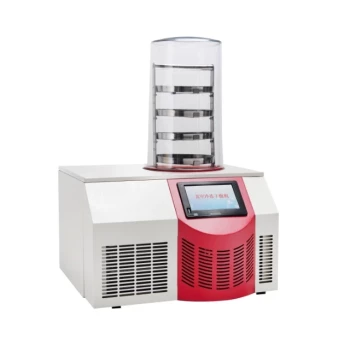
Using a vacuum drying oven is indispensable for the purification and activation of Covalent Organic Framework (COF) powders because it fundamentally alters the thermodynamic conditions of drying. By creating a low-pressure, oxygen-free environment, the oven significantly lowers the boiling points of trapped liquids, allowing for the complete removal of residual solvents and moisture without exposing the delicate framework to destructive thermal stress or oxidation.
Core Takeaway The vacuum drying process serves as a critical "activation" step that clears blocked pores to maximize surface area while protecting the material's chemical stability. Without this specific environment, trapped solvents and moisture would compromise the COF's structural integrity and its reliability in downstream applications like battery testing.
Unlocking the Porous Architecture
The primary goal of COF synthesis is to create a material with a high specific surface area. The "activation" phase is the process of emptying the pores to make that surface area accessible.
Lowering Solvent Boiling Points
During synthesis and washing, COF pores become filled with organic solvents like tetrahydrofuran (THF) or acetone. Under normal atmospheric pressure, removing these requires high heat. A vacuum environment lowers the boiling point of these liquids, causing them to evaporate rapidly at much lower, safer temperatures.
Preventing Pore Blockage
If solvents remain trapped within the lattice, they effectively "clog" the material. Vacuum drying ensures the deep evacuation of these molecules from the internal micropores. This is essential to "open" the framework, ensuring the material achieves the ideal specific surface area required for its function.
Ensuring Chemical Stability and Purity
Beyond physical activation, the vacuum environment provides a chemical safeguard that standard thermal convection ovens cannot offer.
Creating an Oxygen-Free Shield
COF materials and their precursors can be sensitive to oxidation. By removing air from the chamber, the vacuum oven prevents oxygen from reacting with the powder during the heating process. This preserves the chemical structure of the framework and prevents surface degradation.
Eliminating Trace Moisture
Adsorbed moisture is a critical contaminant, particularly if the COF is intended for use in batteries. Vacuum drying is highly efficient at stripping away moisture that is physically adsorbed onto the pore walls. Removing this water is vital to prevent proton exchange or the formation of byproducts (like sodium hydroxide in Na-ion contexts) that could ruin electrochemical performance.
Common Pitfalls to Avoid
Understanding what happens without vacuum drying highlights why it is non-negotiable for high-quality COFs.
The Risk of Thermal Degradation
Attempting to remove high-boiling solvents like dimethylformamide (DMF) or water using heat alone (without vacuum) requires temperatures that may exceed the COF's thermal stability limit. This can lead to the collapse of the crystalline structure before the pores are even empty.
The Danger of "Side Reactions"
In electrochemical applications, purity is paramount. If a COF retains solvent or moisture due to incomplete drying, these impurities will trigger side reactions during battery testing. This leads to gas generation, inaccurate data, and potential battery failure.
Making the Right Choice for Your Goal
How you approach the vacuum drying step should depend on your ultimate application for the COF material.
- If your primary focus is Battery Performance: Prioritize the complete removal of moisture to prevent side reactions and gas generation during electrochemical cycling.
- If your primary focus is Catalysis or Storage: Focus on the gentle, low-temperature removal of organic solvents to maximize the open specific surface area without collapsing the pores.
Effective vacuum drying is not just a cleaning step; it is the final measure that transforms a synthesized powder into a functional, high-performance material.
Summary Table:
| Feature | Impact of Vacuum Drying on COF Powders |
|---|---|
| Boiling Point Reduction | Allows solvent removal at lower temperatures, preventing thermal structural collapse. |
| Pore Activation | Completely clears internal micropores to maximize specific surface area. |
| Atmosphere Control | Provides an oxygen-free environment to prevent chemical oxidation and degradation. |
| Moisture Removal | Strips adsorbed water to prevent side reactions in electrochemical applications. |
| Structural Integrity | Protects the delicate crystalline framework from high-heat stress. |
Elevate Your Material Research with KINTEK Precision
High-performance COF synthesis demands uncompromising purity and structural integrity. KINTEK specializes in advanced laboratory solutions, offering a comprehensive range of vacuum drying ovens specifically designed to handle delicate powders without thermal stress or oxidation.
Whether you are focusing on battery testing, catalysis, or gas storage, our expertise extends beyond ovens to a full suite of research tools, including:
- Battery research tools and consumables for precise electrochemical testing.
- High-temperature high-pressure reactors and autoclaves for robust material synthesis.
- Crushing, milling, and sieving systems for perfect powder preparation.
- High-purity ceramics and crucibles to ensure contaminant-free processing.
Don't let residual solvents or moisture compromise your results. Contact KINTEK today to discover how our specialized laboratory equipment can optimize your purification and activation workflows.
Related Products
- 56L Vertical Laboratory Vacuum Drying Oven
- 23L Laboratory Vacuum Drying Oven
- Laboratory Scientific Electric Heating Blast Drying Oven
- Benchtop Laboratory Vacuum Freeze Dryer
- Vacuum Heat Treat Sintering Brazing Furnace
People Also Ask
- Why is a laboratory vacuum drying oven recommended for rice straw residues? Protect Your Biomass Integrity
- What role does a laboratory vacuum drying oven play in the preparation of modified multi-walled carbon nanotubes?
- What is the importance of using a laboratory vacuum drying oven? Preserving Slow-Release Microcapsule Integrity
- Why is a Laboratory Vacuum Drying Oven recommended for PBAT microspheres? Protect Sensitive Polymer Integrity
- What role does a laboratory vacuum drying oven play in processing nanoparticle powder samples? Protect Sample Integrity