Platinum (Pt) is universally selected as the counter electrode for High-Entropy Alloy (HEA) corrosion experiments primarily due to its exceptional chemical inertness and superior electrical conductivity. It serves a critical function: providing a stable means of balancing charge transfer within the electrochemical cell without dissolving, reacting, or introducing noise that would distort the data collected from the alloy.
The Core Insight: The counter electrode must be "invisible" to the measurement. Platinum is chosen because it facilitates the necessary current flow to drive the experiment while ensuring that the resulting impedance and polarization data reflect only the behavior of the High-Entropy Alloy, free from artifacts caused by electrode degradation.
The Principles of Signal Isolation
Chemical Inertness in Aggressive Environments
The primary requirement for a counter electrode is stability. In typical corrosive environments, such as Sodium Chloride (NaCl) solutions, many metals would oxidize or dissolve.
Platinum resists these reactions. It does not dissolve or participate in complex electrochemical interactions with the electrolyte.
This ensures that the solution chemistry remains constant throughout the experiment, preventing contamination that could alter the corrosion behavior of the HEA.
Unimpeded Electrical Conductivity
Platinum is an excellent conductor. This allows for efficient charge transfer between the counter electrode and the electrolyte.
High conductivity minimizes voltage drops across the counter electrode. This is essential for maintaining a precise control loop in a three-electrode system.
It ensures that the potential applied is directed effectively toward the working electrode (the HEA), rather than being lost to resistance within the setup components.
Ensuring Data Accuracy
Preserving Impedance Data Integrity
In HEA research, scientists often analyze the passive film—the protective oxide layer that forms on the alloy's surface. This is done using Electrochemical Impedance Spectroscopy (EIS).
If the counter electrode reacts or creates its own "double layer" capacitance due to instability, it generates interfering signals.
Platinum provides a stable baseline. This guarantees that the impedance spectra captured are strictly characteristic of the alloy’s surface passivation properties, not the counter electrode.
Minimizing Polarization Effects
To maintain accuracy, the counter electrode must not become the "bottleneck" of the system.
While the material properties of Platinum are vital, its physical configuration—typically a large-area foil or wire—is equally important.
A large surface area reduces the current density on the Platinum itself. This minimizes polarization effects on the counter electrode, ensuring the applied current passes steadily through the system to accurately test the HEA.
Understanding the Trade-offs
While Platinum is the gold standard for accuracy, there are operational considerations to keep in mind.
Cost vs. Surface Area Ratios
Platinum is expensive. This often leads researchers to use smaller wires to save costs.
However, if the surface area of the Platinum counter electrode is smaller than that of the HEA working electrode, the counter electrode can become polarized. This limits the current flow and can artificially "cap" the measured corrosion rate of the alloy, leading to false negatives regarding corrosion susceptibility.
Electrolyte Compatibility
While Platinum is inert in NaCl and most acids, it is not impervious to everything.
In specific exotic electrolytes (such as those containing high concentrations of cyanide or aqua regia), even Platinum can degrade. Always verify the Pourbaix diagram for Platinum against your specific testing solution.
Making the Right Choice for Your Goal
When designing your HEA corrosion experiment, apply these principles to ensure validity:
- If your primary focus is Passive Film Analysis (EIS): Use a high-purity Platinum mesh or foil to ensure zero background noise interferes with delicate impedance readings.
- If your primary focus is High-Rate Corrosion Testing: Ensure the Platinum electrode surface area is significantly larger (ideally 10x) than your HEA sample to prevent current throttling.
By utilizing Platinum correctly, you transform the counter electrode from a potential variable into a reliable constant.
Summary Table:
| Feature | Benefit for HEA Research | Impact on Data Accuracy |
|---|---|---|
| Chemical Inertness | Resists oxidation and dissolution in aggressive NaCl or acidic media. | Prevents electrolyte contamination and artifact signals. |
| High Conductivity | Facilitates efficient charge transfer with minimal voltage drop. | Ensures precise potential control over the HEA working electrode. |
| Stable Baseline | Minimizes its own double-layer capacitance interference. | Guarantees EIS spectra reflect only the alloy's passive film properties. |
| Large Surface Area | Reduces current density on the counter electrode itself. | Prevents current throttling and polarization bottlenecks. |
Elevate Your Electrochemical Research with KINTEK
Precision in High-Entropy Alloy (HEA) characterization starts with reliable components. KINTEK specializes in providing high-purity laboratory equipment and consumables designed for the most demanding research environments.
Whether you need high-purity platinum electrodes (mesh, foil, or wire) for signal isolation, electrolytic cells, or specialized corrosion testing systems, our team delivers the tools necessary to transform variables into constants. Beyond electrodes, explore our comprehensive range of high-temperature furnaces, crushing systems, and hydraulic presses tailored for material science professionals.
Ready to optimize your lab setup? Contact us today to discuss how our high-performance solutions can enhance your research accuracy and efficiency.
References
- Santiago Brito-García, Ionelia Voiculescu. EIS Study of Doped High-Entropy Alloy. DOI: 10.3390/met13050883
This article is also based on technical information from Kintek Solution Knowledge Base .
Related Products
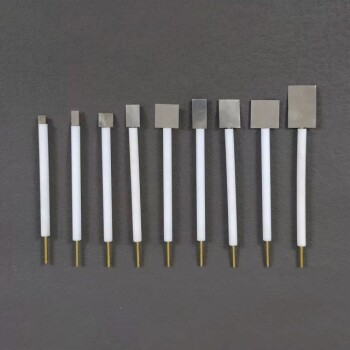
- Platinum Sheet Electrode for Laboratory and Industrial Applications
- Rotating Platinum Disk Electrode for Electrochemical Applications
- Platinum Sheet Electrode for Battery Lab Applications
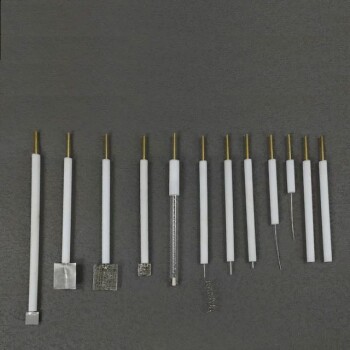
- Platinum Auxiliary Electrode for Laboratory Use
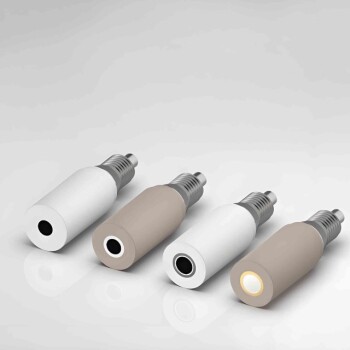
- RRDE rotating disk (ring disk) electrode / compatible with PINE, Japanese ALS, Swiss Metrohm glassy carbon platinum
People Also Ask
- What is a common use for a platinum sheet electrode? As a Reliable Counter Electrode in Electrochemical Cells
- What is the most critical guideline for immersing a platinum sheet electrode in an electrolyte? Ensure Accurate Electrochemical Measurements
- What is the purity of the platinum sheet in a platinum sheet electrode? The Key to Reliable Electrochemical Data
- What is the expected lifespan of a platinum sheet electrode? Maximize Your Electrode's Service Life
- What are the available specifications for platinum sheet electrodes? Find the Perfect Fit for Your Electrochemical Needs