Precision sieving is a technical requirement for walnut shell processing to ensure that every particle reacts uniformly during thermal experiments. By strictly controlling the particle size—typically within the 100–250 µm range—researchers eliminate physical inconsistencies that would otherwise skew data on heating rates, gas release patterns, and chemical kinetics.
The central takeaway is that precision sieving standardizes the heat and mass transfer surface area of the raw material. This transformation of heterogeneous biomass into a uniform feedstock is the only way to ensure that experimental results reflect the material's chemical properties rather than its physical size variations.
The Role of Physical Uniformity in Thermal Dynamics
Standardizing Heat and Mass Transfer
Precision sieving ensures that walnut shell particles have a consistent surface-area-to-volume ratio. This uniformity is essential for achieving even heating throughout the pyrolysis process, preventing the core of larger particles from remaining cool while the exterior overcooks.
Without this control, temperature gradients within larger particles can delay the release of volatile components. Standardized sizing eliminates these gradients, ensuring that the kinetic data obtained is highly repeatable and accurately represents the material's thermal behavior.
Optimizing Residence Time in Reactors
In an entrained flow reactor, the time a particle spends in the heated zone (residence time) is directly influenced by its mass and aerodynamic profile. If the particle size distribution is too broad, smaller particles may exit too quickly while larger ones lag behind.
By using precision equipment to isolate a narrow size range, such as 100–250 µm, researchers guarantee consistent residence times. This ensures that every particle undergoes the same degree of thermal degradation, which is critical for analyzing gas release patterns.
Enhancing Experimental Validity and Repeatability
Isolating Chemical Kinetics from Physical Variables
The primary goal of combustion and pyrolysis experiments is often to understand the chemical reaction rates of the biomass. If the raw material varies in size, the observed reaction speed becomes a function of particle geometry rather than chemical composition.
Precision sieving removes particle size as a variable, allowing researchers to isolate the internal reaction kinetics. This level of control is what makes it possible to compare results across different laboratories or different types of biomass shells.
Ensuring Stable Product Quality
For experiments aimed at producing activated carbon or biochar, particle uniformity directly dictates the pore structure of the final product. Uneven heating caused by size variance can lead to unstable adsorption performance or fragile structural integrity.
Strict sieving ensures that the thermal process is predictable, resulting in a stable activated carbon product. This reliability is vital for research that bridges the gap between laboratory-scale experiments and industrial application.
Understanding the Trade-offs and Technical Limitations
Resource Intensity and Material Waste
Achieving a high-precision particle size distribution often requires significant pre-processing time and energy. Grinding walnut shells to a specific micron range can result in a high percentage of "fines" or oversized particles that must be discarded or re-processed, reducing the overall yield of the raw material.
Limitations of Sieve Accuracy
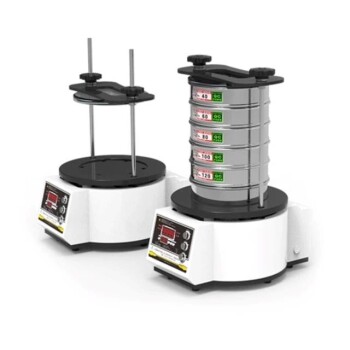
Not all sieving equipment is created equal; standard laboratory sieves can suffer from mesh blinding (clogging) or wear over time. If the mesh apertures deviate even slightly from the standard, the resulting "uniform" powder may actually contain outliers that reintroduce experimental error.
Applying Precision Sieving to Your Research Goal
How to Apply This to Your Project
To ensure the integrity of your pyrolysis or combustion data, select your sieving strategy based on the specific requirements of your reactor and analysis goals.
- If your primary focus is Kinetic Modeling: Use high-precision sieving to isolate a very narrow range (e.g., 80–120 µm) to eliminate all variables related to heat and mass transfer resistance.
- If your primary focus is Industrial Scaling: Use standard test sieves to classify materials into broader but controlled categories (e.g., 0–250 µm) to simulate the feedstocks used in large-scale biomass kilns.
- If your primary focus is Product Performance (e.g., Activated Carbon): Prioritize mesh accuracy to ensure a uniform surface area, which directly correlates to the stability of the resulting pore structure.
Strict adherence to precision sieving protocols is the foundation of credible, peer-reviewable biomass research.
Summary Table:
| Benefit of Precision Sieving | Impact on Pyrolysis & Combustion Research |
|---|---|
| Standardized Surface Area | Ensures uniform heat and mass transfer, preventing temperature gradients. |
| Consistent Particle Mass | Optimizes residence time in reactors for synchronized thermal degradation. |
| Variable Isolation | Separates internal chemical kinetics from physical geometry variables. |
| Pore Structure Control | Guarantees stable quality and adsorption performance for biochar/activated carbon. |
| Data Repeatability | Eliminates physical inconsistencies to produce peer-reviewable, reliable data. |
Precision Preparation for Superior Biomass Research
Don’t let physical inconsistencies compromise your kinetic data. KINTEK specializes in high-precision laboratory solutions designed to standardize your feedstock and optimize your thermal experiments.
From advanced sieving equipment and crushing systems to our industry-leading muffle and vacuum furnaces, we provide the comprehensive tools you need for every stage of material processing. Whether you are developing activated carbon or modeling complex combustion kinetics, KINTEK offers the reliability and accuracy required for peer-reviewable excellence.
Ready to enhance your lab’s efficiency? Contact KINTEK today to find the perfect equipment for your research goals!
References
- Coskun Yildiz, Bernd Epple. Release of Sulfur and Chlorine Gas Species during Combustion and Pyrolysis of Walnut Shells in an Entrained Flow Reactor. DOI: 10.3390/en16155684
This article is also based on technical information from Kintek Solution Knowledge Base .
Related Products
- Three-dimensional electromagnetic sieving instrument
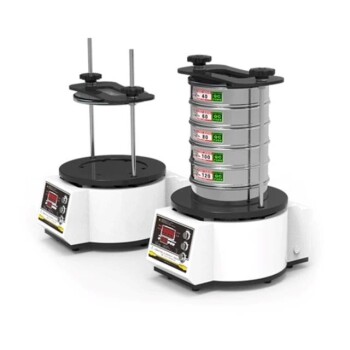
- Laboratory Vibratory Sieve Shaker Machine for Dry and Wet Three-Dimensional Sieving
- Laboratory Test Sieves and Sieving Machines
- Precision Wire Saw Laboratory Cutting Machine with 800mm x 800mm Workbench for Diamond Single Wire Circular Small Cutting
- Laboratory Test Sieves and Vibratory Sieve Shaker Machine
People Also Ask
- Why is sieving equipment essential for the classification of processed bio-activated carbon? Optimize Performance
- What are the limitations of sieving? Understanding the Constraints of Particle Size Analysis
- What are advantages and disadvantages of sieving method? A Guide to Reliable & Cost-Effective Particle Sizing
- How is sieving important? The Critical Role of Particle Size Analysis in Quality Control
- What is sieving and how does it work? A Guide to Accurate Particle Size Analysis