Stepped drying is a critical preservation technique required to manage the high residual moisture found in aluminum-based crucible green bodies after demolding. Without this controlled process, introducing the material directly to high sintering temperatures causes water to vaporize instantly, creating internal pressure that leads to catastrophic cracking and structural failure.
Direct sintering of moist green bodies invariably leads to stress fractures due to rapid water expansion. Stepped drying ensures the gradual, uniform removal of moisture, stabilizing the material physically before it undergoes the chemical changes of sintering.
The Mechanics of Moisture and Stress
To understand the necessity of stepped drying, you must first understand the state of the "green body" (the unfired crucible) immediately after it is formed.
High Residual Moisture Content
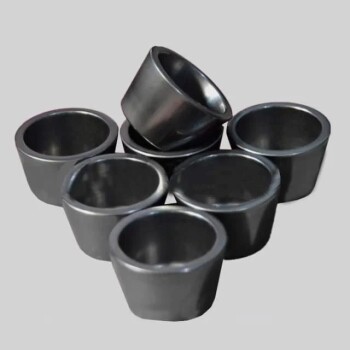
Freshly demolded aluminum-based crucibles are not dry solids; they are porous structures saturated with moisture.
This moisture exists in two forms: free water (water filling the pores) and adsorbed water (water clinging to the particle surfaces).
The Danger of Rapid Vaporization
If you bypass drying and move straight to sintering, the intense heat hits this trapped moisture.
Water expands roughly 1,600 times in volume when it turns to steam. If this happens rapidly inside the crucible, the gas cannot escape fast enough.
This creates immense internal stress. The pressure exceeds the green body's weak structural strength, resulting in cracks, fractures, or even an explosion of the part.
The Stepped Drying Solution
Using a blast drying oven to implement a stepped temperature profile solves the vaporization problem by prioritizing uniformity over speed.
Phase 1: Room Temperature Drying
The process begins at room temperature. This is the stabilization phase.
It allows for the evaporation of surface moisture and the initial migration of internal free water without introducing thermal shock.
Phase 2: The 60°C Transition
Once stabilized, the temperature is raised to 60°C.
This specific temperature is high enough to accelerate the removal of remaining free water and adsorbed water, but low enough to prevent flash-vaporization.
It promotes a slow and uniform drying rate throughout the entire thickness of the crucible walls.
Ensuring Dimensional Stability
Crucibles require precise dimensions for their end-use applications.
By removing water slowly, the particles settle closer together gradually. This prevents uneven shrinkage and warping, ensuring the dimensional stability of the finished product.
Understanding the Trade-offs
While stepped drying is necessary for quality, it introduces specific production constraints that must be managed.
Production Time vs. Yield
The primary trade-off is time. Stepped drying adds a significant duration to the manufacturing cycle compared to direct firing.
However, skipping this step essentially guarantees a high scrap rate. The "time saved" is immediately lost to broken inventory.
The Necessity of Airflow
The process relies on a blast drying oven, not a static oven.
Heat alone is not enough; you need airflow to carry the evaporated moisture away from the crucible surface.
If the oven does not provide uniform air circulation, you may create humidity pockets that lead to uneven drying and warping, negating the benefits of the temperature steps.
Making the Right Choice for Your Goal
To maximize the quality of your aluminum-based crucibles, you should adhere to a strict drying protocol.
- If your primary focus is Structural Integrity: Adhere strictly to the room temperature stabilization phase to prevent initial thermal shock cracks.
- If your primary focus is Dimensional Precision: Ensure the 60°C phase is maintained until the weight of the green body stabilizes, confirming the removal of adsorbed water.
By treating drying as a critical processing step rather than a delay, you transform a fragile green body into a robust precursor ready for successful sintering.
Summary Table:
| Drying Phase | Temperature | Primary Purpose | Key Benefit |
|---|---|---|---|
| Phase 1: Stabilization | Room Temp | Surface moisture & free water migration | Prevents thermal shock and initial cracks |
| Phase 2: Transition | 60°C | Removal of adsorbed water | Uniform drying rate throughout wall thickness |
| Blast Airflow | Constant | Moisture evacuation | Eliminates humidity pockets and uneven shrinkage |
Maximize Your Crucible Yield with KINTEK Precision Solutions
Don't let moisture compromise your material integrity. KINTEK specializes in advanced laboratory equipment, providing the high-performance blast drying ovens and crushing and milling systems essential for preparing high-quality aluminum-based green bodies.
Whether you are refining your drying protocol or scaling up production, our comprehensive portfolio—including high-temperature furnaces (muffle, vacuum, CVD) and hydraulic presses—is designed to ensure dimensional stability and structural perfection for your research and manufacturing needs.
Ready to eliminate structural failure and optimize your sintering process? Contact KINTEK today to speak with our experts about the right equipment for your laboratory.
References
- Hongna Fan, Xiqing Xu. Alumina-based crucibles with enhanced thermal shock resistance via reinforcement of mullite fibers. DOI: 10.23977/jmpd.2023.070303
This article is also based on technical information from Kintek Solution Knowledge Base .
Related Products
- Laboratory Scientific Electric Heating Blast Drying Oven
- Engineering Advanced Fine Ceramics Alumina Crucibles (Al2O3) for Thermal Analysis TGA DTA
- Alumina Al2O3 Ceramic Crucible Semicircle Boat with Lid for Engineering Advanced Fine Ceramics
- Engineering Advanced Fine Alumina Al2O3 Ceramic Crucible for Laboratory Muffle Furnace
- Engineering Advanced Fine Ceramics Alumina Al2O3 Crucible With Lid Cylindrical Laboratory Crucible
People Also Ask
- How does a laboratory electric drying oven contribute to the formation of the initial coating? Expert Insights
- What role does a precision laboratory drying oven play in the synthesis of GO-PANI nanocomposites? Protect Material Integrity
- What role does a laboratory drying oven play in the preparation of zinc oxide nanoparticle precursors?
- What is the necessity of using a laboratory drying oven when processing MoO3/GO composite nanopowders? Find out here.
- What is the role of a laboratory drying oven in cellulose citrate production? Ensure Material Stability & Purity