Knowledge Why is a benchtop magnetic stirrer used in electrocoagulation? Enhance Wastewater Treatment Efficiency
Author avatar

Tech Team · Kintek Solution

Updated 2 days ago

Why is a benchtop magnetic stirrer used in electrocoagulation? Enhance Wastewater Treatment Efficiency


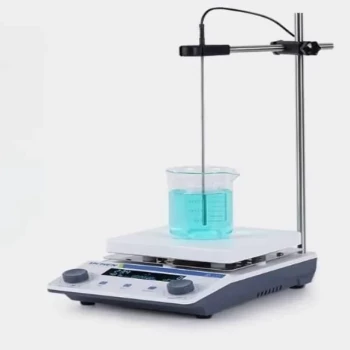
The use of a benchtop magnetic stirrer is critical for maintaining hydrodynamic uniformity within an electrocoagulation reactor. By driving a magnetic stir bar at the bottom of the vessel, the stirrer prevents chemical stagnation at the electrode surface and forces the generated coagulants to actively mix with pollutant particles, ensuring the reaction proceeds efficiently.

Effective electrocoagulation is about more than just applying current; it requires precise physical mixing. The magnetic stirrer bridges the gap between electrochemical generation and physical aggregation, ensuring that ions disperse correctly and particles collide often enough to form stable flocs.

Optimizing Electrochemical Performance

Preventing Concentration Polarization

Without active mixing, ions tend to accumulate rapidly near the electrode surfaces. This phenomenon, known as concentration polarization, creates a resistance layer that hinders the flow of current.

The magnetic stirrer disrupts this layer by constantly circulating the wastewater. This ensures that the bulk solution remains homogenous and that electrical resistance remains low.

Mitigating Electrode Passivation

A common failure point in electrocoagulation is passivation, where an insulating oxide layer forms on the electrodes, effectively stopping the reaction.

Continuous stirring creates a scouring effect across the electrode surface. This reduces the likelihood of passivation, prolonging the life of the electrodes and maintaining consistent treatment performance.

Enhancing Flocculation Dynamics

Increasing Particle Collision

For wastewater treatment to occur, the aluminum hydrolysis products generated by the electrodes must physically contact the pollutant particles.

The stirrer significantly increases the collision frequency between these microscopic elements. By keeping the fluid in motion, it ensures that coagulants do not just sit near the anode but are distributed throughout the reactor to capture pollutants.

Accelerating Floc Growth

The ultimate goal is to turn microscopic pollutants into large, settleable "flocs."

The kinetic energy provided by the stirrer accelerates the formation of these aggregates. This improves the kinetic efficiency of the entire system, meaning the treatment process completes faster than it would under static conditions.

Understanding the Trade-offs

The Danger of Shear Forces

While mixing is necessary, more is not always better. The supplementary data highlights that an appropriate stirring intensity is vital.

If the rotation speed is too high, the resulting shear forces can tear apart the flocs that have already formed. This reverses the treatment process and makes subsequent sedimentation or filtration difficult.

Balancing Velocity Gradients

The stirrer must maintain a controlled velocity gradient (G-value).

For example, a speed of roughly 40 rpm is often used to promote aggregation without causing breakage. The goal is to provide enough energy to bring particles together, but not so much that you destroy the delicate structures being built.

Making the Right Choice for Your Goal

To maximize the efficiency of your electrocoagulation reactor, you must tune the magnetic stirrer to your specific operational phase.

  • If your primary focus is Kinetic Efficiency: Prioritize sufficient agitation to prevent electrode passivation and concentration polarization, ensuring the electrochemical reaction remains vigorous.
  • If your primary focus is Sedimentation Quality: Regulate the rotation speed carefully (e.g., around 40 rpm) to maximize the G-value for collision while avoiding shear-induced floc breakage.

By balancing hydrodynamic mixing with delicate floc management, you transform the reactor from a simple electrified bath into a highly efficient treatment system.

Summary Table:

Factor Role in Electrocoagulation Impact of Magnetic Stirring
Ion Distribution Prevents concentration polarization Maintains low resistance and steady current flow
Electrode Health Reduces oxide layer formation (passivation) Prolongs electrode lifespan and reaction consistency
Floc Formation Increases particle collision frequency Accelerates the aggregation of pollutants into flocs
Shear Control Manages velocity gradients (G-value) Prevents the breakage of delicate flocs at optimal RPM

Maximize Your Wastewater Treatment Results with KINTEK

Precise hydrodynamic control is the secret to efficient electrocoagulation. At KINTEK, we specialize in providing high-performance laboratory equipment designed for rigorous research and industrial testing. Whether you are optimizing flocculation dynamics or preventing electrode passivation, our range of benchtop magnetic stirrers, electrolytic cells, and high-quality electrodes ensures your system operates at peak kinetic efficiency.

From advanced crushing and milling systems to high-temperature reactors and autoclaves, KINTEK provides the tools necessary for precision material science and environmental engineering. Don't let stagnation hinder your treatment process—let our experts help you select the perfect equipment for your specific needs.

Ready to upgrade your laboratory setup? Contact KINTEK today to discuss your project!

References

  1. Moêz Smiri, Soumaya Elarbaoui. Removal of Chromium (Cr) and Formaldehyde[CH<sub>2</sub>O (H−CHO)] from Leather Tannery EffluentsUsing Electrocoagulation Treatment Process. DOI: 10.15244/pjoes/157494

This article is also based on technical information from Kintek Solution Knowledge Base .

Related Products

People Also Ask

Related Products

Laboratory Small Constant Temperature Heated Magnetic Stirrer Heater and Stirrer

Laboratory Small Constant Temperature Heated Magnetic Stirrer Heater and Stirrer

The Laboratory Small Constant Temperature Heating Magnetic Stirrer is a versatile tool designed for precise temperature control and efficient mixing in various laboratory applications.

High Performance Laboratory Stirrers for Diverse Applications

High Performance Laboratory Stirrers for Diverse Applications

Precise laboratory overhead stirrers for high-viscosity mixing. Durable, customizable, and ideal for research. Explore models now!

Laboratory Vortex Mixer Orbital Shaker Multifunctional Rotation Oscillation Mixer

Laboratory Vortex Mixer Orbital Shaker Multifunctional Rotation Oscillation Mixer

The inching mixer is small in size, mixes quickly and thoroughly, and the liquid is in a vortex shape, which can mix all the test solutions attached to the tube wall.

Custom PTFE Teflon Parts Manufacturer for Magnetic Stirring Bar

Custom PTFE Teflon Parts Manufacturer for Magnetic Stirring Bar

The PTFE magnetic stirring bar, made from high-quality PTFE, offers exceptional resistance to acids, alkalis, and organic solvents, coupled with high-temperature stability and low friction. Ideal for laboratory use, these stirring bars are compatible with standard flask ports, ensuring stability and safety during operations.

Laboratory Oscillating Orbital Shaker

Laboratory Oscillating Orbital Shaker

Mixer-OT orbital shaker uses brushless motor, which can run for a long time. It is suitable for vibration tasks of culture dishes, flasks and beakers.

Laboratory Disc Rotary Mixer for Efficient Sample Mixing and Homogenization

Laboratory Disc Rotary Mixer for Efficient Sample Mixing and Homogenization

Efficient Laboratory Disc Rotary Mixer for Precise Sample Mixing, Versatile for Various Applications, DC Motor and Microcomputer Control, Adjustable Speed and Angle.

Custom PTFE Teflon Parts Manufacturer Laboratory High Temperature Mixing Paddle Mixer

Custom PTFE Teflon Parts Manufacturer Laboratory High Temperature Mixing Paddle Mixer

The PTFE mixing paddle mixer is a versatile and robust tool designed for laboratory use, particularly in environments requiring high resistance to chemicals and extreme temperatures. Crafted from high-quality PTFE, this mixer boasts several key features that enhance its functionality and durability.

High Shear Homogenizer for Pharmaceutical and Cosmetic Applications

High Shear Homogenizer for Pharmaceutical and Cosmetic Applications

Enhance lab efficiency with our high-speed Laboratory Emulsifier Homogenizer for precise, stable sample processing. Ideal for pharmaceuticals & cosmetics.

Twin Screw Extruder Plastic Granulation Machine

Twin Screw Extruder Plastic Granulation Machine

Twin screw extruder plastic granulation machine is designed for the mixing and processing experiments of engineering plastics, modified plastics, waste plastics and masterbatches.

Laboratory Rapid Thermal Processing (RTP) Quartz Tube Furnace

Laboratory Rapid Thermal Processing (RTP) Quartz Tube Furnace

Get lightning-fast heating with our RTP Rapid Heating Tube Furnace. Designed for precise, high-speed heating and cooling with convenient sliding rail and TFT touch screen controller. Order now for ideal thermal processing!

Vacuum Hot Press Furnace Machine for Lamination and Heating

Vacuum Hot Press Furnace Machine for Lamination and Heating

Experience clean and precise lamination with Vacuum Lamination Press. Perfect for wafer bonding, thin-film transformations, and LCP lamination. Order now!

Small Vacuum Heat Treat and Tungsten Wire Sintering Furnace

Small Vacuum Heat Treat and Tungsten Wire Sintering Furnace

The small vacuum tungsten wire sintering furnace is a compact experimental vacuum furnace specially designed for universities and scientific research institutes. The furnace features a CNC welded shell and vacuum piping to ensure leak-free operation. Quick-connect electrical connections facilitate relocation and debugging, and the standard electrical control cabinet is safe and convenient to operate.

High Precision Diamond Wire Cutting Machine Laboratory Saw Precision Wire EDM Cutting Machine

High Precision Diamond Wire Cutting Machine Laboratory Saw Precision Wire EDM Cutting Machine

The high precision diamond wire cutting machine is a versatile and precise cutting tool designed specifically for material researchers. It utilizes a continuous diamond wire cutting mechanism, enabling precise cutting of brittle materials such as ceramics, crystals, glass, metals, rocks, and various other materials.

Electrode Polishing Material for Electrochemical Experiments

Electrode Polishing Material for Electrochemical Experiments

Looking for a way to polish your electrodes for electrochemical experiments? Our polishing materials are here to help! Follow our easy instructions for best results.

Graphite Vacuum Furnace Negative Material Graphitization Furnace

Graphite Vacuum Furnace Negative Material Graphitization Furnace

Graphitization furnace for battery production has uniform temperature and low energy consumption. Graphitization furnace for negative electrode materials: an efficient graphitization solution for battery production and advanced functions to enhance battery performance.

Graphite Vacuum Furnace High Thermal Conductivity Film Graphitization Furnace

Graphite Vacuum Furnace High Thermal Conductivity Film Graphitization Furnace

The high thermal conductivity film graphitization furnace has uniform temperature, low energy consumption and can operate continuously.

Non Consumable Vacuum Arc Induction Melting Furnace

Non Consumable Vacuum Arc Induction Melting Furnace

Explore the benefits of Non-Consumable Vacuum Arc Furnace with high melting point electrodes. Small, easy to operate & eco-friendly. Ideal for laboratory research on refractory metals & carbides.

Ceramic Evaporation Boat Set Alumina Crucible for Laboratory Use

Ceramic Evaporation Boat Set Alumina Crucible for Laboratory Use

It can be used for vapor deposition of various metals and alloys. Most metals can be evaporated completely without loss. Evaporation baskets are reusable.1

Molybdenum Tungsten Tantalum Evaporation Boat for High Temperature Applications

Molybdenum Tungsten Tantalum Evaporation Boat for High Temperature Applications

Evaporation boat sources are used in thermal evaporation systems and are suitable for depositing various metals, alloys and materials. Evaporation boat sources are available in different thicknesses of tungsten, tantalum and molybdenum to ensure compatibility with a variety of power sources. As a container, it is used for vacuum evaporation of materials. They can be used for thin film deposition of various materials, or designed to be compatible with techniques such as electron beam fabrication.

Custom PTFE Teflon Parts Manufacturer for Culture Dish and Evaporation Dish

Custom PTFE Teflon Parts Manufacturer for Culture Dish and Evaporation Dish

The PTFE culture dish evaporating dish is a versatile laboratory tool known for its chemical resistance and high-temperature stability. PTFE, a fluoropolymer, offers exceptional non-stick properties and durability, making it ideal for various applications in research and industry, including filtration, pyrolysis, and membrane technology.


Leave Your Message