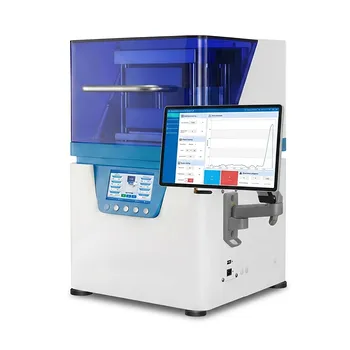
To achieve high-performance magnetic materials, a laboratory hydraulic press is indispensable because it creates the dense physical interface required for solid-phase chemical reactions. By applying high pressure (typically around 30 MPa), the press transforms loose Nd-Fe-B oxide and reducing agent (such as $CaH_2$) into a compact pellet, which minimizes internal voids and maximizes the contact area between particles. This intimate contact is the primary driver for efficient atomic diffusion and the successful formation of the $Nd_2Fe_{14}B$ hard magnetic phase during high-temperature annealing.
Core Takeaway: The hydraulic press acts as a mechanical catalyst, reducing the physical distance between reactants to a microscopic level. This ensures that the reduction-diffusion reaction is both complete and uniform, preventing phase impurities that would otherwise degrade the magnet's properties.
Optimizing the Solid-Phase Reaction Environment
Maximizing Interface Area
Solid-phase reactions occur primarily at the points where reactant particles touch. By compressing the powder mixture into a pellet, the interface area between the rare earth oxide and the reducing agent is significantly increased.
This dense packing ensures that as the reducing agent reacts, the resulting atoms have immediate access to the oxide surface. This proximity is vital for the chemical transformation to proceed without being stalled by physical gaps.
Accelerating Atomic Diffusion
At high temperatures, the formation of the $Nd_2Fe_{14}B$ phase depends on the movement of atoms across particle boundaries, a process known as atomic diffusion. High-pressure compaction shortens these diffusion paths to the smallest possible distance.
When voids are minimized, atoms can migrate more freely between the components. This increased diffusion rate allows the reaction to reach completion faster and at more controlled temperatures, ensuring a higher quality final product.
Enhancing Structural and Thermal Stability
Preventing Component Stratification
In a loose powder state, materials of different densities—like heavy rare earth oxides and lighter reducing agents—tend to shift or settle. This stratification can lead to an uneven reaction where some areas have too much reductant and others too little.
Pelletizing the mixture locks the particles into a fixed, homogeneous matrix. This structural integrity prevents the components from drifting during handling or within the furnace, ensuring a uniform chemical composition throughout the sample.
Improving Heat Conduction and Gas Flow
Dense pellets facilitate more uniform heat conduction compared to loose, aerated powders. As the furnace heats, the pellet absorbs energy evenly, preventing localized "hot spots" that could cause unwanted grain growth or secondary phase formation.
Additionally, a stable pellet format prevents fine powders from being swept away by high-temperature gas flows within the furnace. This ensures that the stoichiometric balance of the mixture remains intact throughout the entire reduction-diffusion process.
Understanding the Trade-offs and Pitfalls
The Risk of Improper Pressure
While high pressure is necessary, the specific force used must be carefully calibrated. Insufficient pressure results in a "green" pellet that is fragile and contains large voids, leading to incomplete reduction and poor magnetic performance.
Conversely, excessive pressure can lead to mechanical failures such as "capping" or lamination, where the pellet splits into layers upon release from the die. These cracks create physical barriers that disrupt both heat flow and atomic diffusion during the reaction.
Contamination and Surface Integrity
The quality of the pellet is also dependent on the cleanliness of the pressing environment. Any contaminants introduced during the pressing stage can act as grain growth inhibitors or create non-magnetic inclusions in the final $Nd_2Fe_{14}B$ structure.
Maintaining a flat, high-density surface on the pellet is also critical for subsequent analysis. A smooth, integrated surface ensures that the sample remains stable under thermal stress and provides consistent results during post-reaction characterization.
Applying Compaction Best Practices
How to Apply This to Your Project
- If your primary focus is phase purity: Ensure the mixture is finely ground and use a consistent pressure of at least 30 MPa to eliminate voids that cause incomplete reactions.
- If your primary focus is scalability: Optimize the pellet dimensions (typically 10-15 mm) to simulate industrial agglomeration while ensuring uniform heat distribution.
- If your primary focus is structural integrity: Monitor for lamination cracks after pressing, as these defects will significantly hinder the diffusion-reduction efficiency.
The laboratory hydraulic press is the foundational tool that converts a simple mixture of powders into a high-efficiency solid-state reactor.
Summary Table:
| Key Factor | Role of Hydraulic Compaction | Impact on Final Material |
|---|---|---|
| Interface Area | Increases contact points between particles | Drives efficient solid-phase chemical reactions |
| Atomic Diffusion | Shortens diffusion paths between reactants | Accelerates $Nd_2Fe_{14}B$ phase formation |
| Homogeneity | Prevents component stratification/settling | Ensures uniform chemical composition |
| Thermal Control | Facilitates uniform heat conduction | Prevents localized hot spots and grain growth |
| Structural Integrity | Eliminates voids and internal gaps | Minimizes phase impurities and defects |
Elevate your materials research with KINTEK’s precision engineering. Whether you are synthesizing high-performance magnets or exploring advanced battery chemistries, our comprehensive range of laboratory hydraulic presses (pellet, hot, and isostatic) and high-temperature furnaces (muffle, tube, vacuum, and CVD) ensures consistent results and structural integrity.
From crushing and milling systems to specialized high-pressure reactors and autoclaves, KINTEK provides the essential tools and consumables, including PTFE and ceramics, to optimize your lab's workflow. Contact our technical experts today to find the perfect solution for your specific application and achieve superior solid-phase reaction efficiency.
References
- Ling Wang, Xiaofen Xu. Facile Synthesis of Nd2Fe14B Hard Magnetic Particles with Microwave-Assisted Hydrothermal Method. DOI: 10.3390/molecules28237918
This article is also based on technical information from Kintek Solution Knowledge Base .
Related Products
- Laboratory Hydraulic Press Lab Pellet Press Machine for Glove Box
- Laboratory Hydraulic Press Split Electric Lab Pellet Press
- Fully Automatic Heated Hydraulic Lab Press for Materials Sintering and Sample Preparation
- Laboratory Hydraulic Press Lab Pellet Press for Button Battery
- Automatic Laboratory Hydraulic Press for XRF & KBR Pellet Press
People Also Ask
- What is the function of a laboratory hydraulic press in W-Cu composites? Control Porosity and Material Ratio
- What is the role of a laboratory hydraulic press in the initial stages of Li6PS5Cl preparation? Key to Green Pellets
- What role does a laboratory hydraulic press play in triboelectric testing? Achieve Precision Alloy Sample Prep
- How can a laboratory hydraulic press be applied to chitosan for wastewater treatment? Optimize Pores & Strength
- How do a precision laboratory hydraulic press and specialized molds contribute to the fabrication of spherical ceramic samples? Achieving High-Density Material Precision