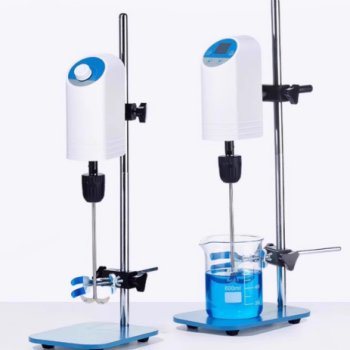
Mechanical stirring serves as the fundamental stabilizer in a biomass gasification reactor, specifically when operating with supercritical water. Its primary function is to maintain a homogeneous mixture by keeping sludge particles suspended, preventing them from settling and clogging the system. Through continuous rotation, typically around 250 rpm, the stirrer ensures that the biomass physically interacts with the reaction medium to drive efficient gas production.
The integration of a mechanical stirring system is not optional but essential for preventing solid deposition and maximizing reaction efficiency. By enforcing particle suspension, stirring optimizes heat and mass transfer, ensuring a uniform and high-quality gas output.
Maintaining Physical Suspension
Preventing Solid Deposition
In a static environment, heavier sludge particles naturally gravitate toward the bottom of the reactor. This sedimentation poses a severe risk to the reactor's longevity and functionality.
Mechanical stirring acts as a constant counter-force to gravity. By agitating the mixture, it keeps these solids in suspension, preventing the accumulation of deposits that could lead to blockages or uneven reaction zones.
The Role of Continuous Rotation
The effectiveness of the suspension relies on consistent motion. The primary reference suggests a rotation speed of 250 rpm as an effective baseline for these systems.
This continuous rotation creates a dynamic environment where particles are unable to settle. This ensures the entire volume of biomass remains active within the reactor rather than becoming dormant sediment.
Optimizing Reaction Kinetics
Enhancing Heat and Mass Transfer
Gasification efficiency is strictly limited by how well heat and reactants move through the mixture. Without agitation, the reaction can suffer from thermal gradients, where some areas are hot enough to react while others remain too cool.
Stirring drives rapid heat and mass transfer throughout the supercritical water medium. This ensures that thermal energy is distributed evenly, accelerating the breakdown of biomass into gas.
Ensuring Sufficient Contact
For the chemical reaction to occur, the biomass must physically contact the supercritical water. Passive diffusion is often too slow to maintain high efficiency in an industrial or high-throughput setting.
The stirring action forces a high frequency of contact between the biomass particles and the water. This maximizes the surface area available for the reaction at any given moment.
The Risks of Passive Systems
Compromised Gas Quality
When a system lacks adequate mixing, the reaction environment becomes heterogeneous. This leads to inconsistent gas production, where the components of the produced gas vary significantly over time.
Mechanical stirring ensures the uniformity of the produced gas components. By maintaining a consistent reaction environment, the output remains stable and predictable.
Thermal Inefficiency
Without the forced convection provided by the stirrer, the system requires more energy to achieve the same conversion rates. Heat transfer becomes sluggish, leading to wasted energy and lower overall gasification efficiency.
Making the Right Choice for Your Goal
To determine how critical the stirring parameters are for your specific reactor design, consider your primary operational objectives.
- If your primary focus is System Longevity: Prioritize the suspension capability of the stirrer to prevent bottom deposition and costly maintenance shutdowns.
- If your primary focus is Product Quality: Focus on the stirrer's ability to enhance mass transfer to ensure the uniformity of the gas components produced.
By integrating a robust mechanical stirring system, you transition your reactor from a passive vessel into a high-efficiency processing unit.
Summary Table:
| Key Function | Impact on Reactor | Operational Benefit |
|---|---|---|
| Particle Suspension | Prevents sludge sedimentation | Avoids clogging and system shutdowns |
| Kinetic Optimization | Enhances heat and mass transfer | Increases gasification rate and yield |
| Uniform Mixing | Eliminates thermal gradients | Ensures consistent gas product quality |
| Forced Convection | Increases biomass-water contact | Maximizes energy efficiency and throughput |
Elevate Your Reactor Performance with KINTEK Expertise
Maximize your biomass gasification efficiency and safeguard your system longevity with KINTEK’s advanced laboratory solutions. As specialists in high-performance laboratory equipment, we provide the precision tools necessary for demanding research and industrial applications.
Our extensive portfolio includes:
- High-Temperature & High-Pressure Reactors and Autoclaves
- Crushing, Milling, and Sieving Systems for biomass preparation
- Rotary, Vacuum, and CVD Furnaces for advanced thermal processing
- PTFE and Ceramic Consumables for chemical resistance
Whether you are refining battery research or scaling up supercritical water gasification, KINTEK delivers the reliability you need. Contact us today to discuss how our specialized reactors and stirring systems can transform your processing capabilities.
References
- Misgina Tilahun, Hemlata Sahu. Cogeneration of renewable energy from biomass (utilization of municipal solid waste as electricity production: gasification method). DOI: 10.1007/s40243-015-0044-y
This article is also based on technical information from Kintek Solution Knowledge Base .
Related Products
- High Performance Laboratory Stirrers for Diverse Applications
- Laboratory Small Constant Temperature Heated Magnetic Stirrer Heater and Stirrer
- Electric Rotary Kiln Small Rotary Furnace Biomass Pyrolysis Plant
People Also Ask
- How does a laboratory stirrer influence MOF product quality? Master Precision in Non-Solvothermal Synthesis
- What critical role does a Laboratory Stirrer play during leaching? Enhance Titanium-Magnesium Waste Recovery
- What is the primary function of laboratory stirring equipment in the preparation of compost leachate? Optimize Extraction
- What is a laboratory mixer? A Guide to Achieving Perfect Sample Homogeneity
- What is a laboratory mixer used for? Choose the Right Tool for Liquids or Solids