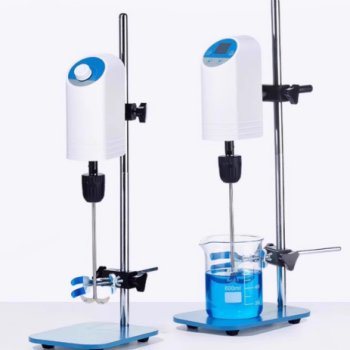
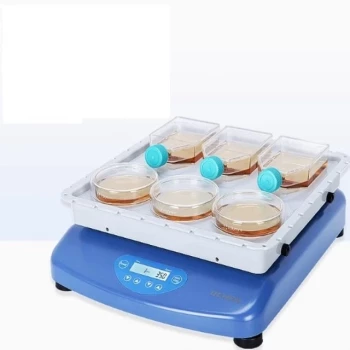
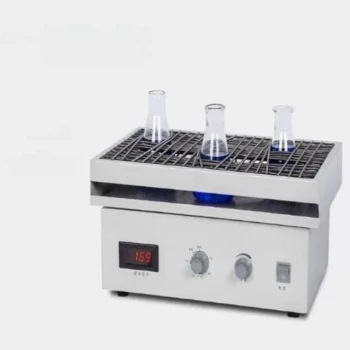
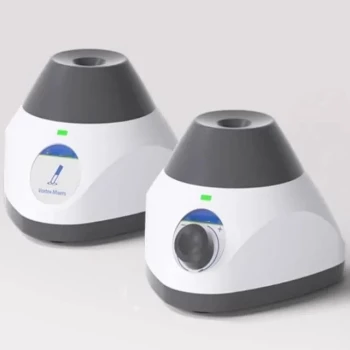
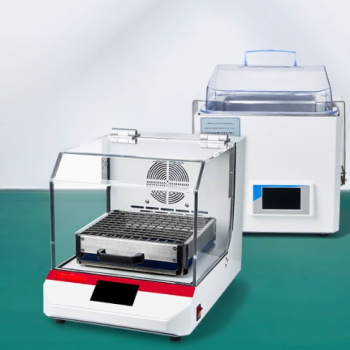
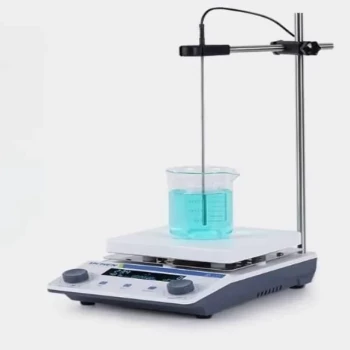
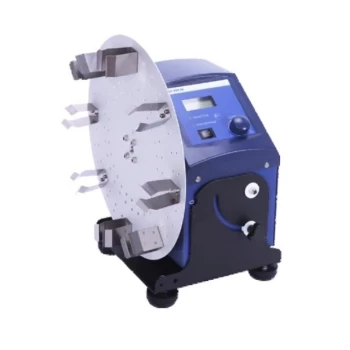
Consistent, gentle agitation is the key mechanism. Laboratory shakers and stirrers ensure coating quality by providing continuous motion that facilitates the uniform hydrolysis and polycondensation of precursor solutions. This steady movement is critical for preventing the uneven buildup of the sol on surfaces, directly resulting in nanocoatings with uniform thickness.
The primary role of mechanical agitation in sol-gel processes is to prevent localized over-accumulation of the sol. By maintaining a uniform kinetic environment, these devices preserve open pore structures and ensure the formation of homogeneous, high-performance nanocoatings.
The Mechanics of Coating Uniformity
Facilitating Consistent Reactions
The sol-gel process relies on specific chemical reactions, primarily hydrolysis and polycondensation.
Laboratory shakers ensure these reactions occur evenly throughout the mixture. By keeping the fluid in motion, the equipment ensures that the conversion from precursor solution to the final network is consistent across the entire batch.
Preventing Localized Accumulation
Without constant motion, the "sol" (the colloidal suspension) can settle or clump in specific areas.
Shakers and stirrers prevent this by continuously redistributing the liquid. This prevents localized over-accumulation, where too much material builds up in one spot, which would otherwise lead to varied coating thickness and defects.
Preserving Membrane Functionality
Maintaining Open Pore Structure
When coating porous materials, such as membranes used for filtration, the risk of clogging is high.
Steady agitation ensures the coating layer is applied thinly and evenly, rather than sinking deep into the material. This maintains an open pore structure, which is essential for the material to function correctly after the coating is applied.
Avoiding Performance Decline
If the coating blocks the pores, the membrane's ability to allow fluid to pass through (permeate performance) drops significantly.
By controlling the distribution of materials like titanium dioxide or zinc oxide, shakers prevent pore blockage. This ensures that the functional benefits of the nanoparticles are added without compromising the underlying utility of the substrate.
Enhancing Structural Integrity
Eliminating Concentration Gradients
Beyond simple thickness, the chemical composition of the coating must be uniform.
Continuous mechanical motion ensures thorough contact between multiple metal precursors and the carrier. This creates a uniform kinetic environment that eliminates concentration gradients, preventing weak spots or chemically distinct zones within the coating.
Enabling Molecular-Level Diffusion
For complex coatings, such as bimetallic alloys or core-shell structures, the components must mix at a molecular level.
The constant agitation promotes molecular-level diffusion. This thorough mixing allows distinct materials to integrate correctly, fostering synergistic effects that improve the final properties of the coating during the drying and heat treatment stages.
Common Pitfalls to Avoid
The Risk of Excessive Agitation
While motion is critical, "more" is not always "better."
Excessively vigorous stirring can disrupt the delicate gel network as it forms or introduce air bubbles that create voids in the coating. The goal is gentle, continuous motion, not aggressive mixing.
Temperature Inconsistency
Mechanical motion alone may not be enough if the environmental conditions fluctuate.
Many advanced processes require constant temperature shakers. If the temperature varies across the vessel, reaction rates will differ regardless of how well the solution is stirred, leading to uneven coating quality.
Making the Right Choice for Your Goal
To optimize your sol-gel immobilization process, align your equipment settings with your specific objectives.
- If your primary focus is Membrane Permeability: Prioritize gentle, consistent speeds to prevent pore blockage while ensuring thin, uniform coverage.
- If your primary focus is Complex Alloy Structure: Ensure your equipment provides vigorous enough circulation to eliminate concentration gradients and maximize molecular diffusion.
Control the motion, and you control the quality of the final nanostructure.
Summary Table:
| Feature | Impact on Sol-Gel Coating | Benefit for Nanoparticles |
|---|---|---|
| Gentle Agitation | Promotes uniform hydrolysis & polycondensation | Consistent coating thickness across surfaces |
| Continuous Motion | Prevents localized over-accumulation | Eliminates defects and uneven buildup |
| Kinetic Control | Maintains open pore structures | Preserves membrane permeability and function |
| Molecular Diffusion | Eliminates concentration gradients | Ensures structural integrity and synergistic effects |
Elevate Your Nanotechnology Research with KINTEK
Precision in sol-gel immobilization requires more than just movement—it requires controlled, reliable agitation. At KINTEK, we specialize in high-performance laboratory equipment designed to meet the rigorous demands of material science.
Whether you are developing advanced membranes or complex bimetallic alloys, our comprehensive range of laboratory shakers, stirrers, and homogenizers ensures the uniform kinetic environment your research deserves. Beyond liquid handling, KINTEK offers a full suite of solutions, including high-temperature furnaces, crushing and milling systems, and precision hydraulic presses to support your entire workflow from synthesis to heat treatment.
Ready to optimize your coating quality and research outcomes?
Contact our technical experts today to find the perfect equipment for your laboratory.
References
- Xiujuan Chen, Baiyu Zhang. Perspectives on Surface Functionalization of Polymeric Membranes with Metal and Metal-Oxide Nanoparticles for Water/Wastewater Treatment. DOI: 10.3808/jeil.202200083
This article is also based on technical information from Kintek Solution Knowledge Base .
Related Products
- High Performance Laboratory Stirrers for Diverse Applications
- Laboratory Oscillating Orbital Shaker
- Laboratory Multifunctional Small Speed-Adjustable Horizontal Mechanical Shaker for Lab
- Laboratory Vibratory Sieve Shaker Machine for Dry and Wet Three-Dimensional Sieving
- Laboratory Vortex Mixer Orbital Shaker Multifunctional Rotation Oscillation Mixer
People Also Ask
- How does a laboratory stirrer influence MOF product quality? Master Precision in Non-Solvothermal Synthesis
- What critical role does a Laboratory Stirrer play during leaching? Enhance Titanium-Magnesium Waste Recovery
- What is the primary function of laboratory stirring equipment in the preparation of compost leachate? Optimize Extraction
- What is a laboratory mixer? A Guide to Achieving Perfect Sample Homogeneity
- What is a laboratory mixer used for? Choose the Right Tool for Liquids or Solids