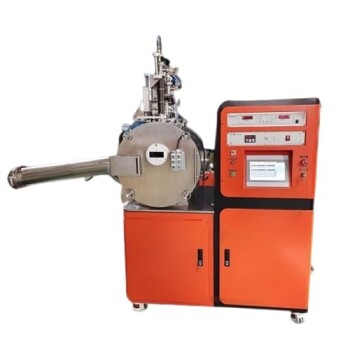
A vacuum system is strictly required to simultaneously prevent chemical degradation and avoid physical structural damage during post-processing. It creates an oxygen-deprived environment that stops highly reactive nanoparticles, particularly zero-valent iron, from oxidizing back into iron oxide and losing their magnetic potential. Furthermore, by lowering the internal pressure, the system allows trapped solvents to evaporate rapidly at safe, low temperatures (e.g., 70 °C), ensuring the material dries without undergoing thermal stress.
By eliminating oxygen and lowering solvent boiling points, vacuum drying preserves the critical magnetic saturation and chemical stability of nanopowders while protecting their delicate porous structures from high-heat damage.
The Critical Role of Oxygen Exclusion
Preventing Rapid Oxidation
Magnetic nanopowders, such as zero-valent iron and cobalt, possess extremely high surface activity.
If exposed to oxygen during the drying process, these materials will rapidly oxidize. A vacuum system removes oxygen from the chamber, ensuring the metal remains in its pure, active state rather than degrading into a metal oxide.
Maintaining Saturation Magnetization
The magnetic performance of a composite material relies heavily on the purity of its metal components.
Oxidation directly reduces saturation magnetization, rendering the magnetic powder less effective. By excluding oxygen, the vacuum system acts as a shield, preserving the specific magnetic properties essential for the final application.
The Physics of Low-Temperature Drying
Reducing Solvent Boiling Points
Nanopowders often contain residual solvents like water, ethanol, or DMF trapped deep within their pores.
At atmospheric pressure, removing these solvents requires high heat. A vacuum environment drastically lowers the boiling point of these liquids, allowing them to vaporize and escape at much lower temperatures (such as 70 °C instead of 100+ °C).
Protecting Pore Architecture
High-temperature thermal stress can be catastrophic for nanomaterials with complex structures.
Excessive heat can cause framework collapse or the blockage of micropores. By facilitating drying at lower temperatures, the vacuum system preserves the sensitive pore structure, ensuring the material retains its intended surface area and porosity.
Understanding the Trade-offs and Risks
The Consequence of Residual Moisture
While vacuum drying is efficient, failure to achieve "absolute dryness" can ruin subsequent processing steps.
For example, if the powder is later mixed with reactive agents like isocyanates, even trace amounts of residual moisture can trigger unwanted chemical reactions. This can produce gas bubbles (CO2) or degrade curing agents, compromising the structural integrity of the final composite.
Balancing Speed vs. Structure
Rapid evaporation is generally desirable, but it must be controlled.
If the pressure is dropped too aggressively, solvents may "bump" or boil violently within the pores. While the vacuum allows for speed, the pressure reduction profile must be managed to prevent mechanical damage to delicate powder aggregations.
Making the Right Choice for Your Project
To maximize the quality of your magnetic nanopowders, tailor your drying strategy to your specific constraints:
- If your primary focus is Magnetic Strength: Prioritize the quality of the vacuum seal to ensure absolute oxygen exclusion, preventing zero-valent iron from reverting to iron oxide.
- If your primary focus is Structural Integrity: Focus on temperature control, utilizing the vacuum to keep processing temperatures well below the thermal stability limit of your pore framework.
- If your primary focus is Chemical Compatibility: Ensure the drying cycle is long enough to remove deep-pore moisture that could react with downstream agents like isocyanates.
Correctly applied, vacuum drying is the only method that reconciles the need for dryness with the need for chemical purity.
Summary Table:
| Factor | Vacuum Drying Impact | Benefit to Nanopowders |
|---|---|---|
| Oxygen Levels | Near-zero oxygen environment | Prevents oxidation of zero-valent metals |
| Boiling Point | Significantly lowered | Enables rapid drying at low temperatures (e.g., 70°C) |
| Magnetic Properties | Maintains chemical purity | Preserves high saturation magnetization |
| Structural Integrity | Minimal thermal stress | Protects delicate pore architecture from collapse |
| Residual Moisture | High extraction efficiency | Prevents unwanted reactions in downstream processing |
Elevate Your Nanomaterial Integrity with KINTEK
Precision in post-processing is the difference between high-performance magnetic powders and degraded materials. KINTEK specializes in advanced laboratory solutions designed for the most sensitive research. Whether you need high-performance vacuum furnaces, specialized rotary systems, or precision hydraulic presses for material shaping, our equipment ensures your nanopowders maintain their chemical purity and structural architecture.
Our value to you:
- Total Environmental Control: Advanced vacuum and atmosphere furnaces to prevent oxidation.
- Thermal Stability: Precise temperature management for sensitive pore structures.
- Comprehensive Support: From ball milling to ULT freezers and PTFE consumables, we provide the full ecosystem for battery and material research.
Don't compromise on your magnetic saturation or chemical stability. Contact KINTEK today to find the perfect vacuum system for your lab!
References
- Levan Chkhartishvili, Roin Chedia. Obtaining Boron Carbide and Nitride Matrix Nanocomposites for Neutron-Shielding and Therapy Applications. DOI: 10.3390/condmat8040092
This article is also based on technical information from Kintek Solution Knowledge Base .
Related Products
- 56L Vertical Laboratory Vacuum Drying Oven
- 23L Laboratory Vacuum Drying Oven
- Benchtop Laboratory Vacuum Freeze Dryer
- Vacuum Cold Mounting Machine for Sample Preparation
- Vacuum Induction Melting Spinning System Arc Melting Furnace
People Also Ask
- Why is a laboratory vacuum drying oven recommended for rice straw residues? Protect Your Biomass Integrity
- What role does a laboratory vacuum drying oven play in the preparation of modified multi-walled carbon nanotubes?
- What is the importance of using a laboratory vacuum drying oven? Preserving Slow-Release Microcapsule Integrity
- Why is a Laboratory Vacuum Drying Oven recommended for PBAT microspheres? Protect Sensitive Polymer Integrity
- What role does a laboratory vacuum drying oven play in processing nanoparticle powder samples? Protect Sample Integrity