Table of Contents
Introduction
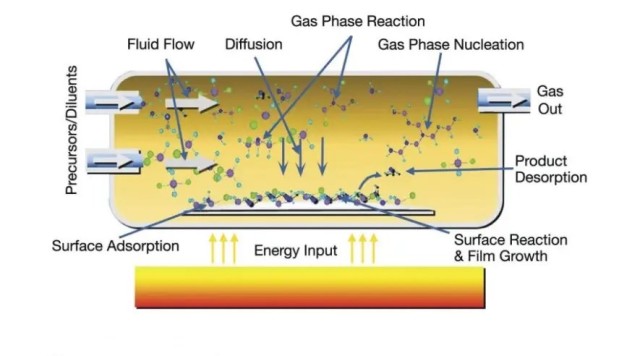
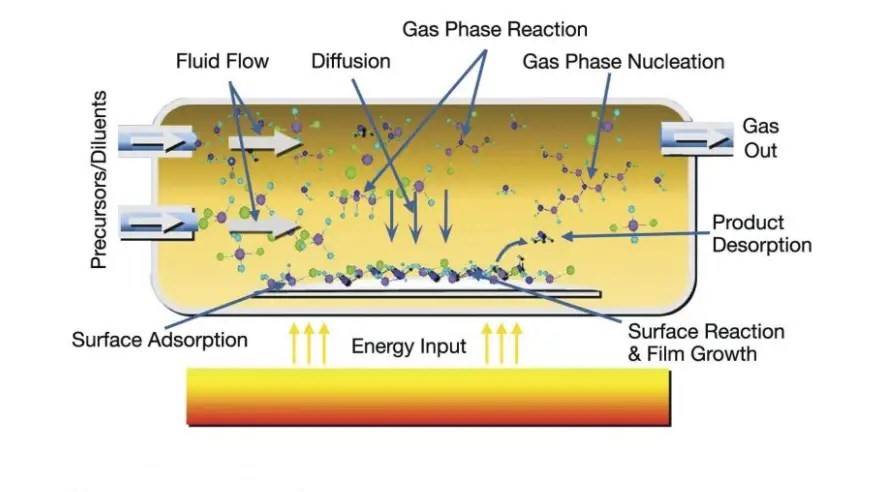
Chemical vapor deposition (CVD) is a versatile thin-film deposition technique that involves the conversion of a gaseous precursor into a solid material. It offers several advantages, including the ability to produce high-quality films with precise control over their properties and scalability for large-area deposition. These attributes make CVD a crucial technology in various industries, ranging from electronics to biomedical engineering.
Advantages of CVD
Chemical vapor deposition (CVD) is a versatile thin-film deposition technique that offers numerous advantages, making it widely used in the fabrication of semiconductors, microelectronics, and advanced materials. Here are some of the key advantages of CVD:
-
High-Quality Films: CVD produces thin films with excellent uniformity, purity, and grain structure. The controlled chemical reactions involved in the deposition process result in films with consistent properties, minimizing defects and enhancing the overall performance and reliability of the deposited materials.
-
Precise Control: CVD allows for precise control over film thickness, composition, and properties by adjusting process parameters such as temperature, pressure, precursor concentration, and gas flow rates. This level of control enables the tailoring of thin films to meet specific requirements for various applications.
-
Scalability: CVD is suitable for large-area deposition, making it ideal for industrial applications. The conformal nature of the deposition process allows for uniform coverage even on complex substrates with high aspect ratios, ensuring consistent film properties across the entire surface.
-
Conformal Deposition: CVD exhibits excellent conformality, enabling the deposition of thin films that uniformly cover complex surface topographies, including high-aspect-ratio structures and trenches. This conformal coverage is crucial for applications where uniform film properties are essential, such as in microelectronics and semiconductor devices.
-
Low-Temperature Processing: CVD processes can be carried out at relatively low temperatures, which is advantageous for depositing thin films on substrates that are sensitive to high temperatures. This low-temperature processing helps to minimize thermal damage and maintain the integrity of the substrate materials.
-
Wide Range of Materials: CVD can be used to deposit a wide range of materials, including metals, semiconductors, insulators, and dielectrics. This versatility makes CVD applicable to a diverse range of applications, from electronic devices to optical coatings and energy-related materials.
-
Flexibility and Adaptability: CVD processes can be tailored to specific requirements by adjusting the choice of precursors, deposition temperature, and other process parameters. This flexibility allows for the optimization of film properties for different applications and materials.
Disadvantages of CVD
CVD offers numerous advantages, but it also has several disadvantages that need to be considered. These include:
1. High Cost:
CVD systems and precursor gases can be expensive, especially for high-temperature processes. The high cost of equipment, including vacuum pumps, gas flow controllers, and high-temperature furnaces, can be a significant barrier to entry for some applications.

2. Toxic By-Products:
CVD often involves the use of toxic gases, such as silane and ammonia. These gases can pose hazards to human health and safety, requiring proper ventilation and safety precautions. Proper handling and disposal of these gases are crucial to ensure a safe working environment.
3. Sensitivity to Parameters:
CVD is sensitive to process parameters, including temperature, pressure, gas flow rates, and substrate preparation. Careful optimization and control of these parameters are essential to achieve desired film properties. Small variations in these parameters can significantly impact the quality and performance of the deposited film.
4. Slow Deposition Rates:
CVD processes can be relatively slow compared to other deposition techniques. The slow deposition rates can be a limiting factor for high-volume production applications, where throughput is critical.
5. Requirement for Specialized Expertise:
Operating CVD equipment and optimizing process parameters require specialized knowledge and expertise. This can be a challenge for organizations that do not have the necessary in-house capabilities and may require outsourcing or hiring specialized personnel.
Despite these disadvantages, CVD remains a critical technology in the fabrication of advanced materials and devices due to its ability to produce high-quality, conformal films with precise control over film properties. Ongoing research and development efforts are focused on addressing these challenges and improving the efficiency, cost-effectiveness, and safety of CVD processes.
Potential New Applications of CVD
Chemical vapor deposition (CVD) is a versatile and widely used manufacturing process that can be tailored to many different applications. In recent years, CVD has been increasingly used to produce new materials and devices with improved properties.
Some of the potential new applications of CVD include:
- Energy: CVD can be used to produce thin-film solar cells, coatings for turbine blades, and fuel cells.
- Biomedical: CVD can be used to create biocompatible coatings for medical implants, drug delivery systems, and tissue engineering scaffolds.
- Environmental: CVD can be used to produce membranes for water purification, desalination, and air pollution control.
CVD is a cost-effective and scalable process that can be used to produce high-quality materials with tailored properties. As a result, CVD is expected to play an increasingly important role in the development of new technologies in the years to come.
Energy
CVD is a promising technology for the production of thin-film solar cells. Thin-film solar cells are lightweight, flexible, and can be produced at a lower cost than traditional silicon-based cells. CVD can be used to deposit a variety of materials on a substrate, including silicon, cadmium telluride, and copper indium gallium selenide. These materials can be used to create solar cells with high efficiency and low cost.
CVD is also being used to develop coatings for turbine blades. These coatings can improve the efficiency and durability of turbine blades, which can lead to significant savings in fuel costs. CVD coatings can be applied to both new and existing turbine blades, and they can be tailored to meet the specific requirements of each application.
Biomedical
CVD is a versatile technology that can be used to produce a wide range of biocompatible materials. These materials can be used to create medical implants, drug delivery systems, and tissue engineering scaffolds.

CVD coatings can be used to improve the biocompatibility of medical implants. These coatings can prevent the implant from being rejected by the body, and they can also reduce the risk of infection. CVD coatings can be applied to a variety of materials, including metals, ceramics, and polymers.
CVD can also be used to produce drug delivery systems. These systems can be used to deliver drugs to specific parts of the body, and they can also be used to control the release of drugs over time. CVD drug delivery systems can be made from a variety of materials, including polymers, ceramics, and metals.
Tissue engineering scaffolds are used to create new tissue and organs. CVD can be used to produce scaffolds from a variety of materials, including polymers, ceramics, and metals. These scaffolds can be designed to promote the growth of new tissue, and they can be used to treat a variety of diseases and injuries.
Environmental
CVD can be used to produce membranes for water purification, desalination, and air pollution control. These membranes can be used to remove contaminants from water and air, and they can also be used to recover valuable resources.
CVD membranes can be made from a variety of materials, including polymers, ceramics, and metals. These membranes can be designed to meet the specific requirements of each application.
CVD is a promising technology for the production of new materials and devices with improved properties. As a result, CVD is expected to play an increasingly important role in the development of new technologies in the years to come.
Conclusion
Chemical vapor deposition (CVD) offers significant advantages in thin-film deposition, such as high-quality films, precise control, and scalability. Despite challenges like high cost, toxic by-products, and parameter sensitivity, CVD's versatility and potential for new applications make it a critical technology across industries. Ongoing research and advancements aim to address these disadvantages, further expanding CVD's capabilities in energy, biomedical, and environmental fields.
Related Products
- CVD Diamond Dressing Tools for Precision Applications
- Multi Heating Zones CVD Tube Furnace Machine Chemical Vapor Deposition Chamber System Equipment
- CVD Diamond Domes for Industrial and Scientific Applications
- CVD Diamond for Thermal Management Applications
- Chemical Vapor Deposition CVD Equipment System Chamber Slide PECVD Tube Furnace with Liquid Gasifier PECVD Machine