The Unyielding Pursuit of Density
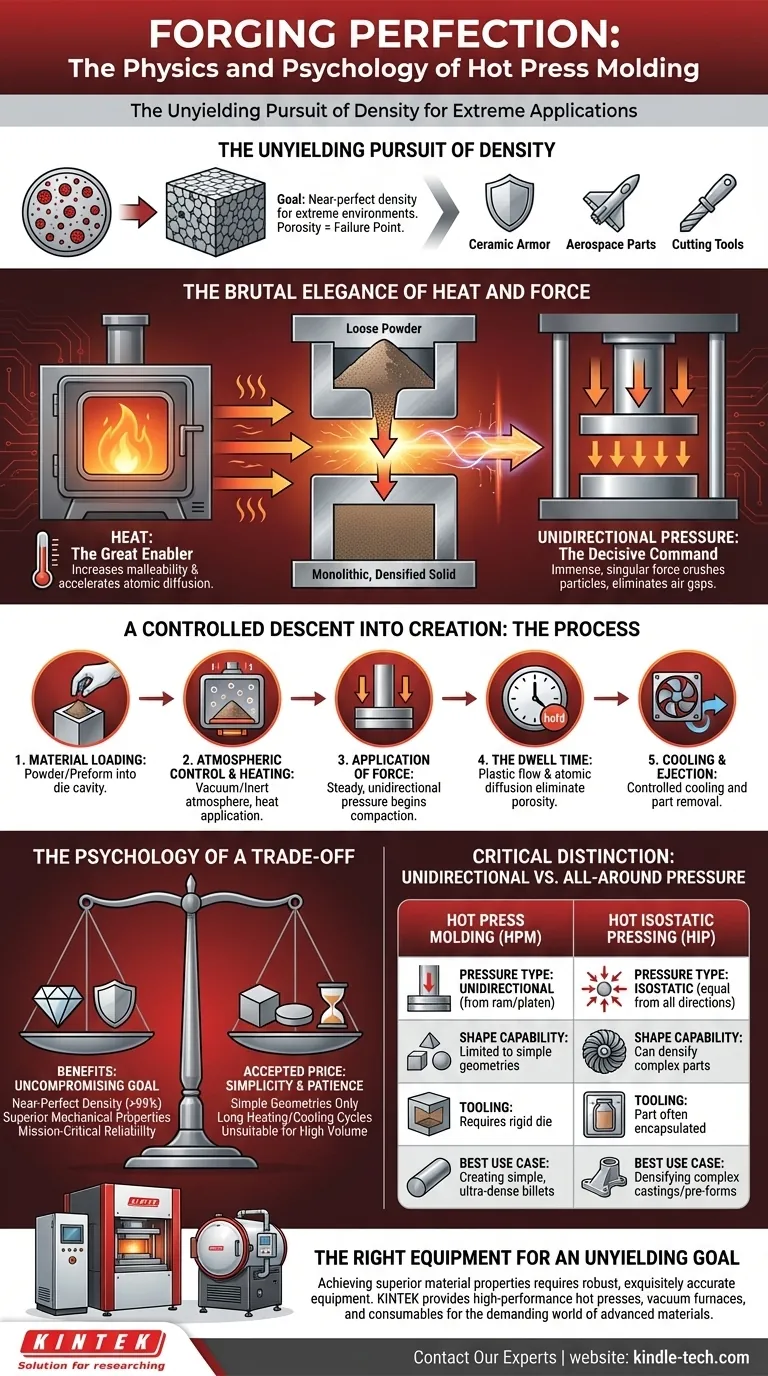
In the world of material science, some challenges cannot be solved with simple melting and casting. Creating components for extreme environments—like ceramic armor, high-performance cutting tools, or aerospace parts—requires a material integrity that conventional methods can't deliver.
These applications demand near-perfect density. Porosity, even at a microscopic level, is a failure point.
To eliminate these voids, engineers turn to a process that is both brutally simple and incredibly precise: hot press molding. It’s a deliberate choice to trade manufacturing speed and geometric complexity for one ultimate goal: unparalleled material strength.
The Brutal Elegance of Heat and Force
Hot pressing is a conversation between two fundamental forces: high temperature and immense, focused pressure. The process strips a material down to its essentials and rebuilds it into a denser, stronger version of itself.
Heat: The Great Enabler
Temperature is the first part of the equation. As the material—typically a fine powder—is heated within a die, its atoms vibrate with increasing energy. Its yield strength plummets, and it becomes pliable, almost like clay.
This heat-induced malleability prepares the particles for what comes next. More importantly, it accelerates diffusion, the slow, atomic-level dance where atoms migrate to fill the final, stubborn voids in the structure.
Unidirectional Pressure: The Decisive Command
While heat makes the material cooperative, unidirectional pressure is the driving command. A hydraulic ram applies an immense, singular force, creating a simple but powerful dynamic.
The particles are crushed together. Air gaps collapse. The material has nowhere to go but inward, conforming perfectly to the shape of the die. This synergy of heat and force transforms a loose powder into a monolithic, densified solid.
A Controlled Descent into Creation: The Process
The hot pressing cycle is less like an assembly line and more like a carefully orchestrated laboratory procedure. Every step is controlled to ensure the final part achieves its theoretical potential.
- Material Loading: The journey begins by placing the fine powder or a pre-compacted "preform" into the die cavity.
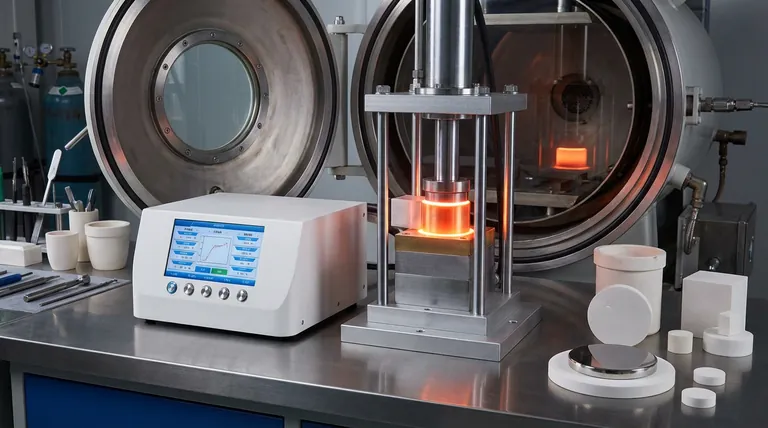
- Atmospheric Control & Heating: The entire assembly is heated, often within a vacuum or inert atmosphere furnace. This crucial step prevents oxidation, protecting both the material and the graphite tooling from high-temperature degradation.
- Application of Force: Once the target temperature is reached, the press engages, applying a steady, unidirectional pressure. This is the moment of transformation, where compaction begins.
- The Dwell Time: The material is held at peak temperature and pressure. This holding phase is not passive waiting; it is when plastic flow and atomic diffusion work to eliminate the last remnants of porosity.
- Cooling & Ejection: After the hold, the system is cooled under strict control. Once stable, the pressure is released, and the newly forged, highly dense part is ejected.
The Psychology of a Trade-Off: Why Choose This Path?
Hot pressing is slow, energy-intensive, and geometrically limiting. So why use it? The psychology behind choosing this method is one of ruthless prioritization. You are knowingly sacrificing speed and complexity for absolute material integrity.
The Uncompromising Goal: Near-Perfect Density
The primary benefit is achieving a density that is often over 99% of the material's theoretical maximum. This translates directly into superior mechanical properties: exceptional hardness, immense strength, and high resistance to wear and fracture. For a mission-critical component, this is not a luxury; it is a necessity.
The Accepted Price: Simplicity and Patience
The trade-off is clear. The unidirectional force limits parts to simple geometries like blocks, discs, and cylinders. Undercuts or complex internal features are impossible. Furthermore, the long heating and cooling cycles mean it is entirely unsuitable for high-volume production. It's a specialist's tool for a specialist's problem.
A Critical Distinction: Unidirectional vs. All-Around Pressure
It’s essential not to confuse hot pressing with a similar-sounding technique: Hot Isostatic Pressing (HIP). While both use heat and pressure, the nature of that pressure changes everything.
| Feature | Hot Press Molding | Hot Isostatic Pressing (HIP) |
|---|---|---|
| Pressure Type | Unidirectional (from a ram/platen) | Isostatic (equal from all directions via gas) |
| Shape Capability | Limited to simple, extruded-like shapes | Can densify complex, near-net-shape parts |
| Tooling | Requires a rigid die defining the final shape | Part is often encapsulated and placed in a vessel |
| Best Use Case | Creating simple, ultra-dense billets or targets | Densifying complex castings or pre-formed parts |
Choosing between them depends on your starting point. If you have a complex part that just needs to be denser, HIP is the answer. If you are creating a simple, high-performance component from powder, hot pressing is the direct and powerful choice.
The Right Equipment for an Unyielding Goal
Executing the hot press molding process successfully is a testament to control. The precision required in temperature regulation, atmospheric purity, and pressure application demands equipment that is both robust and exquisitely accurate. Your furnace is not just a heater; it's the environment where perfection is forged. Your press is not just a weight; it's the instrument of consolidation.
Achieving superior material properties begins with superior laboratory equipment. At KINTEK, we provide the high-performance hot presses, vacuum furnaces, and consumables engineered for the demanding world of advanced materials. When your goal allows for no compromise, ensure your tools don't either.
Visual Guide
Related Products
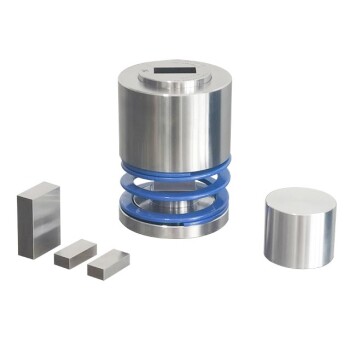
- Special Heat Press Mold for Lab Use
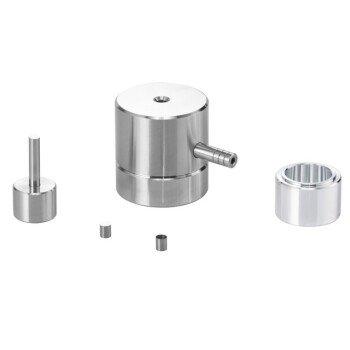
- Ball Press Mold for Lab
- Double Plate Heating Press Mold for Lab
- Cylindrical Lab Electric Heating Press Mold for Laboratory Applications
- Anti-Cracking Press Mold for Lab Use
Related Articles
- Beyond the Press: The Art and Science of Shaping Materials with Heat and Pressure
- Why Your Hot Press Samples Fail: The Hidden Culprit in Material R&D
- The Architecture of Atoms: Why Hot Press Forming Creates Superior Materials
- Taming the Void: The Art and Science of Hot Press Moulding
- How to choose a laboratory hot press