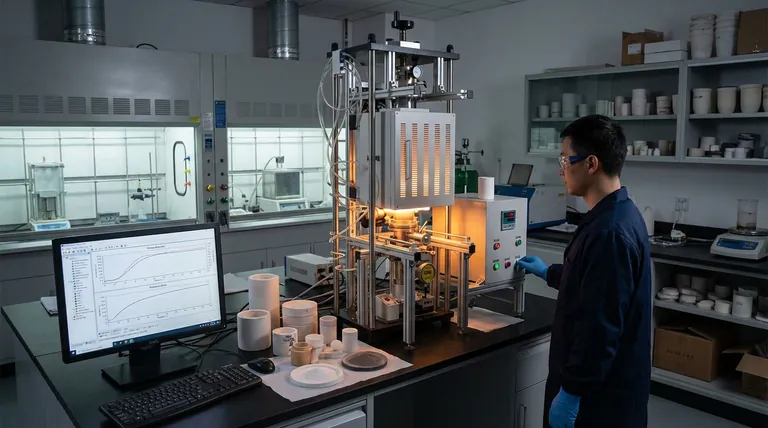
The Engineer's Dilemma: An Obsession with Perfection
Every materials engineer has faced it. A component, perfectly machined and polished, fails unexpectedly under stress. The culprit isn't a visible flaw, but an enemy within: porosity. Microscopic voids, trapped during formation, become the starting points for catastrophic cracks.
This is the silent struggle for perfection—the pursuit of a material's theoretical maximum density. It's a psychological drive as much as a technical one. The goal isn't just to create a shape; it's to impose perfect order on a material's internal structure, leaving no room for weakness.
This pursuit led to a beautifully elegant solution: don't just force a material into shape. Persuade it.
The Physics of Persuasion: How Heat and Pressure Cooperate
Hot press moulding is a manufacturing philosophy built on synergy. It recognizes that brute force alone is inefficient. Instead, it combines two fundamental forces—heat and pressure—to achieve what neither can do as effectively on its own.
Heat: The Catalyst for Cooperation
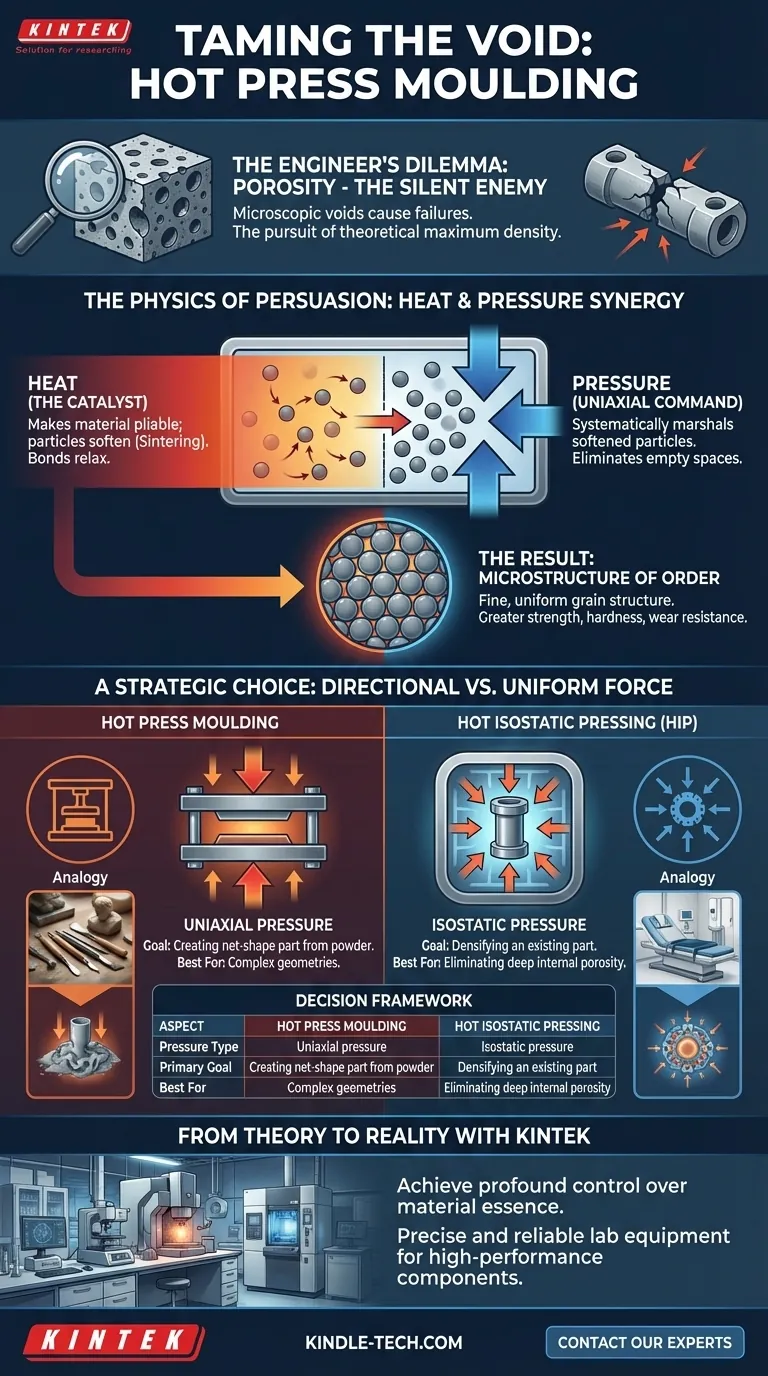
Temperature is the great negotiator. By heating a material in a controlled environment (like a vacuum or inert gas), we aren't melting it, but making it more pliable. Its internal bonds relax.
On a microscopic level, the individual particles soften. Their resistance to deformation plummets. This process, known as sintering, makes the material receptive to change, reducing the immense force and time that would otherwise be required.
Pressure: An Unambiguous Command
While heat makes the particles agreeable, pressure provides the clear, directional command. Applied uniaxially—from one or two directions—it systematically marshals the softened particles.
This force is not about crushing the material but about closing the conversation. It physically eliminates the empty spaces between particles, closing up the voids and pores that compromise structural integrity. The result is a highly densified product, a solid mass approaching its true potential.
The Result: A Microstructure of Order
The controlled combination of heat and pressure achieves something remarkable. It encourages mass transfer for strong bonds while inhibiting unwanted grain growth.
The final component emerges with a fine, uniform grain structure. This internal order translates directly into superior external properties: greater strength, improved hardness, and exceptional wear resistance. Chaos has been turned into predictable, high-performance order.
A Strategic Choice: Directional Force vs. Uniform Embrace
The genius of engineering lies not in knowing a single solution, but in choosing the right one for the job. Hot press moulding is often compared to a related technology, Hot Isostatic Pressing (HIP), but their underlying philosophies—and applications—are fundamentally different.
-
Hot Press Moulding uses uniaxial pressure. Think of it as a sculptor's targeted tools, applying force precisely where needed to create a complex, finished shape directly from powder. It's about creation.
-
Hot Isostatic Pressing (HIP) uses isostatic pressure. Imagine submerging a component in a pressurized hot gas. The force is uniform, coming from all directions. It's less about creating a shape and more about "healing" an existing one by collapsing any internal porosity. It's about densification.
The choice reflects the engineer's primary goal. Are you building a complex part from the ground up, or are you perfecting a part that has already been formed?
A Framework for Your Decision
Choosing the right process is a strategic decision based on your material, geometry, and performance targets.
| Aspect | Hot Press Moulding | Hot Isostatic Pressing (HIP) |
|---|---|---|
| Pressure Type | Uniaxial (directional) | Isostatic (uniform from all sides) |
| Primary Goal | Creating a net-shape part from powder | Densifying an existing part or casting |
| Best For | Complex geometries and high efficiency | Eliminating deep internal porosity |
| Analogy | A sculptor's press | A therapeutic pressure chamber |
From Laboratory Theory to Tangible Reality
Ultimately, hot press moulding is more than a manufacturing technique; it's a method of achieving profound control over the very essence of a material. It's for when "good enough" isn't an option and near-perfect density is the only acceptable outcome.
Bringing this level of control into a laboratory or R&D setting requires equipment that is both precise and reliable. At KINTEK, we specialize in providing the advanced lab equipment and consumables that turn theoretical possibilities into tangible, high-performance components. Our hot press systems provide the stable, controlled environment needed to master the art of material persuasion.
If your goal is to push the boundaries of material performance by creating dense, strong parts with complex shapes, we can help you select the right tools for the job. Contact Our Experts
Visual Guide
Related Products
- Special Heat Press Mold for Lab Use
- Ball Press Mold for Lab
- Double Plate Heating Press Mold for Lab
- Special Shape Press Mold for Lab
- Anti-Cracking Press Mold for Lab Use
Related Articles
- Beyond the Press: The Art and Science of Shaping Materials with Heat and Pressure
- Forging Perfection: The Physics and Psychology of Hot Press Molding
- Why Your Hot Press Samples Fail: The Hidden Culprit in Material R&D
- The Architecture of Atoms: Why Hot Press Forming Creates Superior Materials
- How to choose a laboratory hot press