The Unseen Enemy in High-Performance Materials
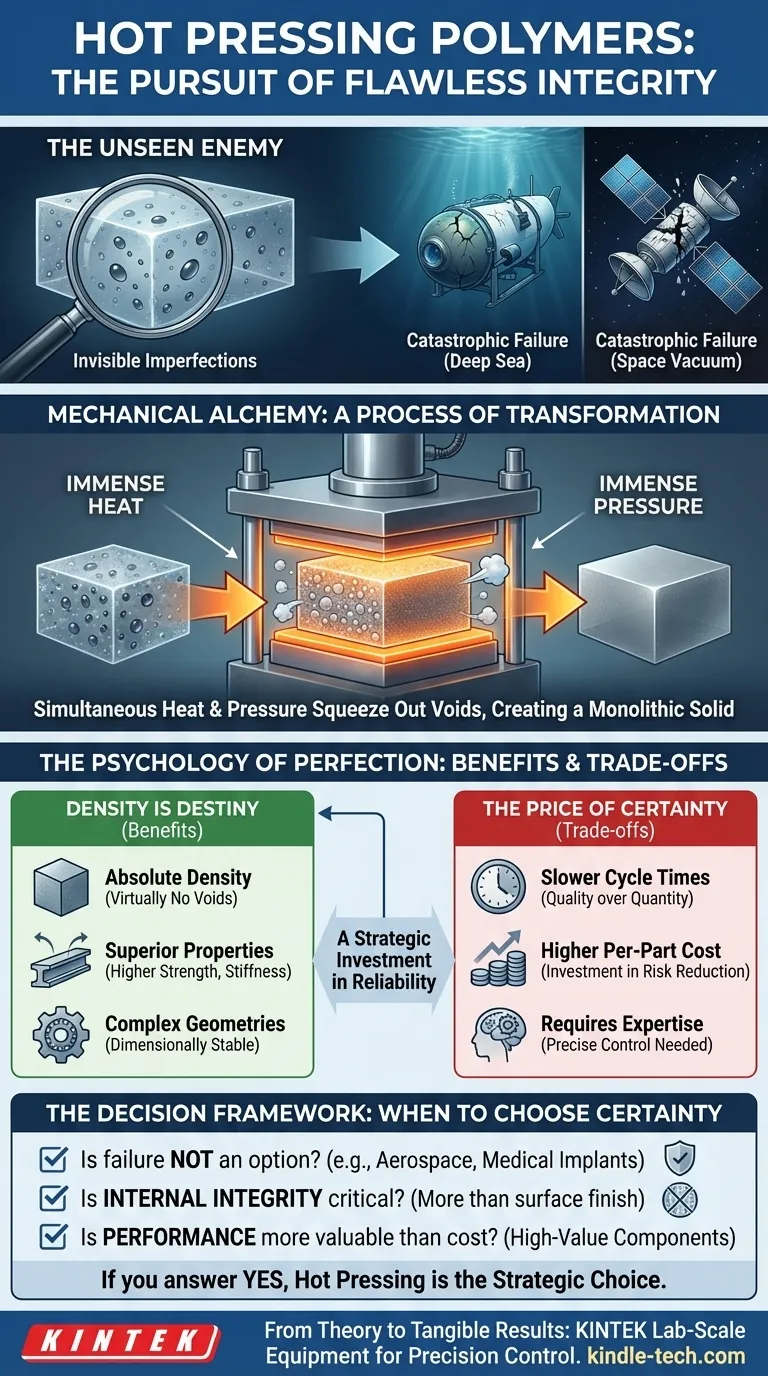
Imagine a microscopic void, a tiny bubble of nothing, trapped deep within a polymer component. On a factory floor, it's invisible. In a standard stress test, it might go unnoticed.
But in the crushing pressure of the deep sea or the thermal vacuum of orbit, this tiny imperfection becomes a focal point for catastrophic failure.
This is the central problem that engineers obsess over in critical applications. It’s not about meeting the spec sheet; it’s about defeating the unseen enemy. This psychological shift from "good enough" to "flawless" is where the logic of hot pressing begins. It's a manufacturing choice that bets everything on certainty.
A Process of Mechanical Alchemy
At its heart, hot pressing is brutally simple: it applies immense heat and pressure simultaneously to a polymer. But its purpose is sophisticated. It is not simply molding a shape; it is a process of deliberate transformation.
The heat softens the polymer, making it pliable. The pressure then does two things:
- It forces the material into the precise geometry of the mold.
- More importantly, it systematically squeezes out the microscopic imperfections—voids, pores, and potential crack sites—consolidating the material into a near-perfect, monolithic solid.
This isn't about speed or volume. It's a slow, methodical process designed to achieve one thing: maximum material integrity.
The Psychology of Perfection: Why Density is Destiny
Choosing a slower, more expensive method is a psychological statement. It signals that the cost of failure is unthinkably high. The advantages of hot pressing are a direct reflection of this mindset.
The Pursuit of Absolute Density
The primary goal is to create a part with virtually no internal voids. By eliminating empty space, you create a component that is as solid and consolidated as physically possible. This high density isn't just a number; it is the physical foundation for strength and reliability.
Engineering Against Failure
A denser, void-free structure directly translates to superior mechanical properties. Parts exhibit greater tensile strength, stiffness, and resistance to environmental stress. You aren't just making a stronger part; you are engineering a component that actively resists the mechanisms of failure.
Freedom in Form
Because the softened material is forced to flow under pressure, hot pressing excels at creating complex and intricate geometries. It allows designers to create large, dimensionally stable components without introducing the internal stresses that plague other high-speed manufacturing methods.
The Necessary Trade-offs: The Price of Certainty
There is no free lunch in engineering. The exceptional quality delivered by hot pressing comes at a clear and deliberate cost. Understanding these trade-offs is crucial.
| Trade-off | Consequence | Strategic Rationale |
|---|---|---|
| Slower Cycle Times | Not suitable for mass production; each part requires significant time. | Prioritizes quality per unit over quantity per hour. |
| Higher Per-Part Cost | Driven by energy consumption and specialized machinery. | The investment is in risk reduction, not just the component itself. |
| Requires Expertise | Demands precise control over temperature, pressure, and timing. | Ensures the process is repeatable and reliable, removing variables. |
Accepting these trade-offs isn't a weakness. It is a strategic decision to invest in reliability where it matters most.
The Decision Framework: When to Choose Certainty
Hot pressing is not a universal solution. It is a specialized tool for a specific class of problems. You should choose it when you can answer "yes" to the following:
- Is failure not an option? For critical components in aerospace, medical implants, or deep-sea equipment, the consequences of a material defect are absolute.
- Is internal integrity more important than surface finish? The process is optimized for eliminating internal flaws in large, thick, or complex parts.
- Is performance more valuable than production cost? This method is for low-volume, high-value components where the part's performance justifies the investment.
From Theory to Tangible Results
Achieving the theoretical perfection of hot pressing requires absolute control over the process variables. The gap between a good idea and a reliable component is bridged by the quality of your equipment.
This level of precision isn't accidental. It is the direct result of a controlled laboratory environment, where every parameter can be meticulously set and repeated. At KINTEK, we specialize in the lab-scale equipment that gives engineers and researchers this exact control. Our hot presses and material testing instruments are designed to transform the deliberate pursuit of integrity into a tangible, high-performance reality.
If your project demands nothing less than the highest material integrity, then the right process—and the right tools—are non-negotiable. Contact Our Experts
Visual Guide
Related Products
- Special Heat Press Mold for Lab Use
- Ball Press Mold for Lab
- Double Plate Heating Press Mold for Lab
- Cylindrical Lab Electric Heating Press Mold for Laboratory Applications
- Anti-Cracking Press Mold for Lab Use
Related Articles
- Beyond the Press: The Art and Science of Shaping Materials with Heat and Pressure
- Forging Perfection: The Physics and Psychology of Hot Press Molding
- Why Your Hot Press Samples Fail: The Hidden Culprit in Material R&D
- The Architecture of Atoms: Why Hot Press Forming Creates Superior Materials
- Taming the Void: The Art and Science of Hot Press Moulding