The Limits of Brute Force
In manufacturing, we often think in terms of force. To shape metal, we press it, stamp it, and bend it. We treat it as an adversary to be conquered.
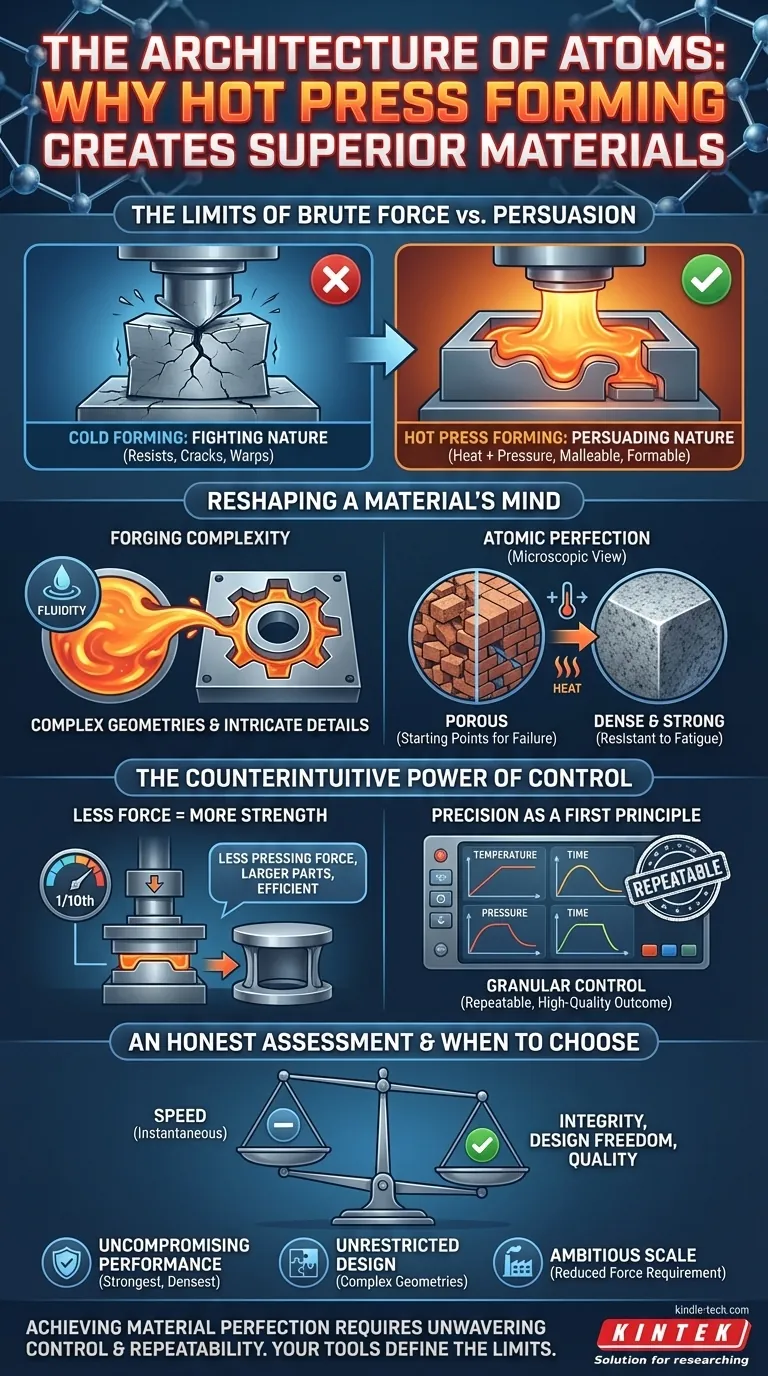
But materials, like people, have a breaking point. Push them too hard, too cold, and they resist. They crack, warp, or fail. This is the fundamental limitation of traditional cold forming: you are fighting against the material's inherent nature.
Hot press forming operates on a different, more profound principle. It doesn't command; it persuades. It uses heat to change the material's internal state, making it willing to be reshaped into something stronger and more complex than it was before.
Reshaping a Material's Mind
The core insight of hot pressing is psychological, applied to physics. By heating a material—be it a powdered metal, a composite, or a high-strength alloy—you lower its defenses. Its internal structure becomes malleable, its formability increases, and it becomes receptive to change.
This isn't just about making it softer. It's about fundamentally altering its behavior under pressure.
Forging Complexity from Fluidity
When heated, a solid material begins to flow, almost like a viscous liquid. This increased fluidity is the key to creating complex geometries.
Under pressure, the material now willingly fills every sharp corner and intricate detail of a mold. It allows engineers to design parts with a level of complexity that would be impossible with cold stamping, where the material would tear or fracture rather than conform.
The Pursuit of Atomic Perfection
The true magic, however, happens at a level you cannot see. The combination of intense heat and pressure does more than just shape a part—it refines it from the inside out.
Every material contains microscopic voids and porosities, tiny imperfections that are the starting points for cracks and failures. Hot pressing systematically squeezes these voids out of existence.
The process forges powerful mechanical and electrical bonds between particles, creating a final component that is denser, stronger, and far more resistant to fatigue and wear. It's the difference between a loosely packed wall of bricks and a single, solid piece of granite.
The Counterintuitive Power of Control
Beyond the final product, the process itself embodies a more sophisticated approach to manufacturing, where intelligence trumps raw power.
Why Less Force Creates More Strength
Paradoxically, hot forming often requires dramatically less pressing force—sometimes as little as one-tenth of that needed for cold forming.
Because the material is more cooperative, you don't need a bigger hammer. This efficiency means larger, more ambitious parts can be produced on smaller, more energy-efficient equipment. It’s a strategic advantage that reduces capital investment and operational costs.
Precision as a First Principle
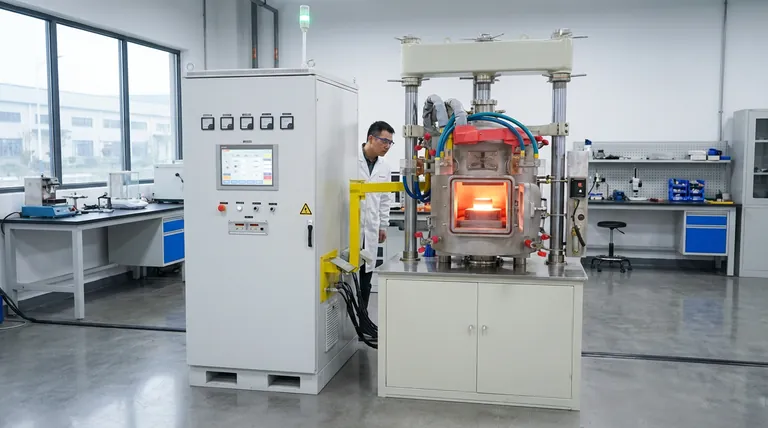
This process is not a blunt instrument. Modern hot press systems, like those used in advanced research labs, are instruments of extreme precision. They allow for granular control over every variable: heating rates, temperature holds, pressure curves, and cooling cycles.
This level of control, managed through programmable cycles, is what ensures that the remarkable properties achieved are not a one-time accident but a repeatable, high-quality outcome. It transforms manufacturing from an art into a science.
An Honest Assessment: Choosing Intentionality Over Speed
No process is a universal solution. The primary trade-off of hot press forming is speed. Heating the material and tools takes time, making cycle times longer than instantaneous cold stamping.
Achieving perfect uniformity in very large or unusually shaped parts also presents a challenge, demanding careful tool design and process management.
But this isn't a flaw. It's a choice. You are trading raw speed for absolute integrity and design freedom. It’s a decision to prioritize quality over quantity.
When to Choose Hot Press Forming
The decision hinges on your primary objective.
- For Uncompromising Performance: If your goal is the strongest, densest, most reliable part possible, the elimination of internal porosity is the decisive advantage.
- For Unrestricted Design: If your design features complex geometries that are non-negotiable, hot pressing is often the only viable path forward.
- For Ambitious Scale: If you need to produce large components without investing in colossal, high-tonnage presses, the reduced force requirement makes it the smarter economic choice.
Ultimately, hot press forming is for those who understand that the final properties of a component are defined not just by its shape, but by the integrity of its internal architecture.
Achieving this level of material perfection requires equipment that delivers unwavering control and repeatability. Whether in a research lab developing next-generation composites or a facility optimizing production, the quality of your tools defines the limits of what's possible. To explore the potential of precisely controlled thermal processing, Contact Our Experts
Visual Guide
Related Products
- Special Heat Press Mold for Lab Use
- Heated Hydraulic Press Machine with Heated Plates Split Manual Laboratory Hot Press
- Vacuum Hot Press Furnace Heated Vacuum Press Machine Tube Furnace
- Heated Hydraulic Press Machine with Heated Plates for Vacuum Box Laboratory Hot Press
- Automatic High Temperature Heated Hydraulic Press Machine with Heated Plates for Lab
Related Articles
- Beyond the Press: The Art and Science of Shaping Materials with Heat and Pressure
- Forging Perfection: The Physics and Psychology of Hot Press Molding
- Why Your Hot Press Samples Fail: The Hidden Culprit in Material R&D
- Taming the Void: The Art and Science of Hot Press Moulding
- How to choose a laboratory hot press