Blog The Geometry of Heat: Engineering the Perfect Thermal Environment
The Geometry of Heat: Engineering the Perfect Thermal Environment

The Geometry of Heat: Engineering the Perfect Thermal Environment

6 days ago

The laboratory is a place of variables. We obsess over the purity of our reagents and the precision of our scales. Yet, often, we treat heat as a blunt instrument. We set a dial to 1000°C and assume the environment inside the chamber is absolute.

It rarely is.

Heat is a fluid, chaotic entity. It seeks to escape. It clusters in corners. It drifts.

Choosing a tube furnace is not merely about purchasing a piece of hardware; it is about choosing a strategy to contain and manipulate this chaos. It is an engineering decision about how your sample interacts with the universe of thermodynamics.

At KINTEK, we believe that understanding the "personality" of your furnace—its geometry, its zoning, and its movement—is just as critical as the chemistry occurring inside it.

The Integrity of the Circle: Access vs. Isolation

The first decision in thermal engineering is physical. It is a battle between human convenience and thermal perfection.

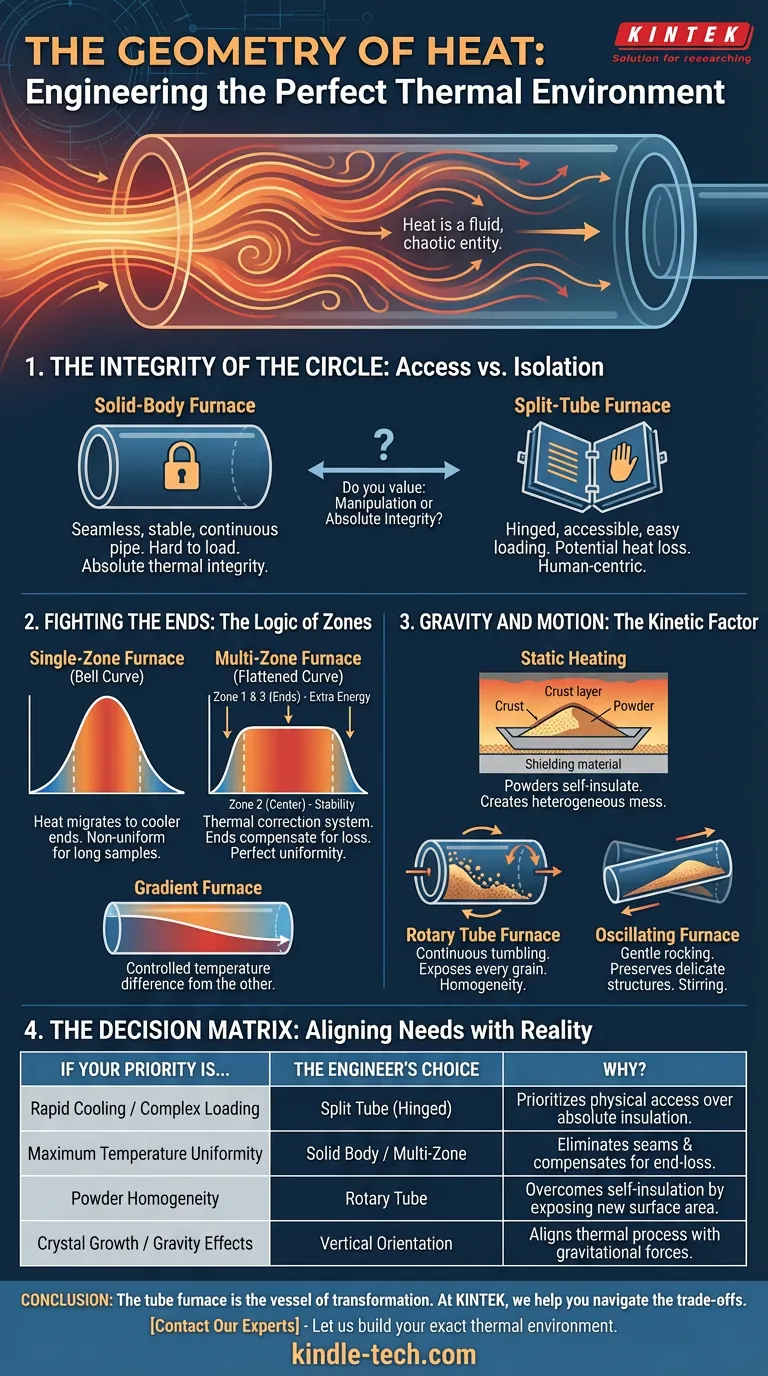
The Solid-Body Furnace Imagine a continuous pipe. A solid, non-split furnace is a seamless cylinder of insulation and heating elements. Because there are no breaks in the architecture, the thermal profile is incredibly stable. Heat has no easy escape route.

However, the physicist’s dream is the operator’s headache. You must thread your sample through the end. If you have complex flanges or fragile setups, this is risky.

The Split-Tube Furnace Here, we introduce a hinge. The furnace opens like a clam.

This is the "human-centric" design. You can lay your reactor tube directly into the heating elements. You can cool the sample rapidly by opening the chassis. But every seam is a potential leak for energy.

The trade-off is clear: Do you value the ease of manipulation (Split) or the absolute integrity of the thermal envelope (Solid)?

Fighting the Ends: The Logic of Zones

If you heat a tube in the center, physics dictates that heat will migrate toward the cooler ends. In a Single-Zone furnace, this creates a bell curve. The center is hot; the edges are cooling down.

For small samples, this is acceptable. For long samples requiring uniformity, it is a disaster.

The Multi-Zone Solution To fight this natural gradient, we use Multi-Zone furnaces. A standard three-zone furnace acts as a thermal correction system.

  • Zone 1 & 3 (Ends): These work harder, pumping in extra energy to compensate for the heat loss at the tube's openings.
  • Zone 2 (Center): This maintains stability.

The result is a flattened curve—a long, extended area of perfect uniformity.

Conversely, some researchers need the chaos. Gradient Furnaces intentionally drive a temperature difference from one end to the other, allowing materials to be tested across a spectrum of temperatures simultaneously. It is controlled instability.

Gravity and Motion: The Kinetic Factor

Most heating is static. The sample sits; the heat washes over it. But what if the sample hides from the heat?

Powders and granules are notorious insulators. If you heat a pile of powder in a static boat, the top layer creates a crust, shielding the material beneath. The result is a heterogeneous mess.

The Rotary Approach The solution is kinetic energy. Rotary Tube Furnaces turn the entire process tube. The powder tumbles. Every grain is exposed to the atmosphere and the heat source in a continuous cycle.

The Oscillating Alternative Sometimes, rotation is too aggressive. Oscillating furnaces gently rock the tube. It is the difference between a blender and a gentle stir. This preserves delicate structures while ensuring that heat—and gas flow—reaches every micron of the sample.

The Decision Matrix

There is no "perfect" furnace. There is only the furnace that aligns with the constraints of your experiment.

We often see researchers over-specifying (buying complexity they don’t need) or under-specifying (ignoring the physics of their sample).

Here is how to align your needs with the engineering reality:

If your priority is... The Engineer's Choice Why?
Rapid Cooling / Complex Loading Split Tube (Hinged) Prioritizes physical access over absolute insulation.
Maximum Temperature Uniformity Solid Body / Multi-Zone Eliminates seams and compensates for end-loss.
Powder Homogeneity Rotary Tube Overcomes self-insulation by constantly exposing new surface area.
Crystal Growth / Gravity Effects Vertical Orientation Aligns the thermal process with gravitational forces.

Conclusion

The tube furnace is the vessel of transformation. Whether you are growing crystals, sintering ceramics, or analyzing pyrolysis, the geometry of your equipment dictates the quality of your data.

You do not need to fight these variables alone.

At KINTEK, we specialize in the intersection of lab requirements and thermal engineering. We help you navigate the trade-offs between access and uniformity, static and dynamic processing.

Contact Our Experts today to discuss your specific application. Let us help you build the exact thermal environment your research demands.

Visual Guide
The Geometry of Heat: Engineering the Perfect Thermal Environment Visual Guide

Related Products

Related Articles

Related Products

Multi-zone Laboratory Tube Furnace

Multi-zone Laboratory Tube Furnace

Experience precise, efficient thermal testing with our Multi Zone Tube Furnace. Independent heating zones and temperature sensors allow for controlled high-temperature gradient heating fields. Order now for advanced thermal analysis!

Laboratory Rapid Thermal Processing (RTP) Quartz Tube Furnace

Laboratory Rapid Thermal Processing (RTP) Quartz Tube Furnace

Get lightning-fast heating with our RTP Rapid Heating Tube Furnace. Designed for precise, high-speed heating and cooling with convenient sliding rail and TFT touch screen controller. Order now for ideal thermal processing!

1700℃ Laboratory High Temperature Tube Furnace with Alumina Tube

1700℃ Laboratory High Temperature Tube Furnace with Alumina Tube

Looking for a high-temperature tube furnace? Check out our 1700℃ Tube Furnace with Alumina Tube. Perfect for research and industrial applications up to 1700C.

Laboratory Vacuum Tilt Rotary Tube Furnace Rotating Tube Furnace

Laboratory Vacuum Tilt Rotary Tube Furnace Rotating Tube Furnace

Discover the versatility of Laboratory Rotary Furnace: Ideal for calcination, drying, sintering, and high-temperature reactions. Adjustable rotating and tilting functions for optimal heating. Suitable for vacuum and controlled atmosphere environments. Learn more now!

1400℃ Laboratory High Temperature Tube Furnace with Alumina Tube

1400℃ Laboratory High Temperature Tube Furnace with Alumina Tube

Looking for a tube furnace for high-temperature applications? Our 1400℃ Tube Furnace with Alumina Tube is perfect for research and industrial use.

High Pressure Laboratory Vacuum Tube Furnace Quartz Tubular Furnace

High Pressure Laboratory Vacuum Tube Furnace Quartz Tubular Furnace

KT-PTF High Pressure Tube Furnace: Compact split tube furnace with strong positive pressure resistance. Working temp up to 1100°C and pressure up to 15Mpa. Also works under controller atmosphere or high vacuum.

1800℃ Muffle Oven Furnace for Laboratory

1800℃ Muffle Oven Furnace for Laboratory

KT-18 muffle furnace with Japan Al2O3 polycrystalline fibe and Silicon Molybdenum heating element, up to 1900℃, PID temperature control and 7" smart touch screen. Compact design, low heat loss, and high energy efficiency. Safety interlock system and versatile functions.

1200℃ Controlled Atmosphere Furnace Nitrogen Inert Atmosphere Furnace

1200℃ Controlled Atmosphere Furnace Nitrogen Inert Atmosphere Furnace

Discover our KT-12A Pro Controlled atmosphere furnace - high precision, heavy duty vacuum chamber, versatile smart touch screen controller, and excellent temperature uniformity up to 1200C. Ideal for both laboratory and industrial application.

Graphite Vacuum Furnace High Thermal Conductivity Film Graphitization Furnace

Graphite Vacuum Furnace High Thermal Conductivity Film Graphitization Furnace

The high thermal conductivity film graphitization furnace has uniform temperature, low energy consumption and can operate continuously.

1700℃ Controlled Atmosphere Furnace Nitrogen Inert Atmosphere Furnace

1700℃ Controlled Atmosphere Furnace Nitrogen Inert Atmosphere Furnace

KT-17A Controlled atmosphere furnace: 1700℃ heating, vacuum sealing technology, PID temperature control, and versatile TFT smart touch screen controller for laboratory and industrial use.

Mesh belt controlled atmosphere furnace

Mesh belt controlled atmosphere furnace

Discover our KT-MB mesh belt sintering furnace - perfect for high-temperature sintering of electronic components & glass insulators. Available for open air or controlled atmosphere environments.

1700℃ Muffle Oven Furnace for Laboratory

1700℃ Muffle Oven Furnace for Laboratory

Get superior heat control with our 1700℃ Muffle Furnace. Equipped with intelligent temperature microprocessor, TFT touch screen controller & advanced insulation materials for precise heating up to 1700C. Order now!

Controlled Nitrogen Inert Hydrogen Atmosphere Furnace

Controlled Nitrogen Inert Hydrogen Atmosphere Furnace

KT-AH Hydrogen atmosphere furnace - induction gas furnace for sintering/annealing with built-in safety features, dual housing design, and energy-saving efficiency. Ideal for lab and industrial use.

Horizontal High Temperature Graphite Vacuum Graphitization Furnace

Horizontal High Temperature Graphite Vacuum Graphitization Furnace

Horizontal Graphitization Furnace: This type of furnace is designed with the heating elements placed horizontally, allowing for uniform heating of the sample. It's well-suited for graphitizing large or bulky samples that require precise temperature control and uniformity.

Vacuum Heat Treat Sintering Brazing Furnace

Vacuum Heat Treat Sintering Brazing Furnace

A vacuum brazing furnace is a type of industrial furnace used for brazing, a metalworking process that joins two pieces of metal using a filler metal that melts at a lower temperature than the base metals. Vacuum brazing furnaces are typically used for high-quality applications where a strong, clean joint is required.

Vacuum Heat Treat and Molybdenum Wire Sintering Furnace for Vacuum Sintering

Vacuum Heat Treat and Molybdenum Wire Sintering Furnace for Vacuum Sintering

A vacuum molybdenum wire sintering furnace is a vertical or bedroom structure, which is suitable for withdrawal, brazing, sintering and degassing of metal materials under high vacuum and high temperature conditions. It is also suitable for dehydroxylation treatment of quartz materials.

Ultra-High Temperature Graphite Vacuum Graphitization Furnace

Ultra-High Temperature Graphite Vacuum Graphitization Furnace

The ultra-high temperature graphitization furnace utilizes medium frequency induction heating in a vacuum or inert gas environment. The induction coil generates an alternating magnetic field, inducing eddy currents in the graphite crucible, which heats up and radiates heat to the workpiece, bringing it to the desired temperature. This furnace is primarily used for graphitization and sintering of carbon materials, carbon fiber materials, and other composite materials.

Molybdenum Vacuum Heat Treat Furnace

Molybdenum Vacuum Heat Treat Furnace

Discover the benefits of a high-configuration molybdenum vacuum furnace with heat shield insulation. Ideal for high-purity, vacuum environments like sapphire crystal growth and heat treatment.

Vacuum Hot Press Furnace Heated Vacuum Press Machine Tube Furnace

Vacuum Hot Press Furnace Heated Vacuum Press Machine Tube Furnace

Reduce forming pressure & shorten sintering time with Vacuum Tube Hot Press Furnace for high-density, fine-grain materials. Ideal for refractory metals.

1400℃ Muffle Oven Furnace for Laboratory

1400℃ Muffle Oven Furnace for Laboratory

Get precise high-temperature control up to 1500℃ with KT-14M Muffle furnace. Equipped with a smart touch screen controller and advanced insulation materials.


Leave Your Message