The Illusion of a Single Price Tag
Asking for the cost of a Cold Isostatic Press (CIP) is like asking for the cost of a vehicle. A scooter and a cargo truck both have wheels and an engine, but their prices reflect entirely different purposes.
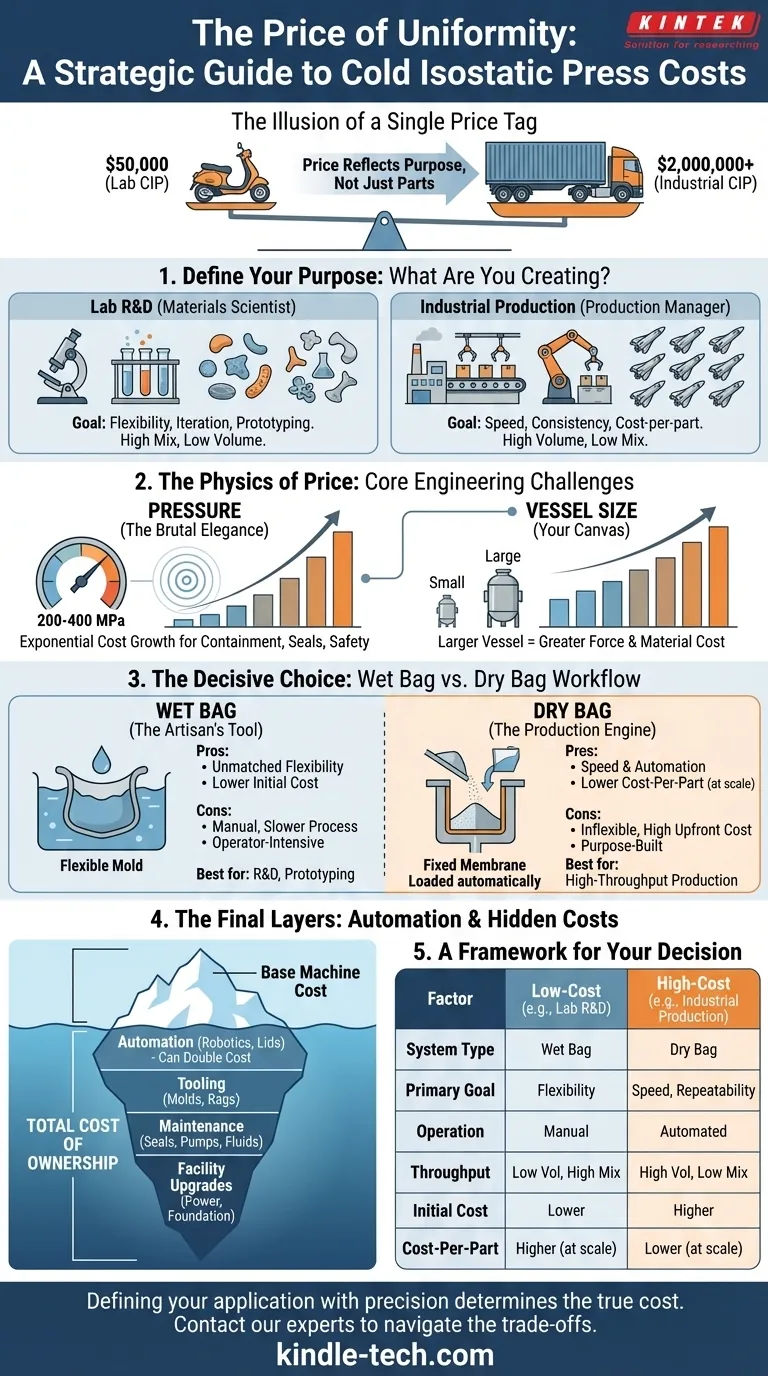
A small laboratory CIP might cost $50,000. A large, fully automated industrial system can exceed $2,000,000. This vast range isn't arbitrary. It’s the direct result of physics, engineering, and operational philosophy. The final price isn't a number you find; it's a number you build, piece by piece, based on the specific problem you need to solve.
The First Question: What Are You Creating?
Before looking at a single specification, picture your goal.
Are you a materials scientist in a university lab, developing novel ceramic composites? Your work is iterative. You need to press a dozen different small, experimental shapes this month. Flexibility is your currency. A production bottleneck is an annoyance, but the inability to test a new idea is a fatal flaw.
Or are you a production manager for a company making thousands of identical aerospace components? Your world is defined by cycle times, repeatability, and cost-per-part. Flexibility is a liability; specialization and unwavering consistency are your goals. A machine that saves two minutes per cycle can save millions over its lifetime.
These two scenarios require fundamentally different machines. The true cost is rooted in this initial question of purpose.
Deconstructing the Machine: The Physics of Price
The cost of a CIP is forged from three core engineering challenges.
H3: Pressure: The Brutal Elegance of Containment
The heart of a CIP is its ability to exert immense, perfectly uniform pressure. Most applications operate between 200 and 400 MPa (30,000 to 60,000 psi)—a force comparable to the bottom of the deepest ocean trenches.
Containing that force is a monumental engineering task. As the pressure rating increases, the cost grows exponentially. The thickness of the vessel walls, the complexity of the seals, and the power of the pumping system all scale dramatically. You are not just paying for pressure; you are paying for the materials science and safety engineering required to control it reliably, cycle after cycle.
H3: Vessel Size: Your Canvas for Compaction
The internal chamber is your workspace. A larger vessel doesn't just mean more steel; it means managing exponentially greater total force against the vessel lid and walls.
The cost is directly tied to the size and quantity of parts you need to process in a single run. A small chamber for lab-scale prototypes is orders of magnitude less complex to engineer than a massive vessel designed to form large, near-net shape industrial blanks.
The Decisive Choice: Wet Bag vs. Dry Bag
This is the most significant fork in the road. It's not just a technical choice; it's a commitment to a specific workflow philosophy.
H3: The Artisan's Tool: The Wet Bag Press
In a wet bag system, a sealed, flexible mold containing the powder is submerged directly in the pressure fluid.
- Pro: Unmatched flexibility. You can press virtually any shape simply by creating a new, inexpensive mold. It's the perfect environment for R&D, prototyping, and high-mix, low-volume production.
- Con: It's a manual, slower process. Each cycle requires manual loading, sealing, submersion, and unloading.
This system is for the materials scientist. The initial investment is lower because the complexity is managed by a skilled operator, not the machine itself.
H3: The Production Engine: The Dry Bag Press
Here, the machine has a permanent elastomeric membrane built into the pressure vessel. Powder is loaded into this membrane, and pressure is applied from the outside.
- Pro: Speed and automation. Designed for high-throughput, repeatable production of a single part or a family of similar parts.
- Con: Inflexible and expensive. The system is purpose-built for a specific geometry.
This is the production manager's engine. The high upfront cost is an investment in reducing long-term labor costs and maximizing output, achieving the lowest possible cost-per-part at scale.
The Final Layers: Automation and Hidden Costs
A basic manual press is the entry point. But as production needs grow, automation becomes essential.
Features like automated lids, robotic part handling, and integrated control systems can easily double the cost of the core machine. This isn't a luxury; it's a strategic trade-off. You are investing capital to reduce operational expenditure, minimize human error, and increase throughput.
Remember to budget beyond the purchase order for the total cost of ownership:
- Tooling: Molds and bags are consumables.
- Maintenance: Seals, pumps, and fluids require regular service.
- Facility: These are heavy, power-hungry machines that may require foundational and electrical upgrades.
A Framework for Your Decision
Choosing a CIP is a process of aligning your budget with your primary objective.
| Factor | Low-Cost (e.g., Lab R&D) | High-Cost (e.g., Industrial Production) |
|---|---|---|
| System Type | Wet Bag | Dry Bag |
| Primary Goal | Flexibility, Prototyping | Speed, Repeatability |
| Operation | Manual, Operator-intensive | Automated, Low labor per part |
| Throughput | Low Volume, High Mix | High Volume, Low Mix |
| Initial Cost | Lower | Higher |
| Cost-Per-Part | Higher (at scale) | Lower (at scale) |
Ultimately, defining your application with precision is the only way to determine the true cost. Navigating these trade-offs requires expertise, especially when your goal is to push the boundaries of material science in a laboratory setting. Contact Our Experts
Visual Guide
Related Products
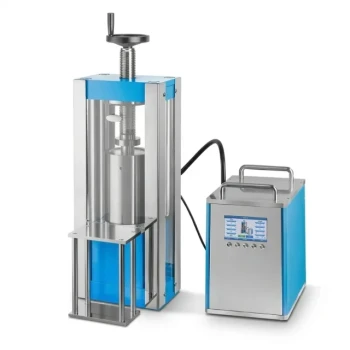
- Electric Split Lab Cold Isostatic Press CIP Machine for Cold Isostatic Pressing
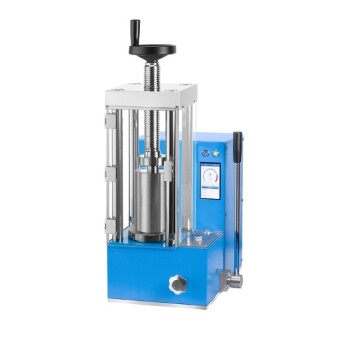
- Electric Lab Cold Isostatic Press CIP Machine for Cold Isostatic Pressing
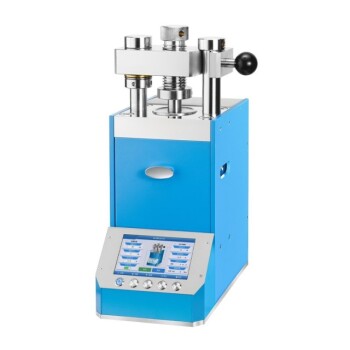
- Automatic Lab Cold Isostatic Press CIP Machine Cold Isostatic Pressing
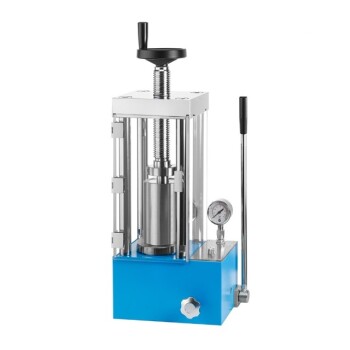
- Manual Cold Isostatic Pressing Machine CIP Pellet Press
- Warm Isostatic Press for Solid State Battery Research