Blog The Thermodynamics of Patience: Mastering the Five-Port Cell
The Thermodynamics of Patience: Mastering the Five-Port Cell

The Thermodynamics of Patience: Mastering the Five-Port Cell

1 week ago

The Silent Variable

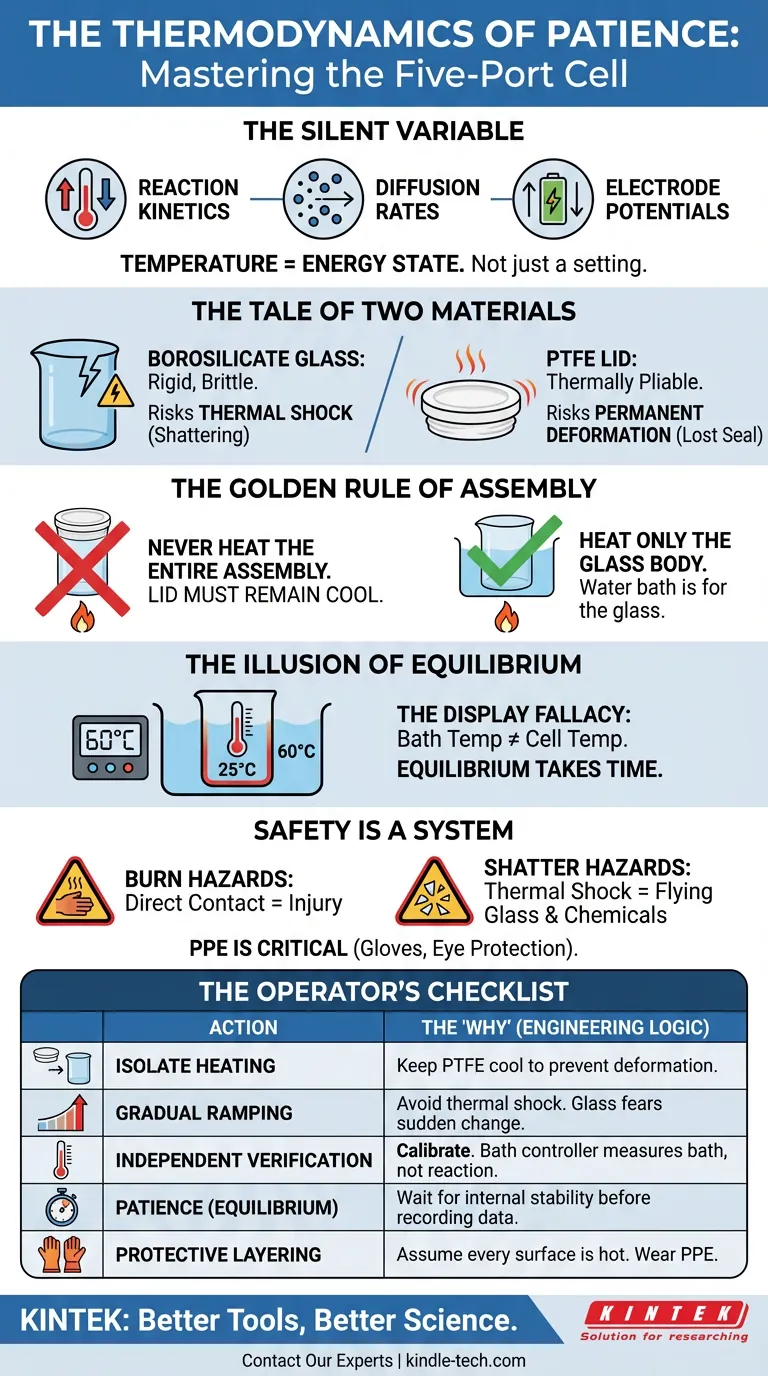
In electrochemistry, temperature is not merely a setting on a dial. It is an energy state.

It dictates reaction kinetics. It governs diffusion rates. It shifts electrode potentials.

Yet, in the rush to gather data, we often treat the five-port water bath electrolytic cell as a static vessel. We assume the temperature on the controller is the truth. We assume the materials will comply with our schedule.

This is a mistake.

The core challenge of high-precision chemistry is not just the reaction itself. It is managing the tension between the need for heat and the physical limitations of your hardware.

The Tale of Two Coefficients

An electrolytic cell is an engineering marriage between two very different materials: Borosilicate glass and Polytetrafluoroethylene (PTFE).

They live together happily at room temperature. But add heat, and the relationship strains.

The Glass Body: It is rigid and brittle. It respects structure but fears sudden change. Subject it to thermal shock—a rapid spike or drop in temperature—and it will shatter.

The PTFE Lid: It is chemical-resistant but thermally pliable. When heated, it expands. Unlike glass, it has a "memory" problem. If you heat the entire assembly (lid included), the PTFE deforms. When it cools, it does not return to its original shape.

The seal is lost. The component is ruined.

The Golden Rule of Assembly

There is one rule that cannot be broken:

Never heat the entire assembly.

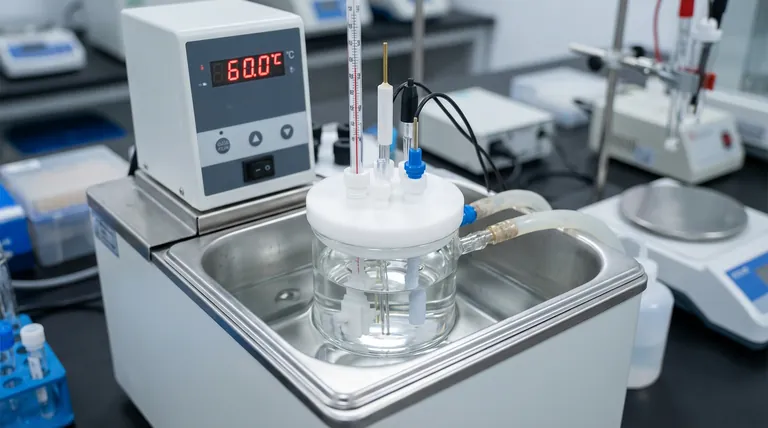
The water bath circulation system is designed for the glass body. The lid must remain cool. This mismatch in thermal behavior is why only the glass body can be autoclaved. Sterilizing the full assembly is a sentence of death for the lid.

The Illusion of Equilibrium

There is a psychological trap in lab work called "The Display Fallacy."

You set the water bath to 60°C. The display reads 60°C. You immediately inject your electrolyte and begin the scan.

Your data will be wrong.

The bath is 60°C. The glass wall is transitioning. The electrolyte in the center is likely still 25°C.

Thermal equilibrium is a function of time, not just energy.

For reproducible results—the kind that stand up to peer review—you must wait. For high-precision work, do not trust the bath controller. Place a calibrated thermometer directly inside the cell.

Safety is a System

Beyond the data, there is the operator.

Thermal control systems are inherently hazardous. We get comfortable with them because water looks benign. But hot glass looks exactly like cold glass.

  • Burn Hazards: Direct contact with the bath or the cell body causes immediate injury.
  • Shatter Hazards: A thermal shock fracture can send glass shards and hot chemicals across the bench.

PPE (heat-resistant gloves and eye protection) is not a formality. It is the only barrier between your skin and a physics failure.

The Operator's Checklist

To navigate these risks, we must adopt a strict protocol.

Here is the operational framework for maintaining both safety and data integrity:

Action The "Why" (Engineering Logic)
Isolate Heating Heat only the glass body. Keep the PTFE lid cool to prevent permanent deformation.
Gradual Ramping Avoid thermal shock. Glass handles high heat, but not sudden heat.
Independent Verification Calibrate. The bath controller measures the bath, not your reaction.
Patience (Equilibrium) Wait for the internal temperature to stabilize before recording data.
Protective Layering Assume every surface is hot. Wear heat-resistant gloves.

Better Tools, Better Science

You cannot fight physics, but you can work with it.

Success in electrochemistry comes from understanding the limits of your materials and the variables of your environment. It requires patience, precision, and the right equipment.

At KINTEK, we design our lab equipment with these realities in mind. Our water baths and electrolytic cells are engineered to provide the stability you need, minimizing the variables that keep you up at night.

Do not let thermal fluctuation be the reason your experiment fails.

Contact Our Experts

Visual Guide

The Thermodynamics of Patience: Mastering the Five-Port Cell Visual Guide

Related Products

Related Articles

Related Products

Super Sealed Electrolytic Electrochemical Cell

Super Sealed Electrolytic Electrochemical Cell

Super-sealed electrolytic cell offers enhanced sealing capabilities, making it ideal for experiments that require high airtightness.

Electrolytic Electrochemical Cell for Coating Evaluation

Electrolytic Electrochemical Cell for Coating Evaluation

Looking for corrosion-resistant coating evaluation electrolytic cells for electrochemical experiments? Our cells boast complete specifications, good sealing, high-quality materials, safety, and durability. Plus, they're easily customizable to meet your needs.

Electrolytic Electrochemical Cell with Five-Port

Electrolytic Electrochemical Cell with Five-Port

Streamline your laboratory consumables with Kintek's Electrolytic Cell with five-port design. Choose from sealed and non-sealed options with customizable electrodes. Order now.

Double-Layer Water Bath Electrolytic Electrochemical Cell

Double-Layer Water Bath Electrolytic Electrochemical Cell

Discover the temperature-controllable electrolytic cell with a double-layer water bath, corrosion resistance, and customization options. Complete specifications included.

PTFE Electrolytic Cell Electrochemical Cell Corrosion-Resistant Sealed and Non-Sealed

PTFE Electrolytic Cell Electrochemical Cell Corrosion-Resistant Sealed and Non-Sealed

Choose our PTFE Electrolytic Cell for reliable, corrosion-resistant performance. Customize specifications with optional sealing. Explore now.

Electrolytic Electrochemical Cell Gas Diffusion Liquid Flow Reaction Cell

Electrolytic Electrochemical Cell Gas Diffusion Liquid Flow Reaction Cell

Looking for a high-quality gas diffusion electrolysis cell? Our liquid flow reaction cell boasts exceptional corrosion resistance and complete specifications, with customizable options available to suit your needs. Contact us today!

Quartz Electrolytic Electrochemical Cell for Electrochemical Experiments

Quartz Electrolytic Electrochemical Cell for Electrochemical Experiments

Looking for a reliable quartz electrochemical cell? Our product boasts excellent corrosion resistance and complete specifications. With high-quality materials and good sealing, it's both safe and durable. Customize to meet your needs.

Customizable PEM Electrolysis Cells for Diverse Research Applications

Customizable PEM Electrolysis Cells for Diverse Research Applications

Custom PEM test cell for electrochemical research. Durable, versatile, for fuel cells & CO2 reduction. Fully customizable. Get a quote!

Side Window Optical Electrolytic Electrochemical Cell

Side Window Optical Electrolytic Electrochemical Cell

Experience reliable and efficient electrochemical experiments with a side window optical electrolytic cell. Boasting corrosion resistance and complete specifications, this cell is customizable and built to last.

Customizable Swagelok Type Test Cells for Advanced Battery Research Electrochemical Analysis

Customizable Swagelok Type Test Cells for Advanced Battery Research Electrochemical Analysis

The KINTEK Swagelok-type test cell is a modular, T-shaped device constructed from high-quality, chemically inert materials.

H Type Electrolytic Cell Triple Electrochemical Cell

H Type Electrolytic Cell Triple Electrochemical Cell

Experience versatile electrochemical performance with our H-type Electrolytic Cell. Choose from membrane or non-membrane sealing, 2-3 hybrid configurations. Learn more now.

FS Electrochemical Hydrogen Fuel Cells for Diverse Applications

FS Electrochemical Hydrogen Fuel Cells for Diverse Applications

KINTEK's FS Electrochemical Cell: Modular PEM fuel cell stack for R&D and training. Acid-resistant, scalable, and customizable for reliable performance.

H-Type Double-Layer Optical Electrolytic Electrochemical Cell with Water Bath

H-Type Double-Layer Optical Electrolytic Electrochemical Cell with Water Bath

Double-layer H-type optical water bath electrolytic cells, with excellent corrosion resistance and a wide range of specifications available. Customization options are also available.

Custom PTFE Teflon Parts Manufacturer Laboratory High Temperature Mixing Paddle Mixer

Custom PTFE Teflon Parts Manufacturer Laboratory High Temperature Mixing Paddle Mixer

The PTFE mixing paddle mixer is a versatile and robust tool designed for laboratory use, particularly in environments requiring high resistance to chemicals and extreme temperatures. Crafted from high-quality PTFE, this mixer boasts several key features that enhance its functionality and durability.

Customizable CO2 Reduction Flow Cell for NRR ORR and CO2RR Research

Customizable CO2 Reduction Flow Cell for NRR ORR and CO2RR Research

The cell is meticulously crafted from high-quality materials to ensure chemical stability and experimental accuracy.

Thin-Layer Spectral Electrolysis Electrochemical Cell

Thin-Layer Spectral Electrolysis Electrochemical Cell

Discover the benefits of our thin-layer spectral electrolysis cell. Corrosion-resistant, complete specifications, and customizable for your needs.

Flat Corrosion Electrolytic Electrochemical Cell

Flat Corrosion Electrolytic Electrochemical Cell

Discover our flat corrosion electrolytic cell for electrochemical experiments. With exceptional corrosion resistance and complete specifications, our cell guarantees optimal performance. Our high-quality materials and good sealing ensure a safe and durable product, and customization options are available.

Multifunctional Electrolytic Electrochemical Cell Water Bath Single Layer Double Layer

Multifunctional Electrolytic Electrochemical Cell Water Bath Single Layer Double Layer

Discover our high-quality Multifunctional Electrolytic Cell Water Baths. Choose from single or double-layer options with superior corrosion resistance. Available in 30ml to 1000ml sizes.

Button Battery Disassembly and Sealing Mold for Lab Use

Button Battery Disassembly and Sealing Mold for Lab Use

The simple sealing and disassembly mold can be directly used on ordinary tablet presses, which can save costs, is convenient and fast, and can be used to encapsulate and disassemble button batteries. Other specifications can be customized.

1200℃ Split Tube Furnace with Quartz Tube Laboratory Tubular Furnace

1200℃ Split Tube Furnace with Quartz Tube Laboratory Tubular Furnace

KT-TF12 split tube furnace: high-purity insulation, embedded heating wire coils, and max. 1200C. Widely used for new materials and chemical vapour deposition.


Leave Your Message