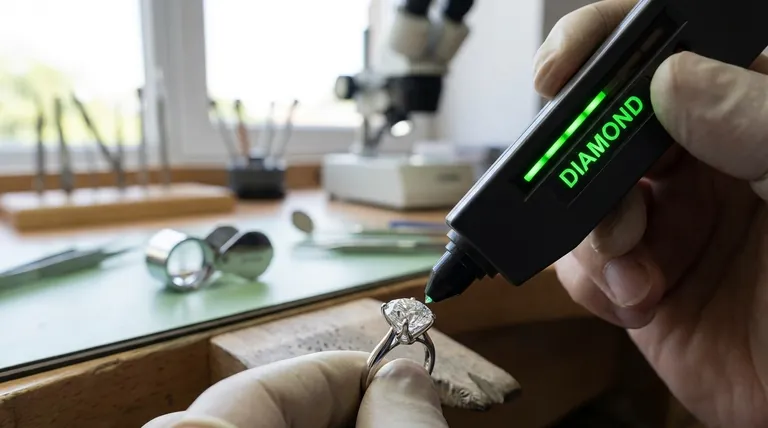
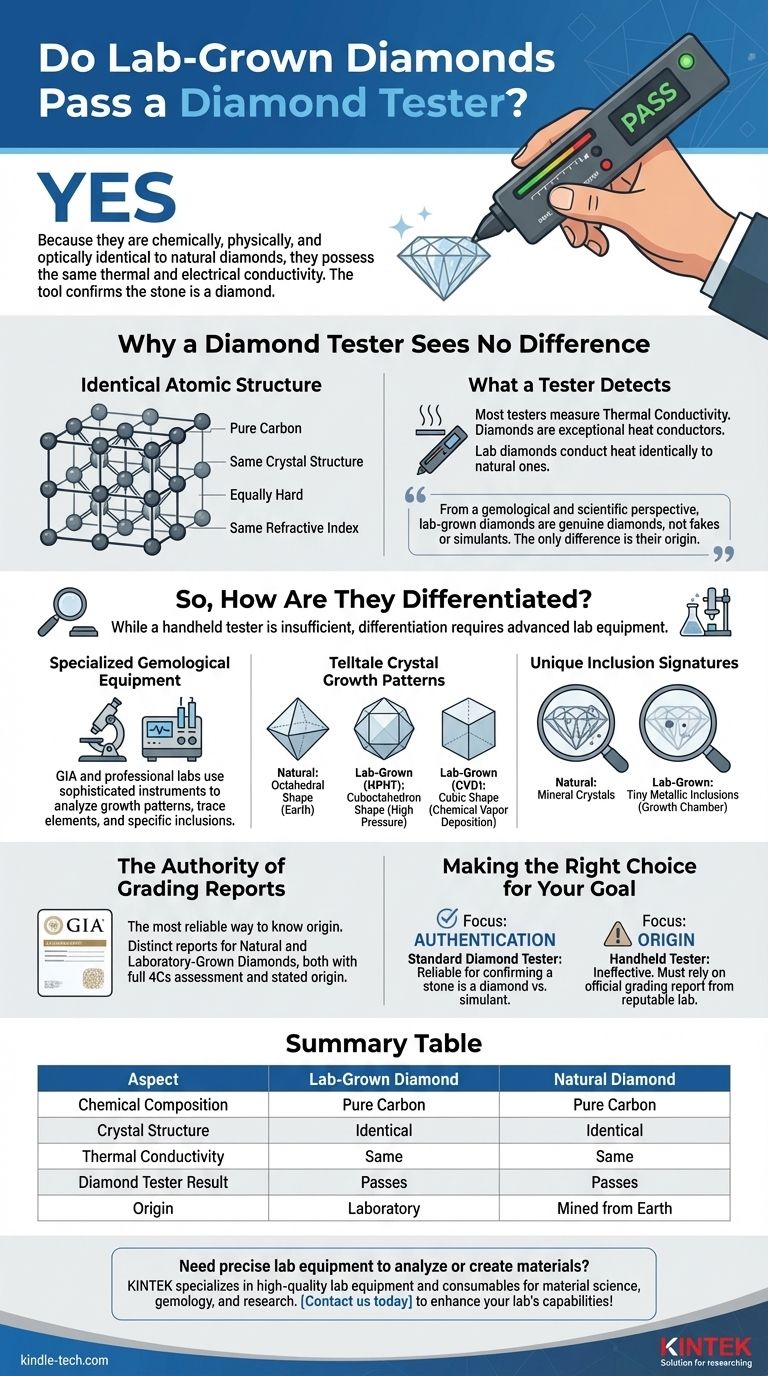
Yes, a lab-grown diamond will pass a standard diamond tester. Because lab-grown diamonds are chemically, physically, and optically identical to natural diamonds, they possess the same thermal and electrical conductivity that these testers are designed to detect. The tool is simply confirming that the stone is, in fact, a diamond.
The critical distinction to understand is that a standard diamond tester is designed to differentiate diamonds from non-diamond simulants, like cubic zirconia or moissanite. It is not designed, nor is it capable of, distinguishing between a diamond grown in a lab and one mined from the earth.
Why a Diamond Tester Sees No Difference
To understand why a lab diamond registers as "diamond," we have to look at what a diamond actually is and what the tester actually measures. This distinction is the source of all confusion.
Identical Atomic Structure
A diamond, whether natural or lab-grown, is crystallized carbon. Both share the exact same crystal structure and chemical composition. This means they are equally hard, have the same refractive index (sparkle), and behave identically under physical stress.
What a Tester Actually Detects
Most common diamond testers work by measuring thermal conductivity—how quickly heat moves through the stone. Diamonds are exceptionally efficient at transferring heat, a property that easily separates them from common look-alikes like glass or cubic zirconia. Since a lab diamond is chemically a diamond, it conducts heat identically to a natural one, resulting in a positive test.
The Definition of a "Real" Diamond
From a gemological and scientific perspective, lab-grown diamonds are not fakes or simulants. They are genuine diamonds. The only difference is their origin story: one formed over billions of years deep within the earth, and the other was created in a highly controlled, technological environment.
So, How Are They Differentiated?
While a simple handheld tester is insufficient, distinguishing between a natural and lab-grown diamond is possible using advanced equipment in a gemological laboratory. The key is identifying the subtle artifacts of their unique growth processes.
Specialized Gemological Equipment
Professional gemological labs like the Gemological Institute of America (GIA) use sophisticated instruments that go far beyond what a jeweler's tester can do. This equipment analyzes growth patterns, trace elements, and specific types of inclusions to determine a diamond's origin.
Telltale Crystal Growth Patterns
The crystal shape of a rough diamond is a major clue for gemologists. Natural diamonds typically form in an octahedral (eight-sided) shape. In contrast, diamonds from the two primary lab-growth methods form differently:
- HPHT (High Pressure/High Temperature): Cuboctahedron shape (14 growth directions).
- CVD (Chemical Vapor Deposition): Cubic shape (one primary growth direction).
Unique Inclusion Signatures
Inclusions are natural imperfections within a diamond. The types of inclusions found in natural diamonds (like tiny crystals of other minerals) differ from those in lab-grown diamonds. Lab diamonds may contain tiny metallic inclusions from the growth chamber, which are a definitive sign of their man-made origin.
The Authority of Grading Reports
The most reliable way for a consumer to know a diamond's origin is through its grading report. Reputable labs like GIA issue two distinct types of reports: one for natural diamonds and another for laboratory-grown diamonds. Both provide a full assessment of the 4Cs (Cut, Color, Clarity, Carat) but will clearly state the diamond's origin.
Making the Right Choice for Your Goal
Understanding the science behind the stone allows you to use the right tool for the job and make a decision that aligns with your priorities.
- If your primary focus is authentication: A standard diamond tester is a reliable and effective tool for confirming that a stone is a diamond rather than a less valuable simulant.
- If your primary focus is determining origin: A handheld tester is completely ineffective; you must rely on the expertise and advanced equipment of a reputable gemological lab via an official grading report.
Ultimately, the choice between a natural and lab-grown diamond is a matter of personal preference, not a question of which one is a "real" diamond.
Summary Table:
| Aspect | Lab-Grown Diamond | Natural Diamond |
|---|---|---|
| Chemical Composition | Pure Carbon | Pure Carbon |
| Crystal Structure | Identical | Identical |
| Thermal Conductivity | Same | Same |
| Diamond Tester Result | Passes | Passes |
| Origin | Laboratory | Mined from Earth |
Need precise lab equipment to analyze or create materials? KINTEK specializes in high-quality lab equipment and consumables, serving laboratories with reliable tools for material science, gemology, and research. Whether you're working with diamonds or other advanced materials, our solutions ensure accuracy and efficiency. Contact us today to enhance your lab's capabilities!
Visual Guide
Related Products
- Filter Testing Machine FPV for Dispersion Properties of Polymers and Pigments
- Metallographic Specimen Mounting Machine for Laboratory Materials and Analysis
- Electrolytic Electrochemical Cell for Coating Evaluation
- Laboratory Vibratory Sieve Shaker Machine Slap Vibrating Sieve
- Platinum Auxiliary Electrode for Laboratory Use
People Also Ask
- Why is coating thickness important? Achieve Optimal Performance and Cost Control
- What is the water content of pyrolysis oil? A Key Factor in Bio-Oil Quality and Use
- What is the significance of compression set? Predict Material Failure and Ensure Long-Term Reliability
- What is the minimum coating thickness? How Steel Thickness Determines Your Galvanizing Needs
- How do you test a lithium battery to see if it's good? A Guide to Measuring Voltage, Capacity & Health