Knowledge Does brazing require higher temperatures than soldering? Yes, and here’s why it matters.
Author avatar

Tech Team · Kintek Solution

Updated 5 days ago

Does brazing require higher temperatures than soldering? Yes, and here’s why it matters.


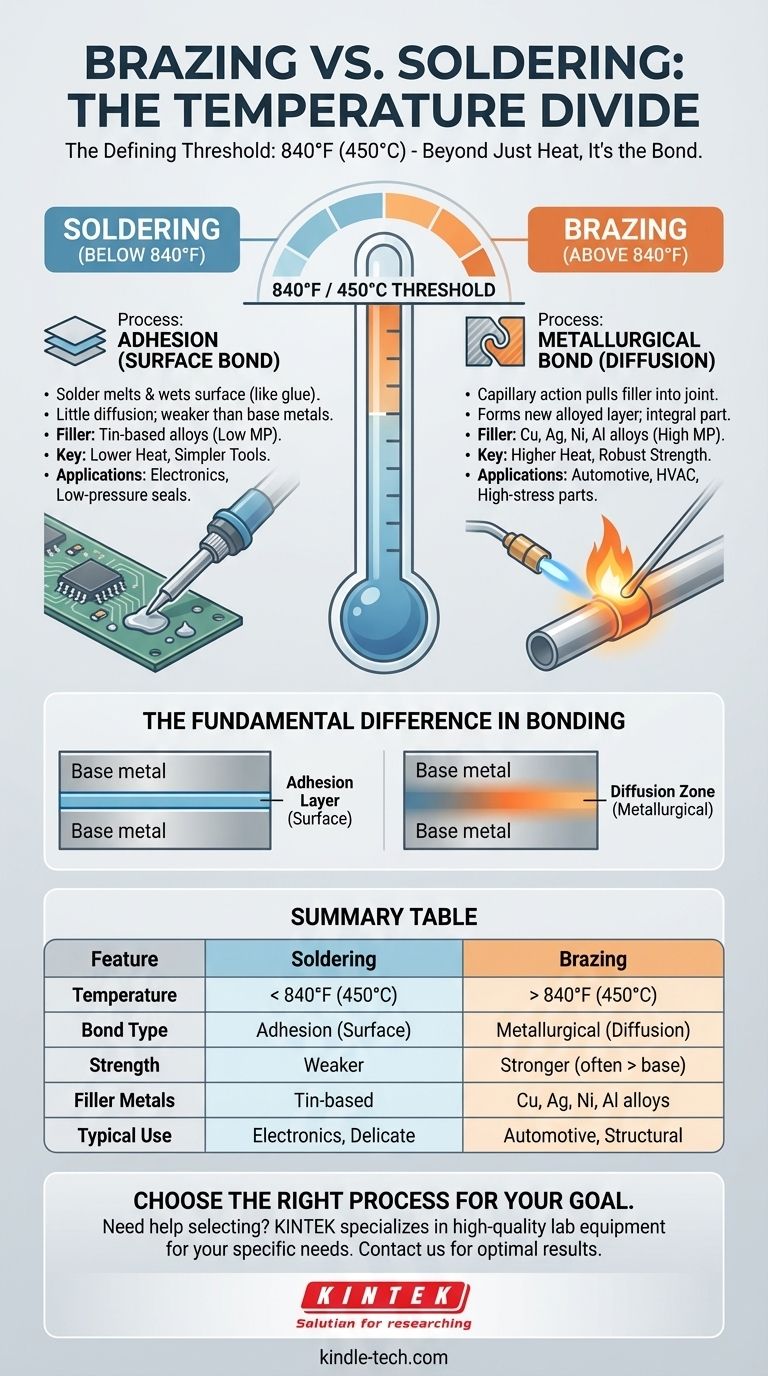
Yes, definitively. Brazing requires significantly higher temperatures than soldering. The internationally recognized threshold is 840°F (450°C); processes that use a filler metal melting above this temperature are defined as brazing, while those using a filler metal melting below it are defined as soldering.

The core difference is not just the temperature itself, but what that temperature enables. The higher heat of brazing creates a fundamentally different, much stronger metallurgical bond, while soldering creates a simpler surface-level adhesion.
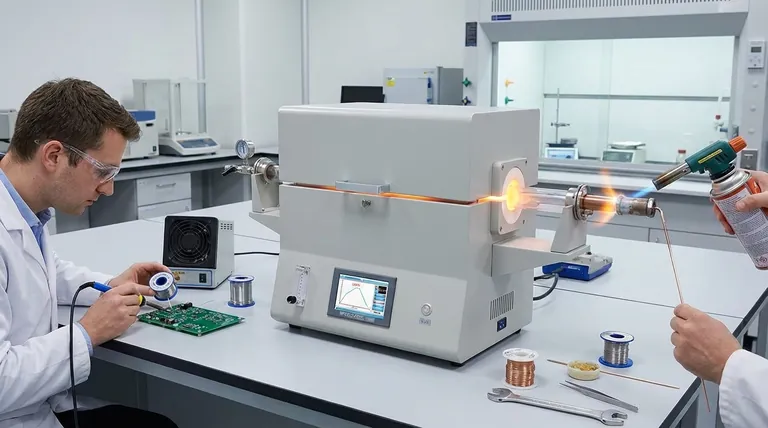
Does brazing require higher temperatures than soldering? Yes, and here’s why it matters.

The Defining Difference: The 840°F (450°C) Threshold

The temperature is the critical factor that dictates the physics of the joint and the type of filler metal used.

What Happens in Soldering (Below 840°F)

Soldering is essentially a process of adhesion. The filler metal, or solder, melts and "wets" the surfaces of the base metals, much like glue sticking two pieces of paper together.

There is very little diffusion or alloying between the solder and the base parts. The strength of the joint is limited to the strength of the solder itself, which is almost always much weaker than the metals being joined.

What Happens in Brazing (Above 840°F)

Brazing creates a true metallurgical bond. At these higher temperatures, the molten filler metal is pulled into the tight-fitting joint by a powerful force called capillary action.

More importantly, the filler metal actively diffuses into the surface of the base metals, forming a new alloyed layer at the interface. This means the brazed joint becomes an integral part of the assembly, not just a surface connection.

How Temperature Dictates Filler Metal

The required temperature directly influences the filler metal's composition.

Solders are typically tin-based alloys (e.g., tin-lead, tin-silver, tin-copper) with low melting points.

Brazing fillers are stronger alloys based on copper, silver, nickel, or aluminum, which require much higher energy to melt.

The Practical Implications: Strength and Application

The difference between a surface bond and a metallurgical bond has enormous consequences for how these processes are used.

Joint Strength: Soldering's Weaker Bond

Because a soldered joint relies on adhesion, it is best suited for applications where mechanical strength is not the primary concern. It is ideal for creating electrical conductivity or a simple, low-pressure seal.

Joint Strength: Brazing's Robust Bond

A properly executed brazed joint is exceptionally strong. In many cases, the joint area can be as strong as or stronger than the base metals themselves. This makes it suitable for parts that will experience high stress, vibration, or temperature changes.

Typical Applications for Soldering

The low heat input and focus on conductivity make soldering the standard for electronics manufacturing. It is also used in some low-pressure copper plumbing and for joining delicate, heat-sensitive components.

Typical Applications for Brazing

Brazing's strength and durability make it essential in demanding industries. It is widely used for automotive parts (like radiators), HVAC system components, industrial tooling, and even high-end cookware where joints must withstand constant thermal cycling.

Understanding the Trade-offs

Choosing a process is not just about seeking maximum strength; it involves balancing complexity, cost, and risk.

The Cost of Strength: Heat Input and Skill

Brazing's high temperatures require more powerful heat sources like torches or furnaces. This significant heat input poses a risk of warping, distortion, or metallurgical damage to the base metals if not controlled by a skilled operator.

The Benefit of Simplicity: Accessibility of Soldering

Soldering is far more accessible. The low heat requirement means simpler, cheaper tools like a soldering iron or a small torch can be used. The process is more forgiving for beginners and requires less stringent preparation.

Material and Design Constraints

The high heat of brazing makes it unsuitable for joining components with low melting points or for applications like circuit boards where nearby components would be destroyed. The need for a tight joint gap for capillary action also places greater demands on the design and fit-up of the parts.

Making the Right Choice for Your Goal

Your application's primary requirement should dictate your choice between these two powerful joining methods.

  • If your primary focus is maximum strength, durability, and performance under stress: Brazing is the superior choice, creating a robust, permanent metallurgical bond.
  • If your primary focus is joining heat-sensitive electronics or avoiding base metal distortion: Soldering is the correct process due to its significantly lower and more localized heat input.
  • If your primary focus is accessibility and a simple seal for a non-structural bond: Soldering provides an effective and low-cost solution for many general-purpose tasks.

Understanding this fundamental temperature divide is the key to selecting the right joining method for a successful and reliable outcome.

Summary Table:

Process Temperature Range Bond Type Typical Filler Metals Key Applications
Soldering Below 840°F (450°C) Adhesion (surface bond) Tin-based alloys (e.g., tin-lead, tin-silver) Electronics, low-pressure plumbing, delicate components
Brazing Above 840°F (450°C) Metallurgical (diffusion bond) Copper, silver, nickel, or aluminum alloys Automotive parts, HVAC systems, industrial tooling, high-stress joints

Need help selecting the right joining process for your lab or production needs? At KINTEK, we specialize in providing high-quality lab equipment and consumables tailored to your specific requirements. Whether you're working with sensitive electronics or high-strength components, our expertise ensures you get the right tools for optimal results. Contact us today to discuss how we can support your laboratory's success!

Visual Guide
Does brazing require higher temperatures than soldering? Yes, and here’s why it matters. Visual Guide

Related Products

People Also Ask

Related Products

Laboratory Muffle Oven Furnace Bottom Lifting Muffle Furnace

Laboratory Muffle Oven Furnace Bottom Lifting Muffle Furnace

Efficiently produce batches with excellent temperature uniformity using our Bottom Lifting Furnace. Features two electric lifting stages and advanced temperature control up to 1600℃.

High Temperature Muffle Oven Furnace for Laboratory Debinding and Pre Sintering

High Temperature Muffle Oven Furnace for Laboratory Debinding and Pre Sintering

KT-MD High temperature debinding and pre-sintering furnace for ceramic materials with various molding processes. Ideal for electronic components such as MLCC and NFC.

1700℃ Laboratory Quartz Tube Furnace with Alumina Tube Tubular Furnace

1700℃ Laboratory Quartz Tube Furnace with Alumina Tube Tubular Furnace

Looking for a high-temperature tube furnace? Check out our 1700℃ Tube Furnace with Alumina Tube. Perfect for research and industrial applications up to 1700C.

Ultra-High Temperature Graphite Vacuum Graphitization Furnace

Ultra-High Temperature Graphite Vacuum Graphitization Furnace

The ultra-high temperature graphitization furnace utilizes medium frequency induction heating in a vacuum or inert gas environment. The induction coil generates an alternating magnetic field, inducing eddy currents in the graphite crucible, which heats up and radiates heat to the workpiece, bringing it to the desired temperature. This furnace is primarily used for graphitization and sintering of carbon materials, carbon fiber materials, and other composite materials.

Molybdenum Vacuum Heat Treat Furnace

Molybdenum Vacuum Heat Treat Furnace

Discover the benefits of a high-configuration molybdenum vacuum furnace with heat shield insulation. Ideal for high-purity, vacuum environments like sapphire crystal growth and heat treatment.

1200℃ Split Tube Furnace with Quartz Tube Laboratory Tubular Furnace

1200℃ Split Tube Furnace with Quartz Tube Laboratory Tubular Furnace

KT-TF12 split tube furnace: high-purity insulation, embedded heating wire coils, and max. 1200C. Widely used for new materials and chemical vapour deposition.

600T Vacuum Induction Hot Press Furnace for Heat Treat and Sintering

600T Vacuum Induction Hot Press Furnace for Heat Treat and Sintering

Discover the 600T Vacuum Induction Hot Press Furnace, designed for high-temperature sintering experiments in vacuum or protected atmospheres. Its precise temperature and pressure control, adjustable working pressure, and advanced safety features make it ideal for nonmetal materials, carbon composites, ceramics, and metal powders.

Vacuum Heat Treat Furnace with Ceramic Fiber Liner

Vacuum Heat Treat Furnace with Ceramic Fiber Liner

Vacuum furnace with polycrystalline ceramic fiber insulation liner for excellent heat insulation and uniform temperature field. Choose from 1200℃ or 1700℃ max. working temperature with high vacuum performance and precise temperature control.

Vacuum Dental Porcelain Sintering Furnace

Vacuum Dental Porcelain Sintering Furnace

Get precise and reliable results with KinTek's Vacuum Porcelain Furnace. Suitable for all porcelain powders, it features hyperbolic ceramic furnace function, voice prompt, and automatic temperature calibration.

Graphite Vacuum Furnace IGBT Experimental Graphitization Furnace

Graphite Vacuum Furnace IGBT Experimental Graphitization Furnace

IGBT experimental graphitization furnace, a tailored solution for universities and research institutions, with high heating efficiency, user-friendliness, and precise temperature control.

Laboratory Vacuum Tilt Rotary Tube Furnace Rotating Tube Furnace

Laboratory Vacuum Tilt Rotary Tube Furnace Rotating Tube Furnace

Discover the versatility of Laboratory Rotary Furnace: Ideal for calcination, drying, sintering, and high-temperature reactions. Adjustable rotating and tilting functions for optimal heating. Suitable for vacuum and controlled atmosphere environments. Learn more now!

Vacuum Sealed Continuous Working Rotary Tube Furnace Rotating Tube Furnace

Vacuum Sealed Continuous Working Rotary Tube Furnace Rotating Tube Furnace

Experience efficient material processing with our vacuum-sealed rotary tube furnace. Perfect for experiments or industrial production, equipped with optional features for controlled feeding and optimized results. Order now.

Vacuum Heat Treat and Molybdenum Wire Sintering Furnace for Vacuum Sintering

Vacuum Heat Treat and Molybdenum Wire Sintering Furnace for Vacuum Sintering

A vacuum molybdenum wire sintering furnace is a vertical or bedroom structure, which is suitable for withdrawal, brazing, sintering and degassing of metal materials under high vacuum and high temperature conditions. It is also suitable for dehydroxylation treatment of quartz materials.

Graphite Vacuum Furnace High Thermal Conductivity Film Graphitization Furnace

Graphite Vacuum Furnace High Thermal Conductivity Film Graphitization Furnace

The high thermal conductivity film graphitization furnace has uniform temperature, low energy consumption and can operate continuously.

Vacuum Hot Press Furnace Machine for Lamination and Heating

Vacuum Hot Press Furnace Machine for Lamination and Heating

Experience clean and precise lamination with Vacuum Lamination Press. Perfect for wafer bonding, thin-film transformations, and LCP lamination. Order now!

Small Vacuum Heat Treat and Tungsten Wire Sintering Furnace

Small Vacuum Heat Treat and Tungsten Wire Sintering Furnace

The small vacuum tungsten wire sintering furnace is a compact experimental vacuum furnace specially designed for universities and scientific research institutes. The furnace features a CNC welded shell and vacuum piping to ensure leak-free operation. Quick-connect electrical connections facilitate relocation and debugging, and the standard electrical control cabinet is safe and convenient to operate.

Laboratory Sterilizer Lab Autoclave Vertical Pressure Steam Sterilizer for Liquid Crystal Display Automatic Type

Laboratory Sterilizer Lab Autoclave Vertical Pressure Steam Sterilizer for Liquid Crystal Display Automatic Type

Liquid crystal display automatic vertical sterilizer is a safe, reliable and automatic control sterilization equipment, which is composed of heating system, microcomputer control system and overheating and overvoltage protection system.

Laboratory Sterilizer Lab Autoclave Pulse Vacuum Lifting Sterilizer

Laboratory Sterilizer Lab Autoclave Pulse Vacuum Lifting Sterilizer

The pulse vacuum lifting sterilizer is a state-of-the-art equipment for efficient and precise sterilization. It uses pulsating vacuum technology, customizable cycles, and a user-friendly design for easy operation and safety.

Benchtop Laboratory Vacuum Freeze Dryer

Benchtop Laboratory Vacuum Freeze Dryer

Benchtop laboratory freeze dryer for efficient lyophilization of biological, pharmaceutical, and food samples. Features intuitive touchscreen, high-performance refrigeration, and durable design. Preserve sample integrity—consult now!

Benchtop Laboratory Freeze Dryer for Lab Use

Benchtop Laboratory Freeze Dryer for Lab Use

Premium benchtop laboratory freeze dryer for lyophilization, preserving samples with ≤ -60°C cooling. Ideal for pharmaceuticals & research.


Leave Your Message